
The former Ipswich parish known as the Hamlet (now Hamilton) was “set off” in 1714-15 after several appeals to the Town and to the General Court. A long-held desire for complete separation from the town of Ipswich gathered strength in 1792 when the town of Ipswich voted $500 for support of the poor. The great bulk of the needy and helpless families were found in the old Town of Ipswich and at Chebacco. As the people of The Hamlet were primarily farmers and financially stable, the burden of taxation for the support of the poor was considered to be an unjust imposition. The leaders of the parish petitioned the leaders of Ipswich to be allowed to incorporate as a separate town, and the petition was granted by the inhabitants at a legal meeting held on May 22, 1792.
The Hamlet was incorporated by the name of Hamilton on June 21, 1793, with the condition that the new town pay the town of Ipswich $908.00 for the support of its paupers. Rev. Cutler of the Congregational Church in the Hamlet had served in Congress before becoming one of the town’s longest-serving pastors, was a strong advocate of Federalism, and urged that the new town be named after Alexander Hamilton. The similarity of the names Hamlet and Hamilton was merely coincidental.
Download: History of the Hamlet
Colonial-era houses in Hamilton, MA
 The Clock Tower at Hamilton First Church - In 1843, the Hamilton meetinghouse was turned 90 degrees to face the Bay Road, and the present bell was installed in the belfry. In 1888 a clock manufactured by E. Howard & Company of Boston was added to accompany the bell.… Continue reading The Clock Tower at Hamilton First Church
 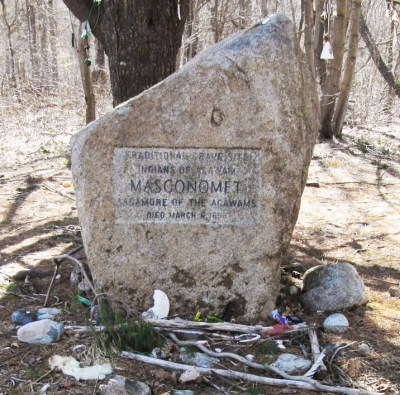 The Bones of Masconomet - On March 6, 1659 a young man named Robert Cross dug up the remains of the Agawam chief Masconomet, and carried his skull on a pole through Ipswich streets, an act for which Cross was imprisoned, sent to the stocks, then returned to prison until a fine was paid.… Continue reading The Bones of Masconomet
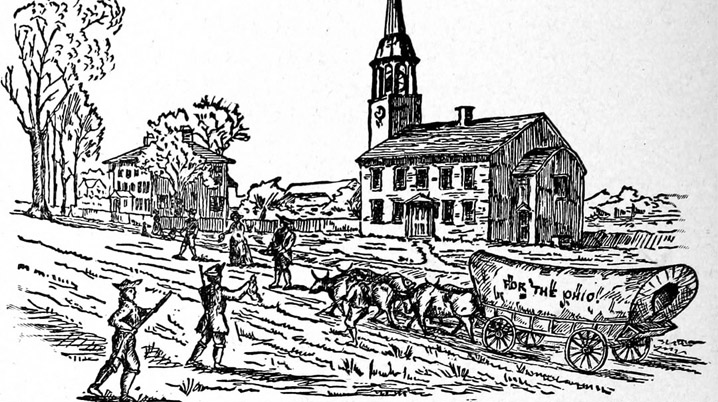
  Ipswich to Marietta, December 1787 - In December 1787, a group of Revolutionary War veterans and adventurers set out from Ipswich on an 800-mile journey through the wilderness by horseback and rafts to establish the first settlement in the Ohio Territory.… Continue reading Ipswich to Marietta, December 1787
  1793 and 1818: the “Burden of the Poor” Divides Ipswich into 3 Towns, Ipswich, Hamilton and Essex - As the people of the Hamlet were financially stable, the burden of taxation for the support of the poor in the old town of Ipswich was considered to be an unjust imposition. 25 years later, the men of Chebacco petitioned the Legislature for incorporation as a separate town.… Continue reading 1793 and 1818: the “Burden of the Poor” Divides Ipswich into 3 Towns, Ipswich, Hamilton and Essex
 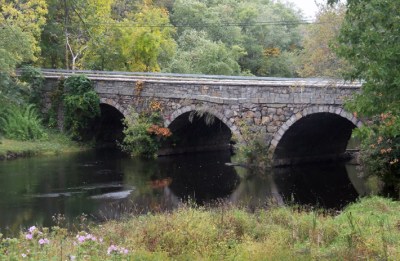 The Mill Road Bridge and the Isinglass Factory - The triple stone arch Warner Bridge that connects Mill Rd. in Ipswich to Highland St. in Hamilton was constructed in 1829, and rebuilt in 1856. The isinglass mill sat on the downstream Ipswich side of the bridge.… Continue reading The Mill Road Bridge and the Isinglass Factory
 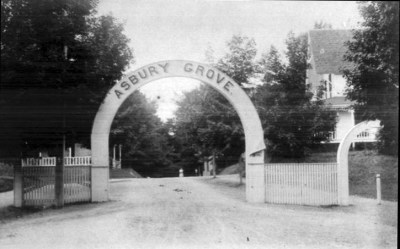 Asbury Grove Methodist Camp Meeting, Hamilton MA - The Asbury Grove Methodist Camp Meeting on Asbury St. in Hamilton is listed in the National Register of Historic Districts, and has a collection of historic buildings that were built between 1870 and 1960. 12,000 people, most from Boston, attended the first camp meeting in 1859.… Continue reading Asbury Grove Methodist Camp Meeting, Hamilton MA
 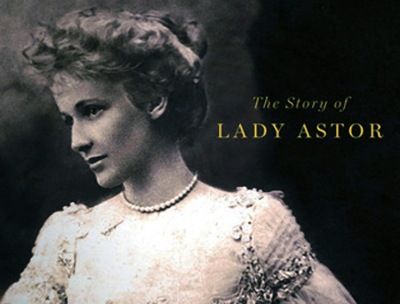 Nancy’s Corner - Google Maps used to show "Nancy's Corner" at the intersection of Highland Street and Cutler Road in Hamilton. I wondered who Nancy was and discovered an amazing story.… Continue reading Nancy’s Corner
  Historic Ipswich