

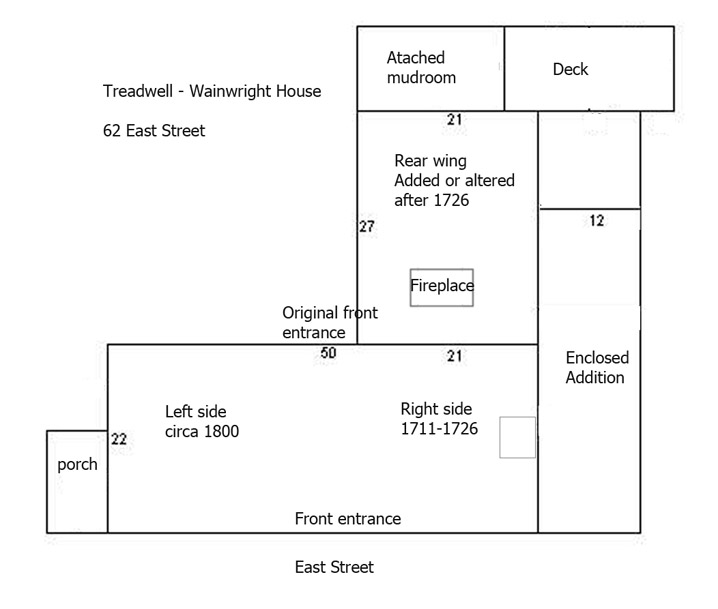
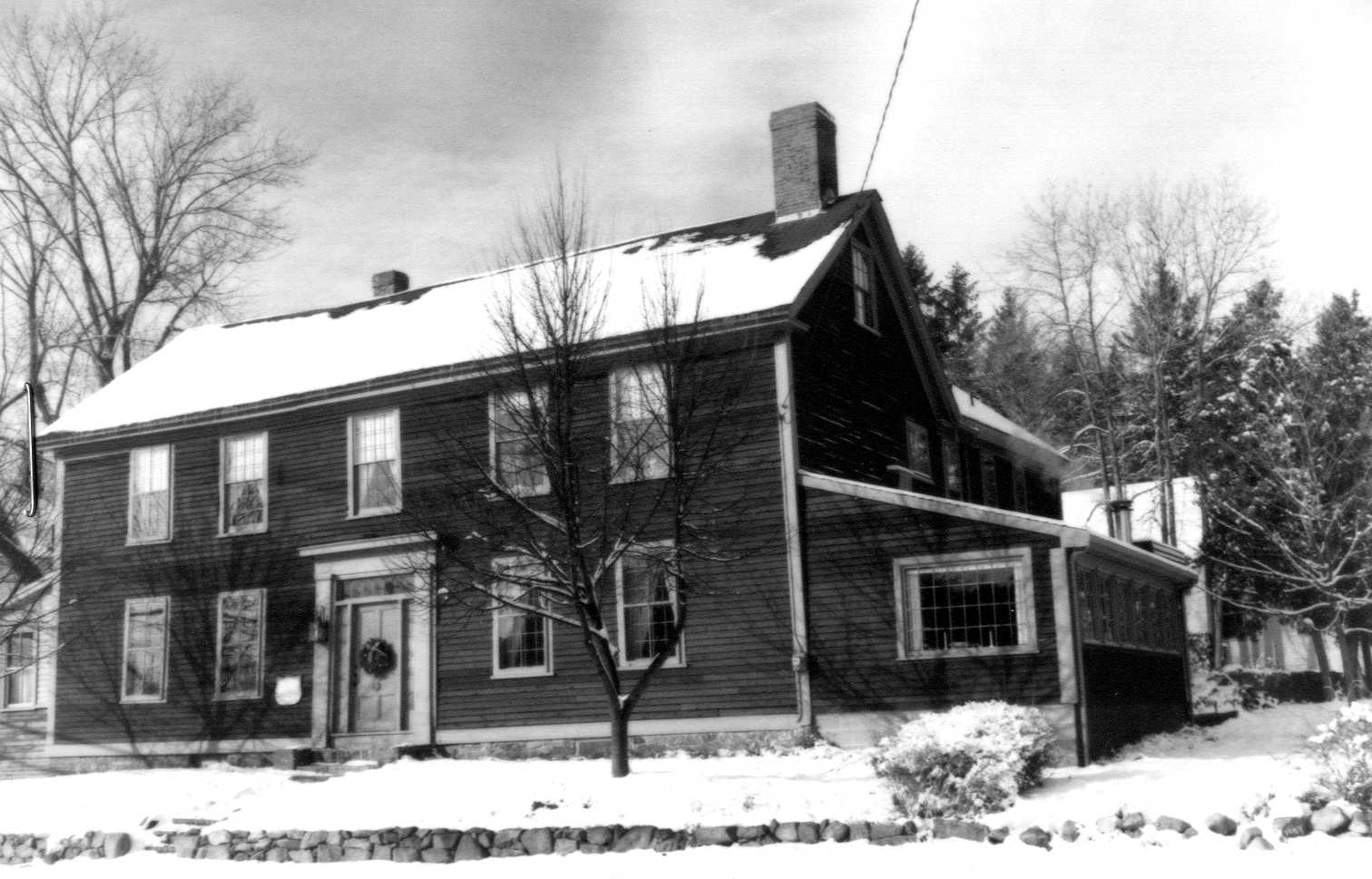
A substantial house lot that included this location was granted to Ipswich founder John Winthrop Jr. in 1633. The east side of the present house was constructed in 1711 by Col. John Wainwright, and the west side was added at the end of the 18th Century, featuring fine Georgian paneling and Rumford fireplaces. The rear ell was constructed during that timeframe, but has a massive fireplace, chimney, and summer beam that may date to the late 17th Century when a house on this lot was owned by Nathaniel Treadwell. A reused summer beam in the basement has mortises for tusk tenons, which have been observed only in a few houses dating to the mid-1600s. This private home has a preservation agreement with the Ipswich Historical Commission.
Architectural Features
The structural form of this house evolved from the late 17th Century until 1800. Re-used summer beams in the basement are from a First Period structure, and the rear wing has a massive fireplace that may date to the ownership of a house on this lot in 1691 by Nathaniel Treadwell. The front east side framing dates to 1711-1726, the rear wing was then built or modified, and the west side is said to have been added in about 1800, giving the house its present Georgian / Federal appearance.
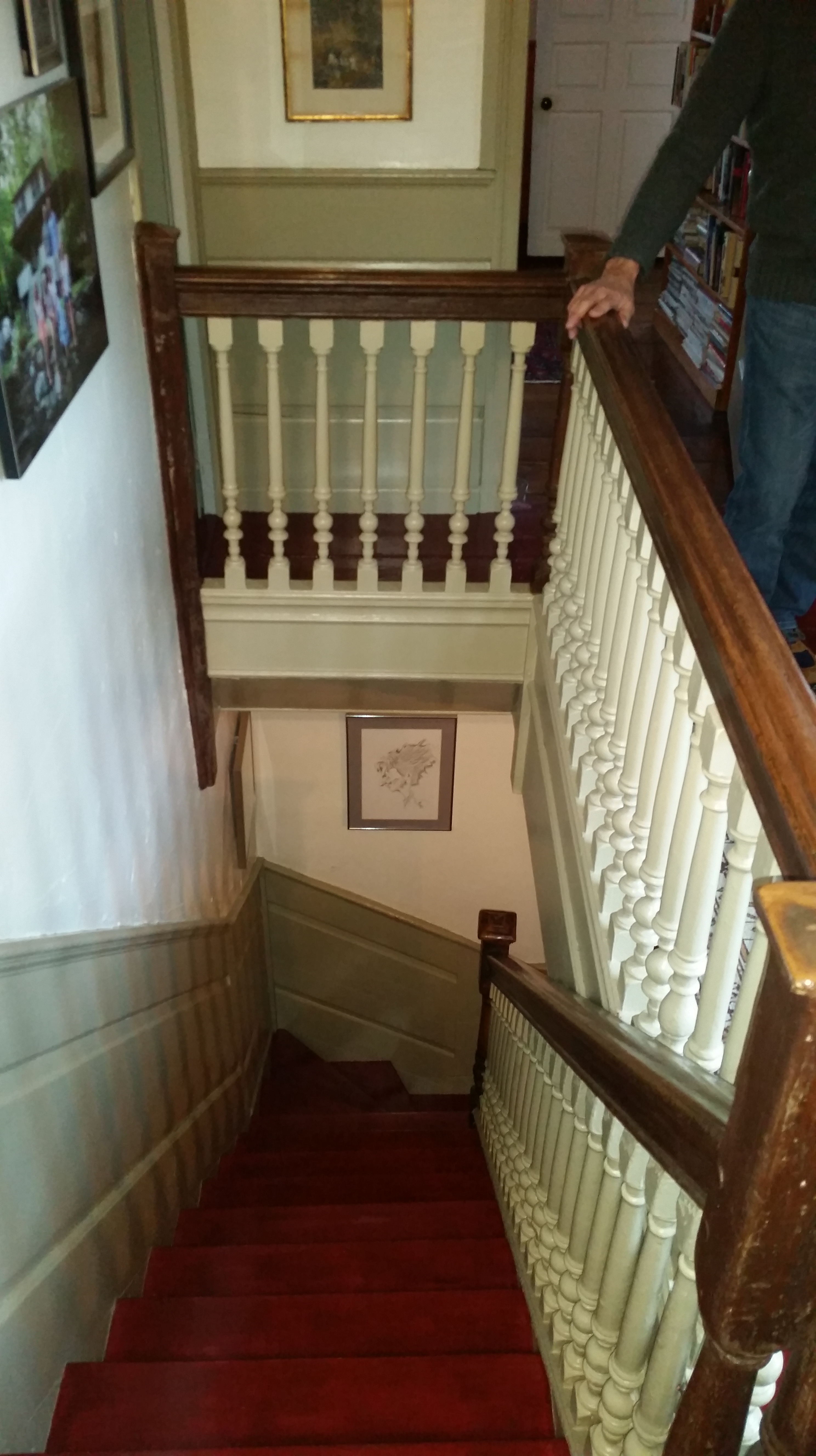
Tall ceilings, raised-field paneling, and feather-edge sheathing found throughout the house are key high-style period features. An exceptional hand-turned balustrade exists in the rear hall, similar to the balustrade in the Capt. Richard Rogers House on North Main St., built in 1728.


Early ownership of this lot

The John Winthrop Jr. lot
The ancient Records of the Town locate the lot of John Winthrop Jr. on East Street, adjoining Mr. Boreman. Winthrop, son of the governor, led the group of settlers of Ipswich in 1633 and was granted a lot of six acres. A list of John Winthrop’s home inventory indicates that it was a small four-room structure. Winthrop’s wife, Martha, died with an infant in the summer of 1634. He returned to England briefly and remarried, and two years later, he accepted a commission to begin a plantation in Saybrook, Connecticut, where he moved in 1639.

Mr. Wade was the owner after Winthrop and sold the same lot with a house to Richard Wells of Salisbury. It was sold to John Johnson, then to William Buckley, Nov. 24, 1671, who carved out four lots. In his deed to Elizabeth Bridgham of Boston, her property is bounded south by the street and “three little parcels on which houses are already built.
Francis Wainwright
The large main lot was sold by Jonathan Bridgham of Boston to Francis Wainwright, on Feb. 27, 1671 (Ips. Deeds 3: 243), who expanded his property holdings. A 36-foot stone wall at 62 East St. may be part of the large cellar from the Francis Wainwright house, which Thomas Franklin Waters wrote was still exposed at the beginning of the 20th Century. Francis Wainwright deeded to his son, John, “as he promised on his marriage with Elizabeth, daughter of Mr. Wm. Norton, March 10, 1674-5 “the house said John occupies.”
On the southwest corner, abutting on Nathaniel Piper, John Barry sold a lot with a house and land to John Wainwright Sr., Aug. 6, 1678 (Ips. Deeds 4: 253), who was living here when he bought the adjoining Piper lot in 1690. Col. Wainwright was one of the most important men of his day, Justice of the Sessions Court, Representative to the General Court in 1696 and 1698, and Justice of the Sessions Court until the year before his death at age 60 in 1708. The estate at his death was valued at £20,000.
Francis Wainwright arrived in Charleston from Chelmsford, Essex, England in 1630 and moved to Ipswich around 1637. He was among the first to volunteer in the Pequot War against the Indians that same year and distinguished himself for personal bravery. Over 700 Pequot people were slain or taken prisoner, and only 16 English died. Wainwright was young and vigorous, firing his musket until his powder and shot were spent, then beating off the enemy with the stock of his gun. For his services in this war, Francis Wainwright received a grant from Ipswich. Francis Wainwright became a prominent merchant and was the beneficiary of his wife’s inherited estate. He expanded his estate, eventually owning a large area of land on East Street near the town wharf.
The Robert Coles lot
The lot adjoining Winthrop’s on the east was granted to Robert Coles, but he sold it to Joseph Medcalf. Medcalf sold the eastern part of his lot to Isaac Cummings and the western to Deacon William Goodhue, before 1639 (Town Records). John Leighton was the owner in 1654.
John Leighton to Nathaniel Treadwell, 1691
John Leighton sold to Nathaniel Treadwell on April 16, 1691, “parcels of land and the messuages thereon, which were mine. First parcel is the homestead of my house, 3 1/2 acres.” (Salem Deeds Book 9: Page 268). The foundation, fireplace, and chimney in the rear wing of the existing house at 62 East St. may be from the ownership of Nathaniel Treadwell or John Leighton, predating the rest of the house, although the roof framing indicates that the present rear wing was built after the front right section. The front left is of later construction.
Thomas Treadwell arrived in New England in 1635 with his wife and infant son, Thomas. Excerpts from his will show that in 1671, he bequeathed to the junior Thomas his property on “Treadwell’s Island” between Labor in Vain Creek and Fox Creek. To his son Nathaniel, he gave half of his upland house, barn, and meadows, and the other half to his wife as long as she lives. He also gave his wife “the benefit of the keeping of four Cows and six sheep upon the pasture also the Wintering five head of Cattle and six sheep, “plus the firewood from the pasture, “Also I give to my wife all my household goods to be at her own disposing…..And if Nathaniel fails of anything he is to do for my Wife my will is that he shall forfeit ten pound every year he fails.” (Proved in Ipswich Court, September 26, 1671. Docket 28, 115).
Nathaniel Treadwell to Col. John Wainwright Jr. 1710
Nathaniel Treadwell and “Rebecca his wife,” true and lawful owners” sold the same three and a half acres “with a certain dwelling” bounded east by Samuel Taylor to John Wainwright, son of John and grandson of the Colonel, with “a certain dwelling house and Homestead or house lot, Oct. 1, 1710 “for £120.00 of current money New England.” “bounded northwardly on the homestead of Giles Cowes and John Wainwright, late of Ipswich, northwesterly and southwesterly by land of Benjamin Newman, and the homestead of Samuel Treadwell southwestwardly .” (Salem Deeds: Book 23: Page 33)
The estate of Nathaniel Treadwell’s grandfather, Samuel Taylor, deceased, then owned the adjoining estate. Nath. Treadwell, his executor, and Samuel Treadwell, his legatee, sold the house and an acre lot for £52 to John Wainwright Jr., Oct. 21, 1710 (Salem Deeds Book 22: Page 216).
Col. John Wainwright Jr.
John Wainwright Jr., son of John Wainwright and Elizabeth Norton, was born June 14, 1691, married Christian Newton, and graduated from Harvard in 1709. He was a Member of the House of Representatives for the Town of Ipswich, Clerk of the House, Justice of the Inferior Court of Common Pleas for the County of Essex, and Colonel of a Regiment of Foot in the County.
After purchasing the lot and house from Treadwell, Wainwright began construction of a large new mansion house on the lot, which is believed to be the right and rear portions of this house. It appears that he removed the rear structure, but reused some of the framing members as he built a new house in front with a new wing in the rear, saving the massive existing fireplace where it stood.
Wainwright overextended and was beset by financial problems. He conveyed for £920.00 to Samuel Appleton of Boston, “sundry messuages or house lots, commonly known by the names of Leighton’s lot, Taylor’s lot, Newman’s homestead and the late messuage or house lott of my honored grandfather, Francis Wainwright,” totaling about fifteen acres, upland, tillage, pasture and meadow, Oct. 25, 1726 (47: 144). The deed informs us that on the former “Leighton’s lot,” there was a “new house not finished.” This confirms that the home of Nathaniel Treadwell, which he sold to John Wainwright Jr., and the house begun by Wainwright were on the same lot.
Col. John Wainwright Jr. died September 1, 1739, “after a lingering Indisposition” in the 48th Year of his Age, leaving his wife Christian Wainwright a widow with children.
Subsequent history
Samuel Appleton owned considerable real estate in Ipswich, but at the time of his death was insolvent. The spacious East Street property was sold to Francis Cogswell on June 2, 1733 (65: 146). Only a single mansion house (this house) is mentioned in this deed, but the land measured twelve acres. The estate, bounded by Samuel Wainwright on the west and Francis Cogswell on the east, was sold to Francis Sayer (Sawyer) on May 3, 1746 (90: 46). Samuel Sawyer, son of Francis, inherited all his real estate and enlarged his inheritance by various purchases, until his holding on this side of East St. included all the original Wainwright land, except the Samuel Wainwright lot. The Wainwright-Treadwell House at 62 East St. appears to be the only building on the tract.

A Ghost Story
There was an old legend about Col. John Wainwright’s sister. Their mother, Phillipa (first wife of Francis Wainwright), died in 1669. Mary was the oldest daughter, so she inherited her mother’s fine clothing and jewels. She was unhealthy and died five years later. On her deathbed, she bitterly promised a curse on her pretty young sister Martha if she wore the fine clothes after her death. Mary resisted for years, but eventually, her resolve was weakened by a crush on a charming young man from England. She dressed in Mary’s finest and went outside to see her reflection in the well. Seeing Mary’s face in the well instead, she went into shock and fainted, and was carried to her bedroom, where she was discovered dead the next day alongside her faithful servant Chloe. An old well exists on this property. The story, however, does not appear to be historically correct. Mary lived to 52 and married Jeremiah Shephard. Martha Wainwright married Joseph Proctor and had ten children, including daughters also named Mary and Martha.
62 East St. Preservation Agreement
This house is protected by a preservation agreement between the owners and the town of Ipswich. Read the East-62-wainwright-preservation-agreement. Protected elements include:
- Front facade
- Frame, primary and secondary members
- Central chimney
- Selected wooden architectural elements, including molding, paneling, mantelpiece, and doors
Photos from inside the house




Sources:
- MACRIS
- Waters, Franklin: Ipswich in the Mass. Bay Colony. Vol. I, p.399.
- Something to Preserve, Ipswich Historical Commission, p. 64.
- The Probate Records of Essex County, Massachusetts: 1665-1674: Estate of Thomas Treadwell Sr. of Ipswich
- Records and Files of the Quarterly Courts of Essex County” (Mass.), Volume IV,: Thomas Tredwell.
- Thomas Franklin Waters’ history of the lots
- John Leighton to Nathaniel Treadwell, April 16, 1691 (Salem Deeds Book 9: Page 268).
- Thomas Treadwell to John Wainwright Jr. Oct. 21, 1710 (22: 216)
- Nath. Treadwell, Samuel Taylor’s executor, and Samuel Treadwell, his legatee, sale of the house and an acre lot to John Wainwright, Oct. 21, 1710 (Salem Deeds Book 22: Page 216)
- wainwright-deed-1726
- Cummings. Abbot Lowell: The Framed Houses of Massachusetts Bay, 1625-1725
- Colonial Society of Massachusetts: Notes on the Wainwright Family by Albert Matthews
 Historic Ipswich