

In 1656, Corporal John Andrews purchased the lot at 34 High St. with a house on it from Henry Archer and began operating a tavern. Angered that the court refused to renew his license after three years, Andrews sold it to Richard Dummer in 1659 and moved to Chebacco Parish (now the town of Essex).
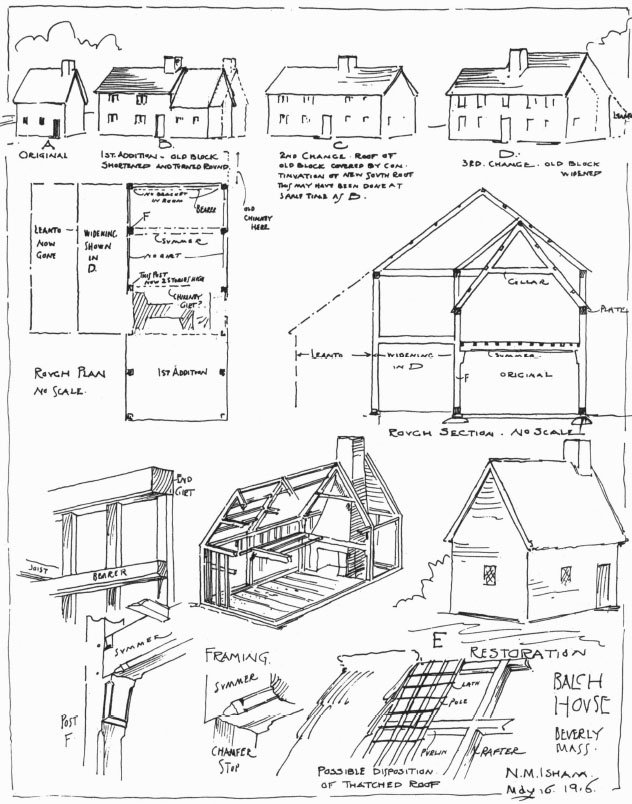
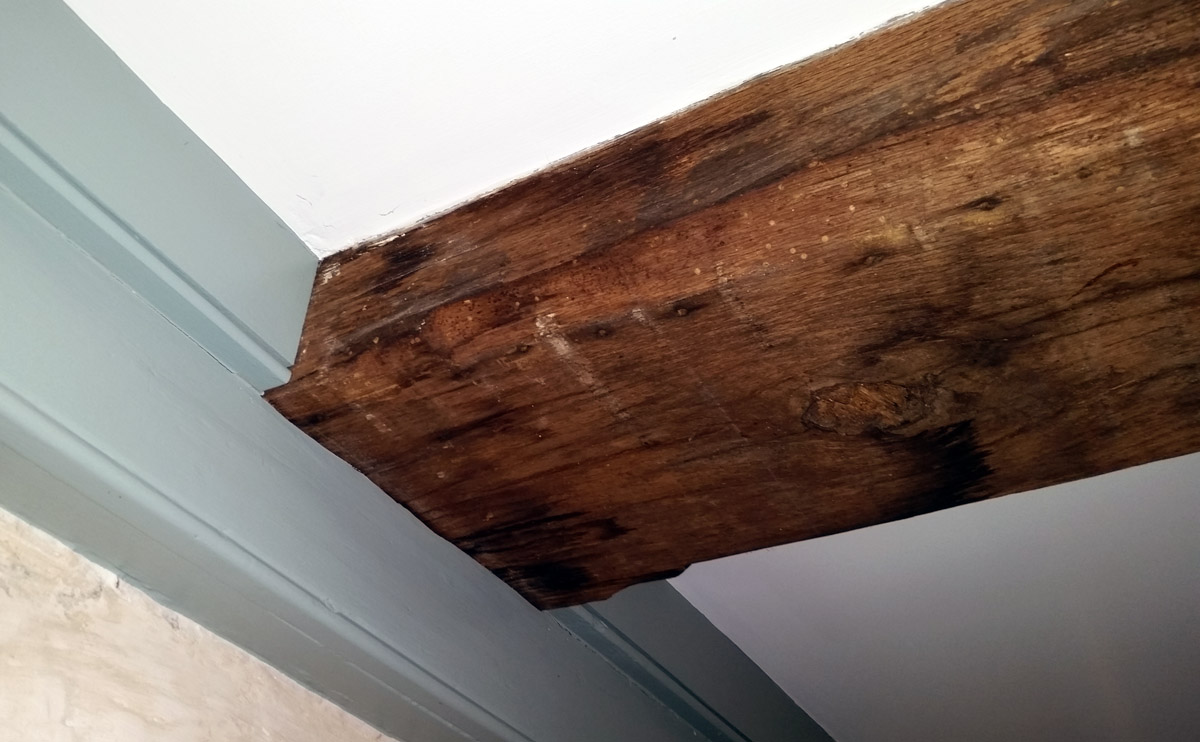
The present residence was built by Jeremiah Lord in 1763. In the early 19th century, the central chimney was removed and replaced with two side chimneys. Summer beams in the two front left-side rooms feature wide chamfers and lamb’s tongue stops, evidence that the house we see today has within it Andrews’ one-over-one 17th-century structure.
Architectural Features of the White Horse Inn
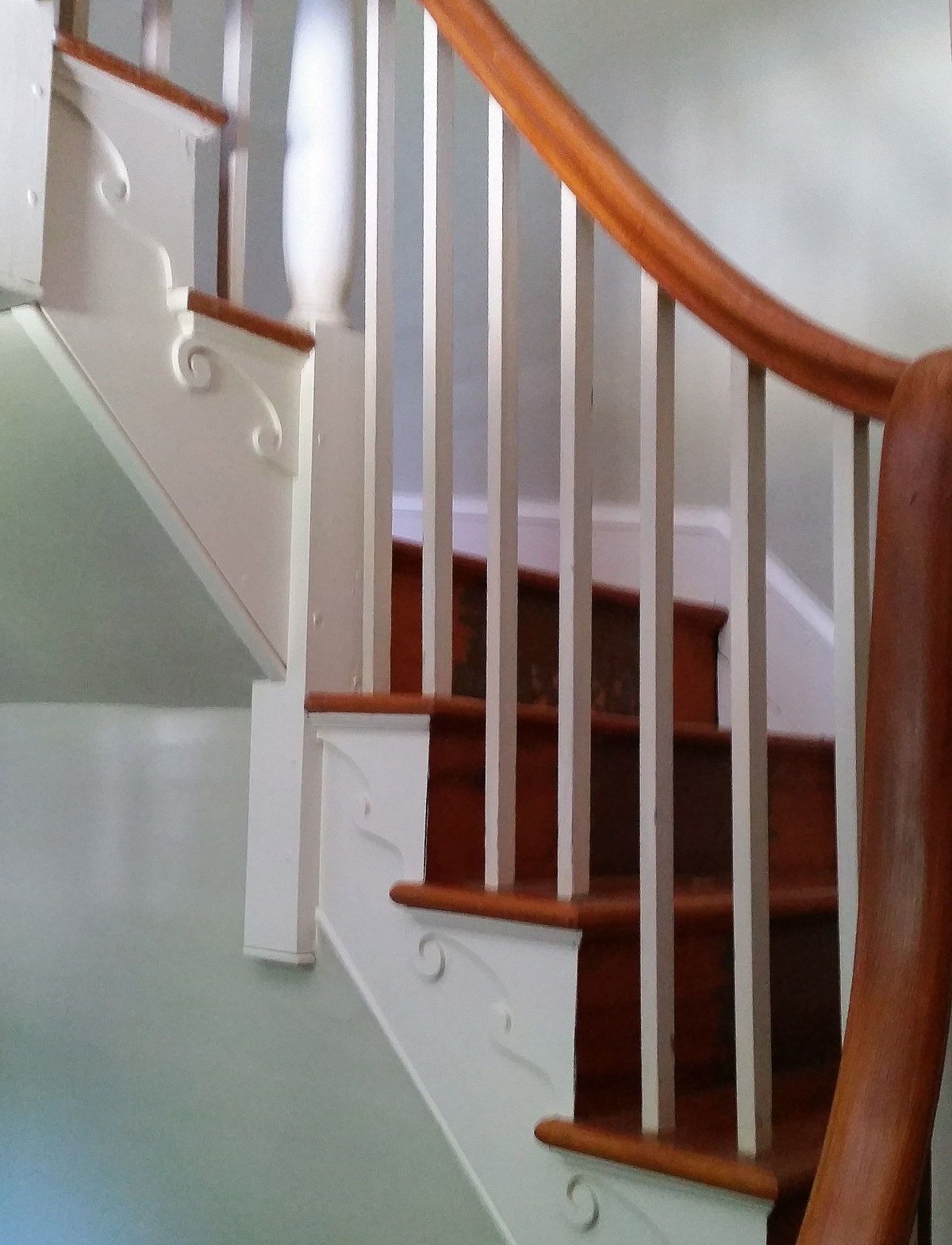
Ceilings in the upstairs and downstairs left-side rooms display chamfered summer beams with lambs-tongue chamfers, typical of the First Period. The dimensions of the rooms and cased framing in the house suggest that an early structure may have been incorporated into the present house that was constructed by Jeremiah Lord in 1763. Around the year 1800, the central chimney house was removed and replaced with two side chimneys. A central double stairway exists in the area where the central chimney may once have stood. A previous owner poured a concrete floor in the basement, erasing any evidence of a possible early stone chimney base.
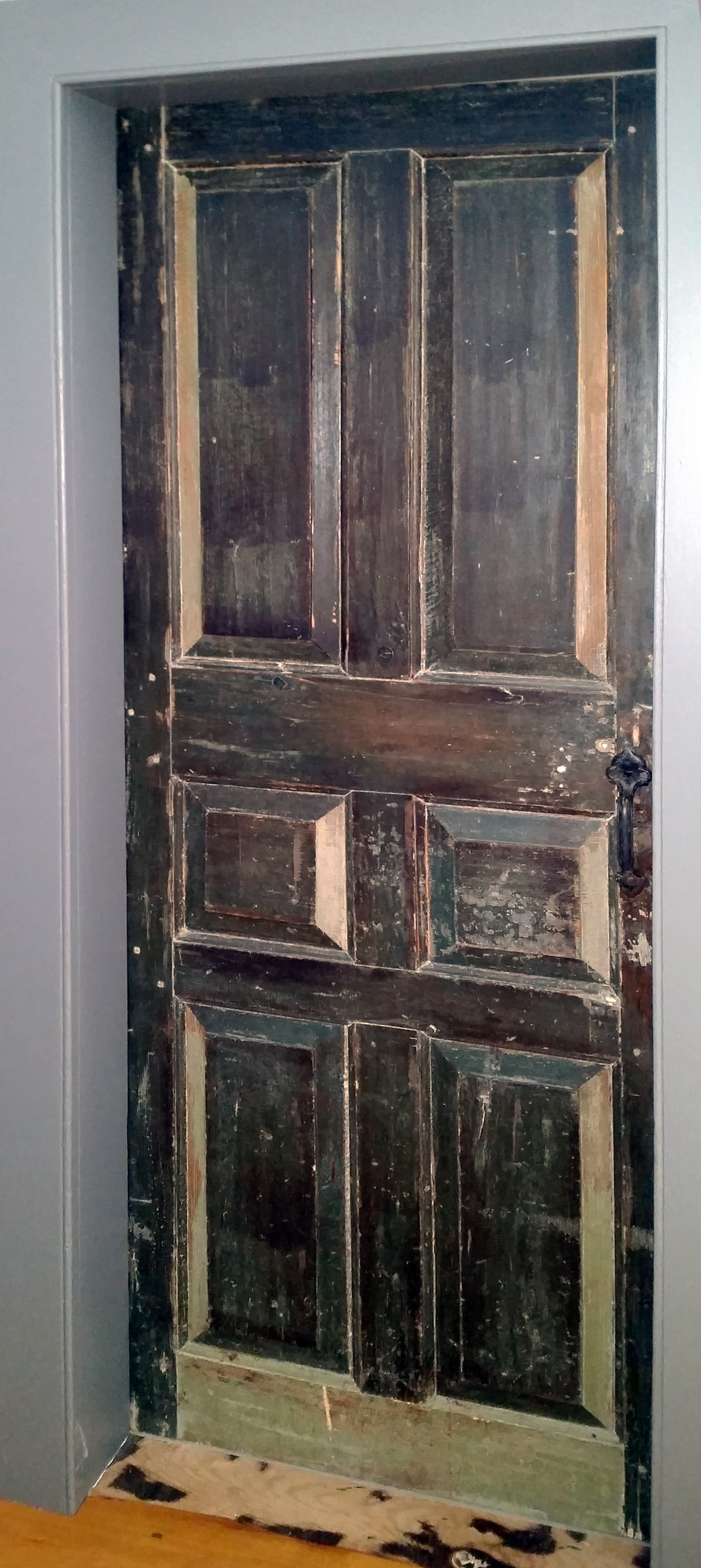
Ceiling heights in the front rooms of the house at 34 High Street are a bit over 7 ft. in height, another indication of the house’s age. Corner posts are boxed, and no wall framing is exposed. If the house originated as an earlier structure, the original roof and basement framing appear to have been replaced when the house was enlarged.
The house was enlarged and renovated in the Georgian style under the ownership of Jeremiah Lord in 1763, and assumed its present appearance around 1800 when the central chimney was removed. It stayed in the Lord family into the 20th Century.


Henry Archer
Henry Archer (1604-1671) was granted a large farm and house in Chebacco (Essex), but was also granted this lot, where he built a house and operated a brewery or tavern. At the September 1652 court, Henry Archer and John Baker were cleared of failing to put a full measure of malt in their beer. He was in court repeatedly regarding debts owed to him, and a court document indicates that Archer and his wife moved out of the town, perhaps to their farm in Chebacco, after September 23, 1656, when they sold it to Corporal John Andrews of Ipswich.
Corporal John Andrews
Andrews gave bond that he would pay a debt in wheat and barley to Henry Archer of Ipswich, but he failed to live up to the agreement, and in September 1660, “Elisabeth Archer, attorney to her husband, Henry Archer,” sued John Andrews for debt. The court document lists goods paid to Goodman Archer and his wife “before they went.”1
Thomas Franklin Waters wrote, “Corporal John Andrews offended the sensibilities of his neighbors by keeping open doors or open bar until past nine o’clock, encouraging young men in devious ways. A petition of protest against the renewal of his liquor license was presented to the Court. Corporal Andrews was for several misdemeanors complained of to this Court for selling wine by retail without license upon pretense of selling by the gallon and three gallons, and yet drawing it by the pint and quart, and for entertaining Townsmen at unseasonable times, as after nine of the clock.”
The Court in Salem in June 1658 determined that it “thought meet to license Corporal Andrews to keepe an ordinary for the entertainment of strangers only till the next Court at Ipswich, and not longer, provided that the Inhabitants do at the said Court present some meet person to keepe an ordinary that the Court shall approve of.” Deacon Moses Pengry, who had signed the complaint against Andrews, was instructed to prepare himself to open an ordinary.
Andrews was so angry about the verdict that he went into a rage and tore down the door of the home of Chief Marshall Edward Brown, the gate at Lt. Samuel Appleton’s yard, and Moses Pengry’s sign. He sold the inn and moved back to his house in Chebacco (Essex), where he was continually hauled into court for running up debts. Here’s a story about some of the young men who got in trouble.
Later ownership of the lot and house
Andrews operated the tavern for three years, and sold to Mr. Richard Dummer, a house and house lot of about an acre, with three acres more of pasture land adjoining, “which said house and land is situated, lying and being in Hill St. . . . called by the name of the White Horse.” on May 14, 1659 (Ips. Deeds 1: 231).
Thomas Franklin Waters listed the subsequent owners of the property
“John Paine was in possession in 1671, by the deed of the adjoining property, and Philip Fowler in 1678. Philip gave to his son, Joseph, his dwelling house, barns, shop, and orchard, “which I have owned since 1677,” extending to the ditch that parted from Philip’s land, on April 2, 1715 (27: 132). Joseph Fowler sold to Jeremiah Lord, on Jan. 7, 1723, 74 rods, the rest of the original lot that remained after his sale to Joseph Bolles (43: 106) for £37. Jeremiah Lord sold the east half of his dwelling to his son, Jeremiah Jr., on May 30, 1757 (121: 22) for £30. He enlarged his lot by the purchase of 2 rods 10 ft. frontage of the William Caldwell estate, adjoining on the southwest, July 11, 1763 (124: 1). He inherited the remainder probably, and was succeeded by his son, Ebenezer Lord, 1771 (Pro. Rec. 347: 153).”
Sources:
- Sanborn, Melinde Lutz and Mahler, Leslie, “The English Origin of Henry Archer of Ipswich, Massachusetts,” in The New England Historical and Genealogical Register, Vol. 158 (April 2004), pp. 119-12
- Waters, Thomas Franklin: Ipswich in the Massachusetts Bay Colony Vol I
 Historic Ipswich