
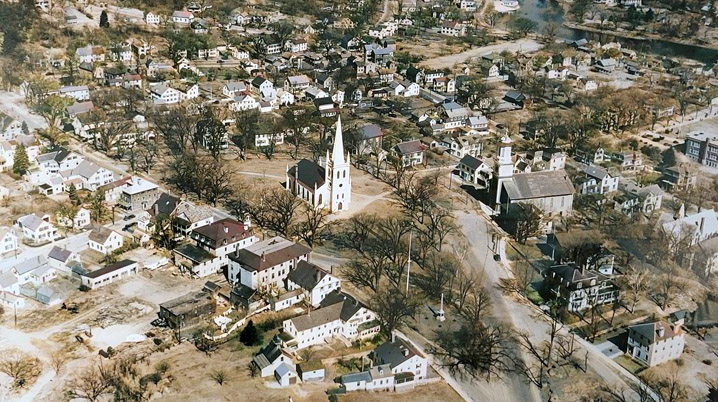
Multi-Family Households in Ipswich
Gordon Harris, local historian

My wife and I are fortunate to own our home on an acre of land, but historically, that’s an aberration. In early Ipswich, houses often accommodated more than one family. Multiple generations of families lived in the same house, sharing resources like water and heat, as well as the responsibilities that come with living together. When you look at 18th and 19th Century Ipswich deeds, people frequently purchased half a house, with the property line going down the middle of the chimney. These traditional historic compact living arrangements helped foster close-knit communities like Ipswich and shaped the communal spirit that we all love about our town today.
After the Revolutionary War, the population of Ipswich plummeted as many young families moved west to settle newly available land. We became a town of the elderly and poor, referred to in the Salem newspaper as a “town that has gone to the dogs.” People couldn’t afford to build new houses, and that’s why so many First Period houses survive today.
What took Ipswich out of the doldrums was the Industrial Revolution. The population of Ipswich doubled with the arrival of French Canadians, Irish, Greek, and Polish immigrants who came to work in the mills. Mill families lived in crowded houses or on the second and third floors of downtown buildings; they worked long hours at low wages, and they stayed. Their dense neighborhoods, Pole Alley and Brownville Avenue are on the National Register of Historic Places. Very quickly, the economy of our old town began to flourish again, and members of those hardworking immigrant families who revived Ipswich a century ago are today among our town’s leaders and successful business people. The lesson from history is obvious: for a community to thrive, we need people, and they need places to live.
Multifamily Living in Ipswich – A Snapshot From 1920
Mariana Ovnic, Chair of the Ipswich Historical Commission
As the Town of Ipswich considers adding a multifamily overlay district bylaw to our zoning regulations, it might be interesting to peek into our past to see if multifamily housing was ever a “thing” in our quaint little town. I looked at census data from 1920, which I chose because it is about 100 years ago, and Ipswich had a vibrant and diverse population at that time. It turns out that multifamily living was actually a really huge thing.
First, so-called single-family dwellings were pretty full and often included more than just single families. For example, 3 Turkey Shore Rd held John Gianakapolous, his wife Helen, 2 sons, 2 daughters, and his brother- and sister-in-law. In addition to Andrew Saffron at 7 Turkey Shore, there lived his 3 cousins, a cousin-in-law, and a baby boy, the son of cousin Apostolos Pappas. Another pattern was a widowed head of household, living with extended family. Living at 12 Labor-in-Vain were 60-year-old widow Ida Small and her niece Sarah Goodhue, a nephew-in-law, and 2 grand-nieces.
Many homes included boarders. At 157 Argilla Rd, Scottish-Canadian immigrant Angus Macleod lived with his wife, 2 young children, his nephew- and niece-in-law, and 11 boarders.
The housing built specifically for mill workers was often very full. At 20 Estes Street, where we now go to get our Riverview Pizza, widow Mary Healy lived with her daughter and daughter’s family, and 9 boarders, all of whom worked at the hosiery mill. At number 2 6th Street, 26-year-old widow Mary Stasuk lived with her 2 little boys and 13 boarders, all Polish immigrants. At number 3 5th Street: Charles Warja, his wife, his brother and sister, 5 daughters, 1 son, and 7 boarders. Again, all Polish immigrants.
I could go on, but I think you get the picture. Multifamily living in Ipswich 100 years ago was very common. Importantly, it often provided a landing spot, a foothold, for a very diverse immigrant community. 100 years later, I think we can all agree that these immigrants made a mark on our little town, and, some would say, they really made our town into what it is today. As a daughter of immigrants, I would tend to agree.
As a member of the 3A task force, I learned that passage of the bylaw is unlikely to lead to rapid change. After all, we are not in the midst of an Industrial Revolution. The economics are completely different. That said, multifamily housing, particularly in the downtown area, does provide an opportunity for seniors to downsize, for young professionals, for new families.
I anticipate, if we pass the 3A bylaw at Town Meeting on October 22, that 100 years from now, a future Ipswich resident will look back to today and simply say, “Thank You.”
Related Posts:
 One Third for the Widow - Under Puritan law an adult unmarried woman was a feme sole, and could own property and sign contracts. A married woman was a feme covert and could not own property individually. Widows regained the status of feme sole but the Right of Dower entitled them to keep only one third of their property. When a woman was left a widow some men like vultures were ready to take the other two thirds.… Continue reading One Third for the Widow
  Ipswich Mills Historic District - Six parallel streets, 1st Street to 6th Street plus Estes and Kimball Streets were laid out by the Ipswich Mills Company to provide housing for their workers, many of whom were Polish. Most of the houses were purchased by residents when the mill closed in 1928.… Continue reading Ipswich Mills Historic District
 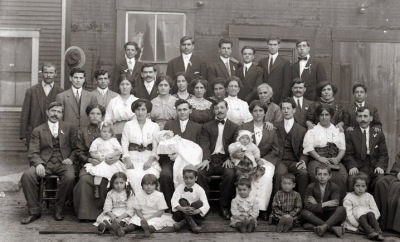 A Town of Immigrants - Puritans founded Ipswich during the “Great Migration” of the early 17th Century. Many residents of the town descend from immigrants who arrived in the late 19th and early 20th centuries to work in the mills.… Continue reading A Town of Immigrants
  Historic Ipswich
100 years ago it would seem that the people of Ipswich were more receptive to different people from different countries.
Now, not so much. Now they want to
close the door that was open when they came to Ipswich.Too bad.
“An open mind leads to enlightenment “.