

Anyone who expressed sympathy with accused persons or doubted their guilt was exposed to danger. Men spoke in whispers. Each one feared to meet another’s eye.”
The 1996 movie “The Crucible” is based on Arthur Miller’s award-winning 1953 play about the Salem Witch Trials. It was filmed on Choate Island, part of the Crane Estate in Ipswich and Essex. The story and movie are based on accusations against John and Elizabeth Proctor of Salem, who had once lived in Ipswich. John Proctor was hanged, and Elizabeth was given a reprieve in jail until her baby was born. Her sentence was never carried out.
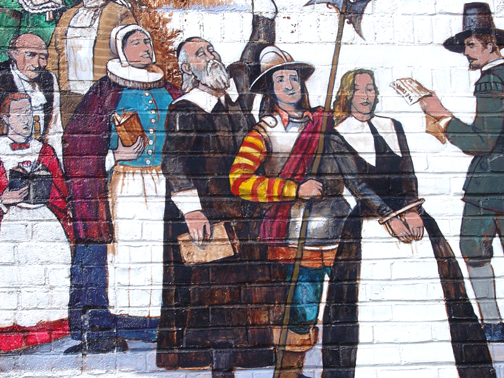
Elizabeth Howe of Linebrook Road in Ipswich was charged with bewitching her neighbor’s child, was arrested on May 28, 1692, and was hanged in Salem on July 19, 1692

Many of the accused were kept in the Ipswich gaol (jail), which was erected near the Meeting House in 1652. The Court paid the keeper 5 shillings per prisoner and ordered that each prisoner should additionally pay the keeper before they could be released for “their food and attendance.” Those who were unable to pay for their food were allowed only bread and water.

The Ipswich jail was filled with the accused. Among them was Mary Easty, the wife of Isaac Easty of Topsfield, and the sister of Rebecca Nurse. She petitioned the Court to proceed with caution, as many self-confessed witches had belied themselves: “I was confined a whole month on the same account that I am now condemned, and then cleared by the afflicted persons, as some of your honors know, and in two days’ time, I was cried out upon by them again, and have been confined, and now am condemned to die. The Lord above knows my innocence then and likewise doth now, as at the great day will be known by men and angels.”
The prison keeper, Thomas Fossie, and Elizabeth, his wife, testified that they “saw no evil carriage or deportment” while Mary Esty was confined in Ipswich jail. She was carried to execution with her fellow prisoners, Martha Corey, Ann Pudeater, and five other unfortunates. “When she took her last farewell of her husband, children, and friends, she was, as is reported by those present, as serious, religious, distinct, and affectionate as could well be expressed, drawing tears from the eyes of almost all present.” Robert Lord Jr. was a blacksmith and made the heavy leg-irons that secured the victims of the witch hysteria who were sent to Ipswich to await trial and execution.
In 1692, both Joan Braybrook and her 40-year-old stepdaughter Mehitable were accused of witchcraft and landed in jail, and were found among the 10 persons petitioning for release. The trials came to an end before the judges heard their cases, and they were released.
Giles Corey was taken from Ipswich prison, where he made his will, to Salem, and there he was pressed to death by heavy weights upon his chest because he refused to plead.
John Harris, the Deputy Sheriff, had charge of transporting the prisoners, and his account with the County reveals many sorrowful journeys of the reputed witches, through the streets from the Prison to Salem Court or Gallows Hill.
Ipswich in the Massachusetts Bay Colony
In his book Ipswich in the Massachusetts Bay Colony, Thomas Franklin Waters wrote about Ipswich’s involvement in the Salem witch trials:

“The early trials of the accused were before the Court of Assistants, of which Major Samuel Appleton was a member, but a special Commission of Oyer and Terminer was issued to several Justices, which began its sittings on June 2nd. Major Appleton had no part in the deliberations of this Court, which proceeded at once to pass severe sentences on the reputed witches. Bridget Bishop, who had long been under suspicion, was tried and condemned to death on the 8th of June, and on June 10th, she was hanged.
“The Judges, the Ministers of and vicinity, and the most enlightened citizens were sure that the powers of darkness were leagued against them. It was declared that the Devil had met with a great gathering of witches and had declared that Christ’s kingdom must be broken down. He declared that the Judgement Day and the Resurrection were abolished and all punishment for sin. He promised ease and comfort to those who would serve him, and a sacrament was then administered by him, with red bread and a liquid, red as blood. The severest measures were necessary to repel these assaults.
“The Court met again on June 30th, and Sarah Good, Rebecca Nurse, and Elizabeth Howe, wife of James How of the Linebrook Parish, and others were put on trial.
“The evidence was of the usual absurd character. Sarah Good had been confined in Ipswich jail. Joseph Herrick, the Constable of Salem, testified that she had been committed to his charge to carry to Ipswich. That night, he affirmed, he had a guard over her in his own house, and she disappeared for a time, barefoot and barelegged, and went and afflicted Elizabeth Hubbard. Her arm was bloody in the morning. Samuel Braybrook said that while carrying her to lpswich,” she leapt off her horse 3 times, which was between 12 & 3 of the clock.”

“Elizabeth How was charged with causing the death of sundry cattle and horses, and with being one of a company, who knelt down by the bank of the river at Newbury Falls, and worshipped the Devil, and had then been baptised by him. The accused were all condemned and were all executed on July 19th.
“By virtue of an act of the General Court in January 1692-3, (5) the first Superior Court, called the ‘Court of Assizes and General Goal Delivery’, was convened at Salem. The Grand Jury included Mr. Robert Paine, Mr. Richard Smith, and Mr. Thomas Boardman of Ipswich. Robert Paine was the son of the elder Robert Paine whose farm was on Jeffreys Neck Road and who had dealt so generously with the Ipswich School. Robert Payne, the junior, graduated from Harvard in 1656, was a preacher, and attained regrettable prominence as foreman of the Grand Jury that brought in the indictments in the Salem witchcraft trials in 1692. (source: Salem Witchcraft Papers)

“On the ‘Jury for Tryalls’ were Ensign Thomas Jacob, Sargent Nathaniel Emerson, Sen., Mr. Jacob Perkins, Jr., Mr. Matthew Whipple Sen., John Pengery, Seth Story, Thomas Edwards, and John Lamson. The Grand Jury, of which Mr. Paine was foreman, found nothing against thirty who were indicted for witchcraft, and true bills against twenty-six. Of those on trial, only three were found guilty and sentenced to death. These were the last to suffer. Nineteen were hanged, and Giles Corey had been pressed to death; John Proctor and Elizabeth How had perished, but other Ipswich folk, Elizabeth Proctor, Rachel Clinton, andSarah Buckley had escaped.

“All the ministers put themselves on record as out of sympathy with the popular delusion, and Mr. Hubbard and Mr. Wise made formal appeals for the accused. Rev. John Wise, the minister of the Chebacco Parish, had roused the Town to the brave resistance of the Andros edict and had suffered a fine and removal from his pulpit. When the Witchcraft Delusion swept many of the coolest and best-balanced men off their feet, he dared to protest and addressed a petition to the Magistrates, signed by many of his parishioners, on behalf of John Proctor, Jr. and his wife, imploring the favor of the Court for these innocent victims of a false charge.”
“Attempts to make amends for the irreparable harm soon began to be made. Twelve ministers of the County of Essex, including William Hubbard, John Rogers, Jabez Fitch, and John Wise, petitioned the General Court in July 1703 to clear the names of the accused and relieve those who had suffered.”
In late April 1693, the Court convened in Boston and cleared Capt. John Alden by proclamation. On May 2, the Superior Court convened in Ipswich with several grand juries. Charges were dismissed against all except Susannah Post, Eunice Frye, Mary Bridges Jr., Mary Barker, and William Barker Jr. who were all found not guilty. At the Ipswich court, unlike Salem, all were acquitted. (See also: Procedures, Courts & Aftermath of the Salem Witch Trials; Wikipedia: Salem Witch Trials)
In 1711, the legal disabilities resulting from the witchcraft executions and imprisonments were removed, and damages were awarded to the survivors and the families of the dead. John Appleton, Esquire, of Andros fame, and Nehemiah Jewett, Esquire, who had been a member of the House sixteen times and thrice its speaker, were members of this committee.
Wayers wrote, “Ipswich had suffered grievously in the grim ordeal, but as compared with every other important town in the County, she had been favored indeed. None of her citizens, except Elizabeth Howe from the Linebrook Parish, near Topsfield, were executed, and those who were accused were not condemned. No such delirium as afflicted Salem, Beverly, Wenham, Andover, Salisbury, Gloucester, and Newbury was ever manifest here. The same judicious and far-seeing temper that made Ipswich the leader of the Colony in the Usurpation period, preserved her balance in the wild excitement of the Witchcraft time.”
It is said that the group of accusing girls were brought to Ipswich but they were refused permission to cross the bridge into town. In November 1692, the afflicted girls came to Ipswich, and meeting an old woman at the bridge, they began their usual fits. But the people of Ipswich had not sent for the girls and were fed up with the witchcraft accusations. Their antics were ignored, and there were no further accusations.
Excerpt from Wikipedia:
“In January 1693, the new Superior Court of Judicature, Court of Assize and General Gaol [Jail] Delivery convened in Salem, Essex County, again headed by William Stoughton, as Chief Justice, with Anthony Checkley continuing as the Attorney General, and Jonathan Elatson as Clerk of the Court. The first five cases tried in January 1693 were of the five people who had been indicted but not tried in September: Sarah Buckley, Margaret Jacobs, Rebecca Jacobs, Mary Whittredge (or Witheridge), and Job Tookey. All were found not guilty. Grand juries were held for many of those remaining in jail. Charges were dismissed against many, but 16 more people were indicted and tried, three of whom were found guilty: Elizabeth Johnson Jr., Sarah Wardwell, and Mary Post.
“When Stoughton wrote the warrants for the execution of these three and others remaining from the previous court, Governor Phips issued pardons, sparing their lives. In late January/early February, the Court sat again in Charlestown, Middlesex County, and held grand juries and tried five people: Sarah Cole (of Lynn), Lydia Dustin and Sarah Dustin, Mary Taylor, and Mary Toothaker. All were found not guilty but were not released until they paid their jail fees. Lydia Dustin died in jail on March 10, 1693.
“At the end of April, the Court convened in Boston, Suffolk County, and cleared Capt. John Alden by proclamation. It heard charges against a servant girl, Mary Watkins, for falsely accusing her mistress of witchcraft.
In May 1693, the Court convened in Ipswich, Essex County, and held a variety of grand juries. They dismissed charges against all but five people. Susannah Post, Eunice Frye, Mary Bridges Jr., Mary Barker, and William Barker Jr. were all found not guilty at trial, finally putting an end to the series of trials and executions.” (In early 1693, taverner John Sparks laid down his license, and John Rogers, a saddler, continued its operation as a public house known as the Black Horse Inn. The Ipswich court, undoubtedly meeting in the inn, dismissed charges against all but four women, who were acquitted, and the Salem witchcraft trials finally ended in Ipswich.)
The Massachusetts General Court declared a day of fasting and reflection for the Salem witch trials on January 14, 1697. One of the judges, Samuel Sewel, publicly confessed his guilt. The following 12 jurors signed a Declaration of Regret asking forgiveness: Thomas Fisk, Foreman; William Fisk, John Bacheler, Thomas Fisk, John Dane, Joseph Evelith, Thomas Pearly, Sr., John Peabody. Thomas Perkins, Samuel Sayer, Andrew Eliot, and Henry Herrick, Sr.
Read Thomas Franklin Waters’ entire history of Ipswich in the Salem Witchcraft trials at Ipswich in the Massachusetts Bay Colony, Volume 1, Chapter 16: Witchcraft. online at Archive.org.
Further information:
- Salem-Village Witchcraft: A Documentary Record of Local Conflict in Colonial New England by Paul Boyer (Editor), Stephen Nissenbaum (Editor)
- Massachusetts Archives Volume 135: Witchcraft Papers Index 1692-1759
- Publications of the Ipswich Historical Society Volume X1
- History of Ipswich, Essex, and Hamilton by Joseph Felt
- Acts and Resolves, Province Laws passed by the General Court 1692-3
- SWP No. 169: Superior Court of Judicature: Warrants for Jurors and Returns (December 1692 – January 1693)
- Wikipedia: Salem Witchcraft Trials
- University of Virginia: Salem Witch Trials
- Verbatim Transcriptions of the Court Records In three volumes. Edited by Paul Boyer and Stephen Nissenbaum Da Capo Press: New York, 1977.
- The Project Gutenberg eBook of Salem Witchcraft, Volumes I and II, by Charles Upham
- Superior Court of Judicature: Warrants for Jurors and Returns (December 1692 – January 1693)
- Legends of America: Procedures, Courts & Aftermath of the Salem Witch Trials
- Petitions from Relatives of Prisoners and Others (October 1692 – January 1693)
- Petition of Ten Prisoners at Ipswich. View original
- Superior Court of Judicature: Ipswich Warrant for Jurors and Return
- Warrant for the apprehension of Rachel Clinton, and Summons for Witnesses v. Rachel Clinton
- Warrant for the Apprehension of Elizabeth How
- Examination of Elizabeth How
- Warrant for the execution of Sarah Good, Rebecca Nurse, Susannah Martin, Elizabeth How, and Sarah Wilds
- Petition of Mary and Abigail How for Restitution for Elizabeth How
- Petition for John Proctor and Elizabeth Proctor by the inhabitants of Ipswich
- (RETURN OF THE TOWN OF IPSWICH)
- (WARRANT FOR THE APPREHENSION OF RACHEL CLINTON, AND SUMMONS FOR WITNESSES V. RACHEL CLINTON, AND OFFICER’S RETURN )
- ( TESTIMONY OF MARY EDWARDS V. RACHEL CLENTON )
- (SUMMONS FOR WITNESSES TO THE EXAMINATION OF RACHEL CLINTON, AND OFFICER’S RETURN )
- (LIST OF ELEVEN ACCUSED PERSONS AND THEIR ACCUSERS, MAY, 1692)
- (DEPOSITION OF SAMUEL PERLEY & RUTH PERLEY V. ELIZABETH HOW )
- (DEPOSITION OF SARAH ANDREWS V. ELIZABETH HOW )
- ( TESTIMONY OF SAMUEL PHILLIPS & EDWARD PAYSON FOR ELIZABETH HOW )
- (TESTIMONY OF WILLIAM HUBBARD FOR SARAH BUCKLEY )
- (DEPOSITION OF DEBORAH HADLEY FOR ELIZABETH HOW )
- (STATEMENT OF DANIEL WARNER, JOHN WARNER, AND SARAH WARNER FOR ELIZABETH HOW
- (STATEMENT OF JOSEPH KNOWLTON AND MARY KNOWLTON FOR ELIZABETH HOW )
- (DEPOSITION OF JOSEPH HERRICK, SR. , AND MARY HERRICK V. SARAH GOOD )
- (INDICTMENT NO.1 OF ELIZABETH HOW, FOR AFFLICTING MARY WOLCOTT )
- (INDICTMENT NO. 2 OF ELIZABETH HOW, FOR AFFLICTING MERCY LEWIS )
- (TESTIMONY OF FRANCIS LANE V. ELIZABETH HOW )
- (DEPOSITION OF JACOB FOSTER V. ELIZABETH HOW )
- (TESTIMONY OF JOHN HOW V. ELIZABETH HOW )
- (DEPOSITION OF JOSEPH SAFFORD V. ELIZABETH HOW & BRIDGET BISHOP )
- (TESTIMONY OF THOMAS ANDREWS V. ELIZABETH HOW )
- (TESTIMONY OF REV. JOHN HALE V. SARAH WILDS )
- (WARRANT FOR THE EXECUTION OF SARAH GOOD , REBECCA NURSE, SUSANNAH MARTIN , ELIZABETH HOW , AND SARAH WILDS )5
- (DEPOSITION OF JOSEPH BAILEY & PRISCILLA BAILEY V. ELIZABETH PROCTOR & JOHN PROCTOR )
- (PETITION FOR JOHN PROCTOR AND ELIZABETH PROCTOR )
- (Petition of ten prisoners at Ipswich
- (Indictment of Tituba for Covenanting)
- (Account for payment submitted by Isaac Little and John Harris of Ipswich, Deputy
- Search the Salem Witchcraft Papers
Recommended reading:
 Mehitabel Braybrooke, in the Shadow of Salem - "In the Shadow of Salem" by Donna B. Gawell is about the life of Mehitabel Braybrooke of Ipswich, told in the first person. 17th Century court records exist that describe the charges against her, but the author's comprehensive research gave depth to the portrayal of this unfortunate young woman's life.… Continue reading Mehitabel Braybrooke, in the Shadow of Salem
  The Witchcraft Accusations Against Sarah Buckley and Mary Witheridge - On May 23, 1692, a complaint for witchcraft was filed against Sarah Buckley and her widowed daughter Mary Witheridge. The "bewitched" girls of Salem Village claimed that the women's specters had attacked them. Held in shackles in the cold crowded jail, both were acquitted in January,1692… Continue reading The Witchcraft Accusations Against Sarah Buckley and Mary Witheridge
  Four-Year-Old Dorothy Good is Jailed for witchcraft, March 24, 1692 - On March 24, 1682. a child, Dorothy Good of Salem was taken custody, and interrogated by the local magistrates for two weeks. Hungry, cold and missing her mother, Dorcas broke down and told the inquisitors what they wanted to hear, that her mother was a witch, and consorted with the devil.… Continue reading Four-Year-Old Dorothy Good is Jailed for witchcraft, March 24, 1692
  PTSD in the Massachusetts Bay Colony - The Great Migration brought nearly 14,000 Puritan settlers, unprepared for the hardships and trauma that awaited them. Building a new society in the wilderness induced transgenerational post-traumatic stress culminating in the Salem Witch Trials, which some professionals describe as mass conversion disorder.… Continue reading PTSD in the Massachusetts Bay Colony
  The Legend of Goody Cole - Some said that Goody Cole took the shapes of eagles, dogs, cats and apes. At last she lay under sentence of death in the Ipswich jail for changing a child in its cradle.… Continue reading The Legend of Goody Cole
  The Witchcraft Trial of Elizabeth Morse of Newbury, 1680 - Elizabeth Morse of Newbury was accused and found guilty of being a witch. She was initially sentenced to be hanged, but after spending a year in the Boston jail, she was sent home… Continue reading The Witchcraft Trial of Elizabeth Morse of Newbury, 1680
  Lucretia Brown and the Last Witchcraft Trial in America, May 14, 1878 - Lucretia Brown, an invalid living on the South Green in Ipswich was a disciple of Mary Baker Eddy,. When she suffered a “relapse” in 1875, Mrs. Eddy convinced her that Daniel Spofford was exercising mesmeric powers upon her.… Continue reading Lucretia Brown and the Last Witchcraft Trial in America, May 14, 1878
  Ipswich and the Salem Witchcraft Trials - During the Salem witch trials, Elizabeth Howe of Linebrook Road was tried and hanged. The Ipswich jail was filled with the accused, but the ministers of the town opposed the trials as a delusion. Residents blocked the bridge to prevent the accusing girls from being brought into Ipswich.… Continue reading Ipswich and the Salem Witchcraft Trials
  The Witchcraft Trial of Elizabeth Howe, Hanged July 19, 1692 - Elizabeth Howe and her husband James resided on outer Linebrook. She was charged with bewitching her neighbor’s child and was arrested on May 28, 1692. She was one of the five women hanged in Salem on July 19, 1692.… Continue reading The Witchcraft Trial of Elizabeth Howe, Hanged July 19, 1692
  “We Walked in the Clouds and Could Not See our Way” - Rev. John Hale of Beverly participated in the witch trials until his wife was accused. Hale later published an analysis in which he asserted that Satan had tricked the Puritans, and made a plea for forgiveness.… Continue reading “We Walked in the Clouds and Could Not See our Way”
  Rachel Haffield Clinton Arrested for Witchcraft, May 28, 1692 - Everything about Rachel Clinton's life went wrong, and in her old age she was an easy target for the witchcraft hysteria that spread from Salem throughout Essex County.… Continue reading Rachel Haffield Clinton Arrested for Witchcraft, May 28, 1692
  Peg Wesson, the Gloucester Witch - An old legend about the Gloucester witch Peg Wesson is often mentioned, but never was it told in such detail as in this story published in the Boston Evening Transcript, October 14, 1892. It was carried in papers throughout the country.… Continue reading Peg Wesson, the Gloucester Witch
  Mary Perkins Bradbury, Charged as a Witch - Mary Perkins was born in 1615, the daughter of Sergeant John Perkins, Sr. and Judith Perkins. She became the wife of Capt. Thomas Bradbury of Salisbury, and was sentenced to death as witch in 1692, but was not executed. Over a hundred neighbors testified in her support.… Continue reading Mary Perkins Bradbury, Charged as a Witch
  The Spectre Leaguers, July 1692 - In the midst of witchcraft accusations in 1692, Gloucester was invaded by a spectral company for a fortnight. Their speech was in an unknown tongue, and bullets passed right through them. … Continue reading The Spectre Leaguers, July 1692
  Historic Ipswich
Robert Paine was probably not on the jury in 1692. Here is why.
1) Sources that say he was . . . all seem to be from the age-old gossip distortion phenomenon. In this, they’re conflating 1692 with 1693.
Can anybody refute the following?
“No personal diary, letter, or deposition from a 1692 juror or spectator has surfaced naming Robert Paine as a jury member that year.”
“Without a firsthand account, such as a magistrate’s note, a clerk’s list, or a spectator’s record, (Robert Paine’s) presence on a 1692 jury for the Salem Witch Trials) remains unconfirmed.
“No known eyewitness or firsthand accounts from 1692 explicitly identify Robert Paine as a member of a jury during the Salem witch trials that year. The primary records and contemporary narratives from that year do not name individual jurors, -and- no surviving document—court paper, letter, or apology—places Paine on a 1692 jury. ”
“In the Salem context, the change from 1692 to 1693 coincided with a major judicial shift.
“The Superior Court of Judicature, starting in January 1693, operated under stricter evidentiary rules and cleared many remaining defendants, reflecting a new phase rather than a routine jury rotation.
“While some jurors from 1692 might have carried over, the new court’s broader jurisdiction and reformed approach likely involved summoning new panels, as seen with Paine’s documented role.
“In the Salem witch trials, any new jury in 1693 resulted from the establishment of a new court.”
Robert Paine was foreman of the Grand Jury, but not on the Jury for Trials. Here’s an image of the warrant listing his name. https://historicipswich.net/wp-content/uploads/2024/12/warrant-ipswich-grand-jury-paine-witchcraft.jpg.
What happened to the 12 jurors that wrote the apology for their actions while doing their civic duty as jurors? They have been maligned in many articles. Has any follow up ever been done to see how this affected their lives going forward?
In 1697, Judge Samuel Sewall, and 12 jurors apologized for their roles in the Salem witch trials. The other magistrates never admitted they were wrong. The Book Judge Sewall’s Apology is a fascinating history of his life and the times. https://www.amazon.com/Judge-Sewalls-Apology-American-Conscience/dp/0007163630?&_encoding=UTF8&tag=bikneweng-20&linkCode=ur2&linkId=5ecaba7c9c98887f1dde9db3ea6b7398&camp=1789&creative=9325
Yes. Thank You. It’s another document where Robert Paine isn’t mentioned.
Do you find this interesting, or can anyone refute
“No personal diary, letter, or deposition from a 1692 juror or spectator has surfaced naming Robert Paine as a jury member.”
“Without a firsthand account, such as a magistrate’s note, a clerk’s list, or a spectator’s record, (Robert Paine’s) presence on a 1692 jury for the Salem Witch Trials) remains unconfirmed.
“No known eyewitness or firsthand accounts from 1692 explicitly identify Robert Paine as a member of a jury during the Salem witch trials that year. The primary records and contemporary narratives from that year do not name individual jurors, -and- no surviving document—court paper, letter, or apology—places Paine on a 1692 jury. ”
“In the Salem context, the change from 1692 to 1693 coincided with a major judicial shift.
“The Superior Court of Judicature, starting in January 1693, operated under stricter evidentiary rules and cleared many remaining defendants, reflecting a new phase rather than a routine jury rotation. “While some jurors from 1692 might have carried over, the new court’s broader jurisdiction and reformed approach likely involved summoning new panels, as seen with Paine’s documented role.
In the Salem witch trials, any new jury in 1693 resulted from the establishment of a new court.”
Thanks for reading!
Love to learn more about these events as I am a direct descendant of Mary Esty . This is quite an informative article.
Superb article, as is all of your writing! Thanks.
Hi…my 8th great grandmother Suzannah Rootes (Roots) was accused of being a witch. Any info on her or her family?
Thank you!