
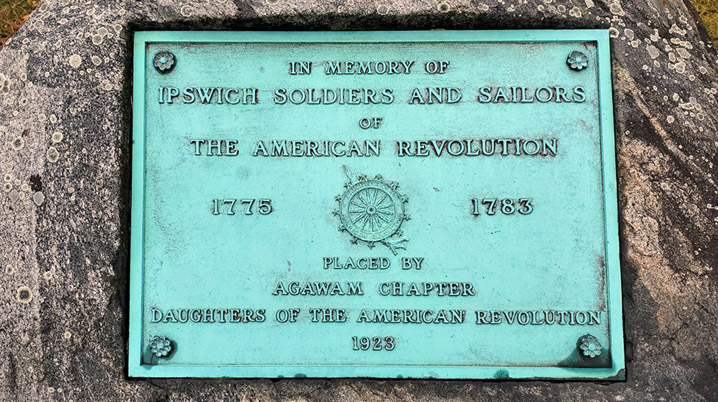
(Read Part 1: Ipswich and the Breach with Britain)
During the 250th Anniversary of the American Revolution, this site is highlighting the timeline of Ipswich in the breach with Britain and the Revolutionary War.
Additional history and stories:
Excerpts from Ipswich in the Massachusetts Bay Colony by Thomas Franklin Waters
Early in the morning of April 19, 1775, the British regulars marched to Lexington and Concord, resulting in the first battle of the Revolutionary War. Late in the day, the news reached Ipswich, and three hundred minutemen marched off with their captains to fight the British, continuing 24 miles to Medford before halting for the night. A company from Hampton arrived in Ipswich the next morning after an all-night march and found the town nearly defenseless and panic-struck. A rumor had spread that two British ships, which had anchored in the river, were full of British soldiers on their way to burn the town. About two hundred men, many elderly, were mustered to protect the town, and Capt. Burnham stayed as their commander. As the Ipswich residents fled to Newbury, residents there fled north into New Hampshire. By the next day, word came that it was all a mistake, recorded in John Greenleaf Whittier’s “The Great Ipswich Fright.”
A Committee on Minute Men reported a contract to be signed by those who enlisted, and their proposed wages, on Jan. 3, 1775. This report recommended the enlistment of a quarter part of the Training Band or Alarm List, and the payment of a shilling to each enlisted man for each half day he attended muster. Every man was bound to “attend Duty two half days each week.” After the first of April, the pay was advanced to two shillings, to be continued until “taken into Province pay or Dismissed by said Town.”
On January 24, 1775, Ipswich men signed articles of enlistment, and a company of Ipswich and Rowley Minutemen was formed with Captain Nathaniel Wade and Lieutenant Joseph Hodgkins of Ipswich in command. The Ipswich Company had its first opportunity to fight in the misnamed Battle of Bunker Hill on June 17, 1775. Throughout the war, Joseph Hodgkins maintained an ongoing correspondence by mail with his wife, Sarah, who acted as a conduit to the Ipswich community, with him providing news about the war and invaluable first-hand records from the American Revolution.
The patriot army’s siege of Boston dragged on. On September 15, three companies consisting of over a thousand riflemen under the command of Col. Benedict Arnold camped in Ipswich on their way to Quebec, accompanied by wagon trains carrying camp equipment. Arnold’s troops crossed the Saint Lawrence on November 13 and 14 in an attempt to take fortified Quebec City, but suffered defeat. This was the closest Ipswich came to experiencing the war at home, but the threat of naval attack was a constant concern for the coastal towns. Several privateers sailed from the port in Ipswich.

Prosecution of Tories
A price was put on the head of John Calef, and he fled with his family to Castine near the Penobscot Peninsula, where he worked as a surgeon for the British troops. As the War continued, Tory sentiments were met with severe measures. Jonathan Stickney Jr. of Rowley was so unwise that he used very uncomplimentary language regarding the patriot cause and its leaders. He was arrested and sent to the General Court. Its decision was quick and sharp:
“To the Keeper of Ipswich Jail: You are ordered to receive into your custody Jonathan Stickney Jr., who has been apprehended by the Committee of Inspection, Correspondence and Safety of the Town of Rowley and sent to the General Court for having in the most open and daring manner endeavored according to the utmost of his abilities to encourage & introduce Discontent, Sedition, and a Spirit of Disobedience to all lawful authority among the people by frequently clamoring in the most impudent insulting and abusive Language against the American Congress, the General Court of this Colony and others who have been exerting themselves to save the Country from Misery & Ruin all which is made fully to appear.
You are therefore to keep him safely in close confinement (in a Room by himself & that he be not allowed the use of pens, ink, nor paper, and not suffer him to converse with any person whatever unless in your hearing) till the further order of the General Court or he be otherwise discharged by due course of Law.”
—-In the Name and by the order of the Council and House of Representatives John Lowell, Dep. Sec. Council Chambers April 18, 1776.”
The Committee of Safety of Rowley petitioned the Court on June 5th, 1776, that, in view of his penitence, he be removed from jail to his father’s house, under such restrictions as may be imposed.
Declaration of Independence
The Summer of 1776 was brightened by one luminous event, the Declaration of Independence, on July 4th, the thought of which had been indignantly disclaimed by the votes of Ipswich not many months before, and by Washington himself and all the patriot leaders, but which had been forced upon the Colonies by the trend of events.
On June 10th, 1776, the men of Ipswich, in a town meeting assembled, instructed their representatives that “if the Continental Congress should, for the safety of the said colonies, declare them independent of the Kingdom of Great Britain, they would solemnly engage with their lives and fortunes to support them in the measure.”
Articles of Confederation
The Articles of Confederation served as the first constitution of the united colonies after they declared independence from Great Britain. Virginia ratified on December 16, 1777, and Massachusetts ratified on February 6, 1788. The articles required unanimous approval from the thirteen states, which finally happened with ratification by Maryland on February 2, 1781.

Providing for the War


The Price Act, passed at Ipswich in February 1777
During the Revolution, with no national treasury or power to levy taxes, the Continental Congress and former colonies undertook to bankroll the war by the issuance of paper money, which quickly resulted in marketplace chaos. The newly created “Continental” fell in value, and to keep prices from spiraling out of control, a meeting of delegates from Massachusetts, New Hampshire, Rhode Island, and Connecticut was held at Providence in December 1776, and a schedule of prices was created with recommendation for its adoption by the states.

In Ipswich on February 10, 1777, the Selectmen and the Committee of Correspondence and Safety, acting under the authority of the General Court, issued a schedule of prices covering all articles of food, clothing, wages of labor of every kind, entertainment at hotels, shipping rates, etc.
In April, the Committee appointed to draft a vote relative to the Act of General Court to Prevent Monopoly and Oppression reported that “Some persons from an inimical Disposition to the Glorious Cause are doing their best to prevent the regulation of prices from being carried out.”
The citizens of Ipswich at a Town meeting on April 14, 1777, unanimously adopted a resolution that “The Inhabitants of this Town will not only strictly adhere to & observe the aforesaid act but also use our utmost endeavors to detect and bring to punishment those unfriendly selfish persons who at this important crisis shall have the effrontery to counteract the good wholesome laws of this State.”
The Selectmen were instructed not to approbate any innholder or retailer who did not strictly adhere to the regulating Act. A Committee of seven persons was chosen on June 9 to prosecute all persons guilty of any breach of the Act, and the Town’s Representatives were instructed to oppose the repeal of the Act.
In April 1778, several prominent Essex County men reconvened the Ipswich Convention to discuss the drafting of a new Massachusetts constitution, and became the local backbone of the Federalist Party, advocating the financial policies of Alexander Hamilton. Among its members were George Cabot, Timothy Pickering, Nathan Dane, and Theophilus Parsons. President John Adams coined the name “Essex Junto” for this group, and many of its members were his political adversaries.
In August 1779, a Committee was chosen to meet with Committees of other towns to consider proposals for new regulations respecting the high prices of several articles of consumption. In October, John Baker and Stephen Choate were the Ipswich delegates to a convention that met in Concord to regulate prices. A month later, a Town Committee was chosen to regulate the prices of innholders, mechanics’ wages, etc., according to the recommendations of the Convention.
1783: The end of the Revolutionary War
Historian Howard H. Peckham counted 25,534 American combatants who lost their lives in the eight-year war from combat injuries, disease, and death in British prison camps.
General George Washington’s order declaring an end to hostilities was read to the Continental Army eight years to the day after the Battle of Lexington and included instructions that “an extra ration of liquor is to be issued to every man tomorrow to drink to Perpetual Peace, Independence, and Happiness to the United States of America,” In April 1783, celebrations were held throughout the new country to mark the end of the war. The celebration in Ipswich was recorded in “The Life, Journals and Correspondence of Rev. Manasseh Cutler, LL. D“:
“April l, (1783), Tues. News of Peace between America and Great Britain.
“April 29, Tuesday. This day was appointed to celebrate the return of Peace. The whole town desiring to assemble at Mr. Frisbie’s Meeting House in Ipswich, at 10 o’clock, and a committee having waited on the several ministers, desiring their attendance, I set out from here at 8 o’clock, in company with Captain Dodge and thirty or forty of the parish, who waited on me for this purpose.
“At 10 o’clock, the people assembled in the Meeting House, which was exceedingly crowded. The Proclamation from Congress being read, Mr. Cleaveland made a short prayer, an anthem was sung, and an elegant oration delivered by Mr. Frisbie, after which an anthem was sung, and the congregation dismissed. Thirteen cannons were fired.
“At 2 o’clock, an elegant, plentiful collation of cold hams, bacon, tongues, fowls, veal, etc., was spread on two very long tables on the green, at which all the people partook. This collation was a free donation of the people, which everyone through the town, who pleased, sent ready-cooked. There was also a great plenty of spirits and other liquors. When those who came first to the table had dined, thirteen toasts were given by the High Sheriff, and thirteen cannons were discharged for several of the first, and for the rest a smaller number.
“In the evening, very handsome fireworks were played off — a large number of sky-rockets, serpents, crackers, wheel-works, etc. Many gentlemen illuminated their houses, which appeared very beautiful, and the whole exercises of the occasion were performed with the greatest good order and decorum. Every countenance was smiling, and no intemperance was perceived even among the lowest class. And thus this joyful day concluded, without the smallest accident, to universal satisfaction, and much to the honor of the town. There was given, of the article of meat, between twenty-one and twenty-two hundredweight, and one hundred dollars in money. This day was eight years and ten days from the commencement of the war.”
A partial list of Ipswich soldiers in the Revolutionary War
A Committee on Minute Men reported a contract to be signed by those who enlisted, and their proposed wages, on Jan. 3, 1775. This report recommended the enlistment of a quarter part of the Training Band or Alarm List, and the payment of a shilling to each enlisted man for each half day he attended muster. Every man was bound to “attend Duty two half days in each week.” After the first of April, the pay was advanced to two shillings, to be continued until “taken into Province pay or Dismissed by said Town.”
The Troop of Horse in the Third Regiment of Militia in the County of Essex, Being about to choose their Officers, (agreeable to the Advice of the Provincial Congress) came into the following Agreement this fourteenth day of November, Anno Domini 1774, viz… “We the Subscribers the Troopers hereafter, if armed, promise to subject ourselves to the Officers that may be chosen whether it be the Captain or other Officers under him, duly Chosen by a Major part of the Troop, and that we will attend all military Musters, and in case of Delinquency, we Promise to pay a fine as By-Law if that case is made and provided, unless a Reasonable Excuse be given to the Commanding Officer for the time being, in witness whereof, We have hereunto sett our hands the Day & year above written.”
The list of subscribers (rearranged in alphabetical order):
- Allen Baker
- John Bradstreet
- Samuel Bragg
- Timothy Bragg
- Elisha Brown Jr.
- Paltiah Brown
- Ebenezer Brown
- Francis Brown
- Nehemiah Brown
- Joseph Brown
- Amos Burnam
- Isaac Burnam
- Robert Burnum
- John Chapman
- Nehemiah Choate
- Robert Choate
- Moses Conant
- William Conant Jr.
- John Cross
- Joseph Cummings Jr.
- Abner Day Jr.
- George Dodge Jr.
- Thomas Dodge
- John Emerson
- Aaron Eveleth
- Joseph Goodhue
- Seth Goodhue
- John Harris Jr.
- Mark Haskell 3
- Aaron Jewett
- Jeremiah Jewett
- John Kinsman
- Michael Kinsman
- Samuel Kinsman
- Joseph Metcalf
- Nehemiah Patch
- John Pearson
- Stephen Pearson
- Robert Perkins
- Samuel Potter
- Samuel Quarles
- Joseph Roberts
- Daniel Smith
- Nathaniel Smith
- Thomas Smith
- Zebulon Smith
- John Whipple
Capt Wade’s company of minutemen signed their contract on January 24, 1775:
- Joseph Hodgkins
- Aaron Perkins
- Francis Hovey
- John Graves Jr.
- Francis Merrifield
- Jonathan Foster
- Daniel Goodhue
- Jabez Farley
- Nathaniel Brown
- Isaac Giddings
- Nathaniel Newmarch
- Nathaniel Treadwell
- Samuel Bumham
- Stephen Dutch
- Benjamin Heard
- Jeremiah Stanford Jr.his house
- Nathaniel Ross
- William Goodhue Jr. (Chebacco)
- John Stanwood in the room of William Longfellow.
- Philip Lord Jr.
- Benjamin Ross
- Michael Farley Jr.
- John Fowler
- Samuel Lord 5th
- Henry Spiller
- Joseph Appleton Jr.
- William Dennis
- Nathaniel Jewett
- John Waite
- Nathaniel Rust Jr.
- Charles Lord
- Ephraim Goodhue
- Nathaniel Lord 3rd
- Benjamin Averill
- Isaac Stanwood
- John Fitts Jr.
- Daniel Stone
- John Harris 5th
- Joseph Fowler 3rd
- Jabez Sweet Jr.
- Thomas Appleton Jr.
- Kneeland Ross
- Stephen Pearson
- Ebenezer Lakeman in the room of John Waitt
- John Peters in the room of Benjamin Averell
- Thomas Hodgkins in the room of Jeremiah Stanford
- Nathaniel Wade
- Asa Baker
- Nathaniel Souther
- James Fuller Lakeman
- Jabez Ross Jr. for Jonathan Perkins
- Thomas Bordman (Boardman) Junior
- Edward Stacy
- Nathaniel Lakeman in the room of Philip Lord.
Other Revolutionary War soldiers
- John Freeman
- Lieutenant Ruhama Andrews
- Daniel Brown Smith
- Thomas Emerson Cole died Jan. 4, 1776
- Jonathan Cogswell 3rd died Jan. 11, 1776
- William Jones died in the summer of 1776
- David Goodhue died Aug. 8,1776
- Joseph Lufkin of the Hamlet was killed in 1776
- Jonathan Galloway drowned in the sudden sinking of a privateer in 1777
- Matthew Whipple of the Hamlet was killed in the privateer Thorn in 1781
- John Boardman of the Hamlet was killed in the privateer Thorn in 1781
- Captain Moses Harris died on board the prison ship in New York in 1783
- William Rust died on board the prison ship in New York in 1783
Ipswich Minutemen who marched to Lexington and Concord
- 63 Chebacco Parish men under Capt. Jon Cogswell Jr.
- 43 Linebrook men under Capt. Abram How
- 33 men with the horse troop under Capt. Moses Jewett
- 36 Hamlet Parish men under Capt. James Patch
- 51 Ipswich men under Capt. Daniel Rogers
- 51 Ipswich men under Capt. Nathaniel Wade
- 39 Hamlet Parish men under Capt. Elisha Whitney
- 59 Ipswich under Capt. Thomas Burnham.
Chebacco Parish soldiers killed in the War
- James Andrews (father of Israel Andrews), Battle of Bunker Hill
- Benjamin Burnham (father of Abner Burnham), Battle of Bunker Hill
- Capt. John Burnam, died at the Battle of Bunker Hill
- Nehemiah Choate, died at the Battle of Bunker Hill
- Moses Lufkin, Private, Capt. John Burnam’s Company died at the Battle of Bunker Hill
- Moses Lufkin Jr. (Drummer, Capt. R. Dodge’s Company) died at the Battle of Bunker Hill
- Aaron Perkins died at the Battle of Bunker Hill
- Jesse Story Jr., a minor, (brother of Ephraim Story), was killed in the Battle of Bunker Hill
- Francis Burnham (brother of Capt. Nathaniel Burnham) was wounded in the Battle of Bunker Hill
- Aaron Low belonged to a Gloucester company and died in the Battle of Bunker Hill
- Samuel Proctor belonged to a Gloucester company and died in the Battle of Bunker Hill
- James Rust of Chebacco, a prisoner at Halifax, died in 1778
- Stephen Kent of Chebacco died at Albany in 1778
- Jonathan Andrews of Chebacco died at Albany in 1778
- Abraham and Isaac Jones of Chebacco died in 1778
- Israel Andrews of Chebacco died in 1778
- Nathaniel Emerson of Chebacco died in 1778
- Abijah Story, a black man of the army, all of Chebacco
- Jeremiah White of Chebacco died at Albany in 1777
- Joseph Burnham of Chebacco died of a wound in the battle of Stillwater in 1777
Town Leaders during the Breach with Britain
An Account of the Revolutionary War
by Joseph B. Felt, Ipswich, Essex, and Hamilton, published 1834
“From the following facts, and not the half has come down to us, it is perceived that, with no small treasure, suffering, and blood, Ipswich has assisted in the defense of our country’s rights, from its beginning to our own age:”
1774
- Ipswich voted £100 for the aid of Boston.
- Nov. 21st. Voted the use of the land, to the eastwardly end of the Town House, for a building by subscribers, where they may meet for military discipline
- Dec. 26th. A committee contracted with minute-men, who may enlist agreeably to proposals of the Provincial Congress.
1775
- May 15th. Voted that the Town Watch, of four persons on guard, be continued; that the watch on Castle Hill, of two men, give notice if the enemy comes by water to seize sheep and cattle. Voted that a suitable quantity of tar be obtained to be set a-fire on a beacon erected for this purpose, so that the town may be alarmed in the night, and that the flag be hoisted in the daytime to give notice of the enemy.
- June 17th. Jesse Story, of Chebacco, is killed in the Bunker Hill fight.
- Sept. 15th. A detachment from Cambridge, on their march to Canada, under Benedict Arnold, pass through Ipswich.
1776
- April 11th. The General Court of our State ordered that the colors of their vessels of war shall be white with a green pine tree, and an inscription “Appeal to Heaven.”
- Jan. 4th, Thomas Emmerson Cole; Jan. 11th, Jonathan Cogswell 3d; in the summer, Wm. Jones.
- June 10: Ipswich instructs her Representatives in favor of Independence.
- Aug. 8th, David Goodhue died in the array. In the fall, Joseph Marshall, Jr. was killed by a cannonball at Lake Champlain, all of Chebacco.
- June 25th. Of 5000 men ordered out, the quota of Ipswich is ten.
- This year, Joseph Lufkin, of the Hamlet, in the western army, was killed by a tree, which fell on him and broke his neck, while the troops were cutting wood, preparatory to their encampment for the night.
1777
- Jan. 21st. A committee reports the service of soldiers belonging to this town, and money paid, from the battle of Lexington till Nov. 28th, the whole amount, £1737 5s. Namely:
- 1775, men for six weeks, eight-months’ men at Cambridge, sea-coast men
- 1776, eight-weeks’ men, men in the Continental army, men four months at Dorchester, sea-coast men, men to Crown Point, men at New York two months.
- January 24th. The town voted £1000 for recruits going to war.
- February 27th. In view of the resolve of the General Court for one seventh part of the males, from 16 to 60, to join the Continental army for three years or during the war, a committee report, that conditional sums be paid yearly, or unconditional sums for three years: first year, £6 besides other pay; second, £8; third, £10. The men who engage here on these terms, if killed or dying with sickness while in service, shall have such money go to their heirs; and £18, absolutely, for three years.
- April 18th. Voted £18, besides Continental and State pay, to every able-bodied man who will enlist for three years or during the war.
- May 2d. Voted £16 to each man who will serve till January 10th, and, if enlisting for the same time, 40s. more.
- May. Jeremiah White of Chebacco dies in the army at Albany.
- August: Voted that the Selectmen buy this town’s proportion of firearms, gun locks, flints, and lead.
- August 18th. Voted that the committee hire men, who shall be called to serve during the war.
- Sept. 17th. Voted that the Selectmen supply the families of soldiers who are in the Continental service. Sept. 19th. Joseph Burnham of Chebacco dies of a wound in the battle of Stillwater.
- Nov. 24th. Voted £1200 to pay for the past hire of soldiers.
- Jonathan Galloway drowned in the sudden sinking of a privateer.
1778
- Jan. 19th. By report of a committee, men had marched hence for Providence in April, and others to reinforce the army in August.
- March 3d. The Selectmen are to make up this town’s quota for the Continental army.
- April 6th. £200 is voted for families of soldiers.
- April 20th. Of the troops ordered out, Ipswich is to find twenty-three.
- May 28th. Voted £600 for families of soldiers. This year, James Rust, a prisoner at Halifax, Stephen Kent and Jonathan Andrews, soldiers at Albany, Abraham and Isaac Jones, Israel Andrews, Nathaniel Emerson, and Abijah Story, a black man of the army, all of Chebacco, died.
1779
- June 28th. Voted £12,000, O. T., to hire recruits now called out.
1780
- May 4th. Ipswich, as its proportion of supplies for the army, is to find one hundred and six shirts, the same number of pairs of shoes and stockings, and thirty-three blankets.
- June 5th, this town is to raise sixty men for six months; 22d, and sixty for three months; 23d, and twelve horses for the public service.
- July 3d. Voted £1200 to hire soldiers for the Continental army.
- Sept. 25th. The proportion of Ipswich’s beef for the army is 31,800 pounds.
- Dec. 19th. The town accepts a report to pay their soldiers in hard money, as resolved by the General Court.
- Dec. 25th. Voted £1850 of new emission, or £74,200 of old emission, for army beef.
1781
- March 20th. Voted £500 for soldiers and the remainder of the beef.
- June 22d. Ipswich is to supply the army with 25,204 pounds of beef, one hundred and six pairs of shoes and stockings, the same number of shirts, and forty-two men.
- August 13th. Voted £400 to pay men hired for three months, and £200 for army clothing.
- August 20th. Voted £220 for soldiers at Rhode Island, who had been there five months.
- This year, Matthew Whipple and John Boardman, prize-masters of the Hamlet, were killed in the privateer Thorn.
1782
- Jan. 1st. Voted £440 to pay men, lately engaged to serve in the army, and other soldiers.
- March 7th. Ipswich is to raise nineteen men for the Continental Army.
- March 14th. Lieutenant Samuel Burnam dies of consumption, contracted by hardships in the war.
1783
- March 1st. News that Captain Moses Harris and William Rust had died on board the prison-ship in New York.
- This year, John Wise died in the army.
- Great rejoicing at Ipswich over the news of peace with England.
1786
- Jan. Twenty-five men, who enlisted for forty days, but were out sixty, march to aid in quelling Shays’s insurrection.
1789
- General George Washington reviews the 3rd Essex Regiment at Ipswich.
1794
- Sept, 30th. Voted that the men, detached from the militia, by resolve of Congress, in May last, receive ten dollars a month, and that each of them has four shillings a day for the time they meet, till they go into actual service.
Sources and suggested reading:
- Thomas Franklin Waters: “The Breach with Great Britain”
- Ipswich Town Records 1738 -1779 Box 9 (Town Clerk’s office & online–(takes a very long time to load)
- Diary kept by Nathaniel Ober of Wenham, Mass., during the Siege of Boston, from 15 May- 3 September 1775.
- Lexington, Worcester, and the American Revolution: Debunking the Myth of the “Shot Heard ‘Round the World” by Ray Raphael
- Ray Raphael, A People’s History of the American Revolution
- John W. Tyler, Smugglers & Patriots: Boston Merchants and the Advent of the American Revolution
Articles on this site about the Revolutionary War
 The Revolutionary War Letters of Joseph Hodgkins and Sarah Perkins - Throughout the Revolutionary War, Joseph Hodgkins sent letters home from the battlefronts to his wife, Sarah Perkins Hodgkins.… Continue reading The Revolutionary War Letters of Joseph Hodgkins and Sarah Perkins
 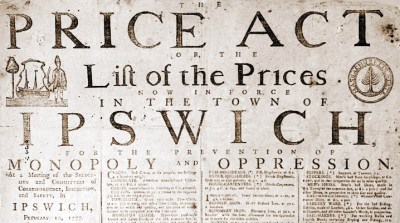 The Price Act, Passed at Ipswich, February 1777 - In 1777, the Ipswich Selectmen and the Committee of Correspondence and Safety, acting under the authority of the General Court, issued a schedule of prices covering all articles of food, clothing, wages of labor of every kind, entertainment at hotels, shipping rates etc.… Continue reading The Price Act, Passed at Ipswich, February 1777
  The Newburyport Tea Party - When Parliament laid a tax on tea, the British locked all the tea that had arrived in Newburyport into the powder house. Eleazer Johnson led a group of men who shattered the door and burned the tea in Market Square.… Continue reading The Newburyport Tea Party
  The Intolerable Acts of 1774 - Despite the failure of the Stamp Act and the Townshend Acts, the British Parliament responded to the "Boston Tea Party" by passing even more restrictive acts to punish the American extremists.… Continue reading The Intolerable Acts of 1774
  The Great Ipswich Fright, April 21, 1775 - A rumor spread that two British ships were in the river, and were going to burn the town. The news spread as far as New Hampshire, and in every place the report was that the regulars were but a few miles behind them, slashing everyone in sight.… Continue reading The Great Ipswich Fright, April 21, 1775
  The Arnold Expedition Arrives in Ipswich, September 15, 1775 - A memorial sits in the intersection between the South Green and the site of the former South Congregational Church in Ipswich. It reads, “The expedition against Quebec, Benedict Arnold in command, Aaron Burr in the ranks, marched by this spot, September 15, 1775."… Continue reading The Arnold Expedition Arrives in Ipswich, September 15, 1775
 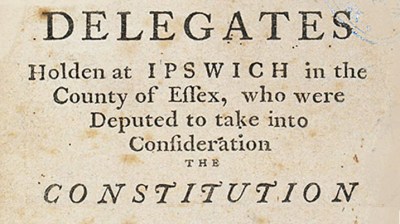 The 1778 Ipswich Convention and the Essex Result - Delegates from 67 towns arrived in Ipswich on Tuesday, Sept. 6, 1774 "to consider and determine on such measures as the late acts of Parliament" and declaring support for a Provincial Congress. They reconvened four years later to debate a draft constitution for Massachusetts. … Continue reading The 1778 Ipswich Convention and the Essex Result
  The 1774 Ipswich Convention “To Consider the Late Acts of Parliament” - Notifications were posted in Salem to gather at the Town House to appoint representatives to meet at Ipswich, on September 6, 1774 along with the representatives of the other towns in the county, to consider "to consider and determine on such measures as the late acts of Parliament, and our other grievances render necessary and expedient."… Continue reading The 1774 Ipswich Convention “To Consider the Late Acts of Parliament”
  The “Detested Tea” and the Ipswich Resolves - On Dec. 16, 1773, the tea brought into Boston harbor was thrown into the sea. A week later, Ipswich citizens met in the most violent mood, and adopted a series of resolutions,… Continue reading The “Detested Tea” and the Ipswich Resolves
  The “Commonwealth” - "Commonwealth" is defined as a state in which authority is vested in the citizenry. In the 17th Century it was the radical philosophy the work and the proceeds thereof should be shared by the people.… Continue reading The “Commonwealth”
  Shay’s Rebellion - On the last Tuesday of August, 1786 some 1500 armed insurgents took possession of the Northampton Court House, initiating a brief war known as Shay's Rebellion.… Continue reading Shay’s Rebellion
  Reply by the Town of Ipswich to the Boston Pamphlet, December 28, 1772 - A document known as the “Boston Pamphlet” was distributed throughout the colony, asserting the colonists’ rights. Ipswich held a Town Meeting, established its own “Committee of Correspondence," passed a series of resolves, and gave instructions to their reresentative in the General Court, Michael Farley.… Continue reading Reply by the Town of Ipswich to the Boston Pamphlet, December 28, 1772
  Prosecution of Loyalists in Essex County - An angry mob surrounded the Haverhill home of Col. Richard Saltonstall, a Loyalist, who opened his door and stated that that he was bound to discharge the duties of the office.… Continue reading Prosecution of Loyalists in Essex County
 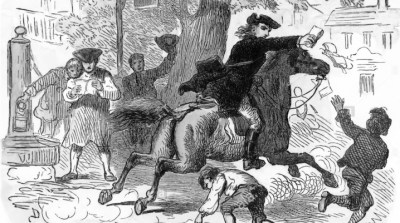 Paul Revere’s Not So Famous Ride Through Ipswich, December 13, 1774 - On the cold icy morning of December 13, 1774, Paul Revere headed out on a 60 mile gallop from Boston along the Old Bay Road through Ipswich to warn the citizens of Portsmouth that British troops may be landing.… Continue reading Paul Revere’s Not So Famous Ride Through Ipswich, December 13, 1774
  Old Toryism, Mock Federalism & the Essex Junto - Baptist minister "Citizen Pottle" gave a toast, "To the Venerable Town of Ipswich. May it be purged of all old Toryism and mock Federalism." As the other ministers were indeed Federalists, his toasts aroused suspicion that the whole celebration was a spirited demonstration of Baptist enthusiasm.… Continue reading Old Toryism, Mock Federalism & the Essex Junto
 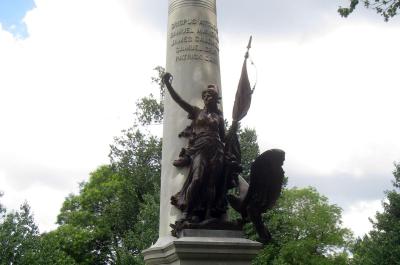 Memorial to Crispus Attucks - The following is an excerpt from a presentation given on November 14, 1889, at the dedication of the Boston Massacre and Crispus Attucks Monument at Boston Common, which memorializes victims Crispus Attucks, Samuel Maverick, James Caldwell, Samuel Gray, and Patrick Carr. ADDRESS BY MR. JOHN FISKE The troubles and disorders in Boston, which led to… Continue reading Memorial to Crispus Attucks
  Madame Shatswell’s Cup of Tea - Madame Shatswell loved her cup of tea, and as a large store had been stored for family use before the hated tax was imposed, she saw no harm in using it as usual. News of the treason spread throughout the town.… Continue reading Madame Shatswell’s Cup of Tea
  Lieutenant Ruhama Andrews and the 1775 Battle of Quebec - On Christmas Day 1823, Gen Benjamin Pierce of Hillsborough, NH held a reunion of twenty-two citizens who had served in the War of Independence. The oldest attendee was Ammi Andrews, born in Ipswich, MA, aged 89 years.… Continue reading Lieutenant Ruhama Andrews and the 1775 Battle of Quebec
  Leslie’s Retreat, or How the Revolutionary War Almost Began in Salem, February 26, 1775 - In our struggle for Independence, the British military received its first setback from the inhabitants of Salem in an episode that could not have been more ludicrous or entertaining if it had been written for Monty Python. … Continue reading Leslie’s Retreat, or How the Revolutionary War Almost Began in Salem, February 26, 1775
 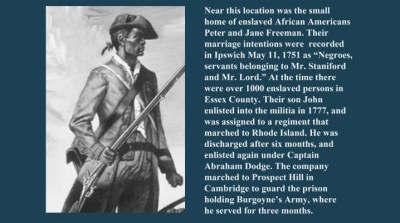 John Freeman, an African American Revolutionary War Soldier from Ipswich - John Freeman, son of enslaved Peter and Jane Freeman of Ipswich, enlisted into the militia of the Revolutionary War in the year 1777, and served in Rhode Island, Providence and Cambridge.… Continue reading John Freeman, an African American Revolutionary War Soldier from Ipswich
 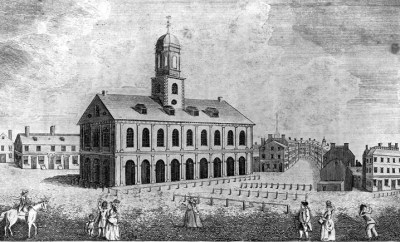 Ipswich Voters Unanimously Support the Massachusetts Circular Letter, February 11, 1768 - The voters of the Town of Ipswich resolved on August 11, 1768, that "Thanks be given to the worthy and much esteemed ninety-two gentlemen of the late Honorable House of Representatives for their firmness and steadiness in standing up for and adhering to the just rights and Liberties of the Subjects when it was required of them at the Peril of their political existence."… Continue reading Ipswich Voters Unanimously Support the Massachusetts Circular Letter, February 11, 1768
 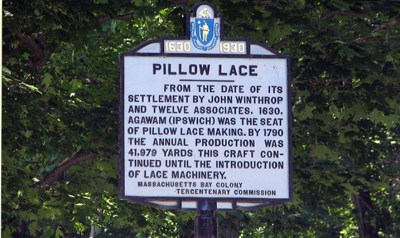 Ipswich Pillow Lace - In the late eighteenth century, Ipswich had 600 women and girls producing more than 40,000 yards of lace annually. Ipswich industrialists imported machines from England to mechanize and speed up the operation, which destroyed the hand-made lace industry. … Continue reading Ipswich Pillow Lace
 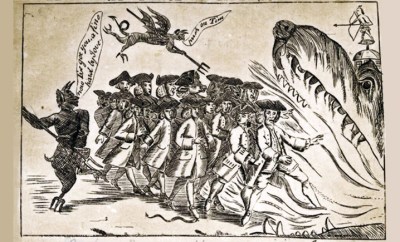 Ipswich Mob Attacks Loyalist Representative Dr. John Calef - Dr. John Calef was among a handful of members of the Massachusetts Assembly who voted to retract the "Massachusetts Circular Letter" which was adopted in response to the 1767 Townshend Acts. Ipswich citizens' anger at Calef lingered as war with England approached.… Continue reading Ipswich Mob Attacks Loyalist Representative Dr. John Calef
  Ipswich and the American Revolution: The Breach with Britain - In John Adams’ 1765 opposition to the Stamp Act, he referenced the citizens of Ipswich who resisted a tax imposed by the Crown in 1687. An Ipswich town meeting on August 11, 1768 approved of "the Conduct of those Gentlemen of the late House of Representatives...when it was required of them at the Peril of their Political Existence." The Town meeting on Dec. 28, 1772 supported the rights of the Colonists as British subjects, and established a Committee of Correspondence to communicate resistance with the Committees of other towns. Delegates from throughout Essex County arrived in Ipswich on Tuesday, Sept. 6, 1774, and by unanimous vote, bound themselves together in establishment of the Provincial Congress for the common safety.
… Continue reading Ipswich and the American Revolution: The Breach with Britain
Ipswich and the American Revolution: The Breach with Britain - In John Adams’ 1765 opposition to the Stamp Act, he referenced the citizens of Ipswich who resisted a tax imposed by the Crown in 1687. An Ipswich town meeting on August 11, 1768 approved of "the Conduct of those Gentlemen of the late House of Representatives...when it was required of them at the Peril of their Political Existence." The Town meeting on Dec. 28, 1772 supported the rights of the Colonists as British subjects, and established a Committee of Correspondence to communicate resistance with the Committees of other towns. Delegates from throughout Essex County arrived in Ipswich on Tuesday, Sept. 6, 1774, and by unanimous vote, bound themselves together in establishment of the Provincial Congress for the common safety.
… Continue reading Ipswich and the American Revolution: The Breach with Britain  Ipswich and the American Revolution, Part 2: The Revolutionary War - On June 10th, 1776, the men of Ipswich, in Town-meeting assembled, instructed their Representatives, that if the Continental Congress should for the safety of the said Colonies Declare them Independent of the Kingdom of Great Britain, they will solemnly engage with their lives and Fortunes to support them in the Measure.… Continue reading Ipswich and the American Revolution, Part 2: The Revolutionary War
  General Michael Farley - In 1774, the Town of Ipswich chose Michael Farley, a tanner, as a delegate to the Provincial Congress. He was appointed major-general of the Militia of Massachusetts in 1777. Farley is buried at the Old North Burying Ground beside his wife Elizabeth. The site of his home is now the Richdale store on Market St..… Continue reading General Michael Farley
 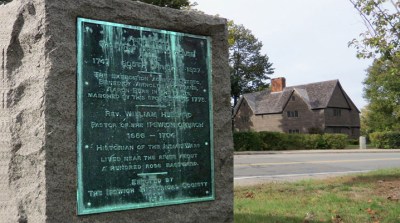 Benedict Arnold and the Fate of the American Revolution - In September 1776, the vulnerable Continental Army under George Washington evacuated New York after a devastating defeat by the British Army. One of Washington’s favorite generals, Benedict Arnold, miraculously succeeded in postponing the British naval advance down Lake Champlain that might have ended the war. Thomas Franklin Waters wrote about Arnold’s march through Ipswich on the way to Quebec “The… Continue reading Benedict Arnold and the Fate of the American Revolution
 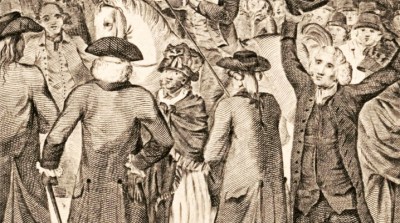 April 29, 1783: How Ipswich Celebrated the End of the Revolutionary War - The manner in which residents of Ipswich celebrated the end of hostilities was recorded in "The Life, Journals and Correspondence of Rev. Manasseh Cutler."… Continue reading April 29, 1783: How Ipswich Celebrated the End of the Revolutionary War
  Account of the Soldiers of Chebacco Parish at Bunker Hill - Of the men from Chebacco parish who were in the battle at Bunker Hill, the names of six are known: James Andrews, Benjamin Burnham, Nehemiah Choate, Aaron Perkins, Jesse Story Jr., a minor who was killed, and Francis Burnham who was wounded. Two Chebacco boys, Aaron Low and Samuel Proctor, belonged to a Gloucester company which reached Cambridge on the afternoon of the 16th.… Continue reading Account of the Soldiers of Chebacco Parish at Bunker Hill
  A Revolutionary Guest: John Adams’ Letters From Ipswich - John Adams visited Ipswich many times during his tenure as the Boston representative to the colonial legislature from 1770 to 1774.… Continue reading A Revolutionary Guest: John Adams’ Letters From Ipswich
  “A State of Nature”, Worcester in 1774 - "In Worcester, they keep no Terms, openly threaten Resistance by Arms, have been purchasing Arms, preparing them, casting Ball, and providing Powder, and threaten to attack any Troops who dare to oppose them....the flames of sedition spread universally throughout the country beyond conception.” -Gen. Thomas Gage… Continue reading “A State of Nature”, Worcester in 1774
 Historical Nerdery
Journal of the American Revolution
 Historic Ipswich
Gordon, Does Volume 2 of Ipswich in the MA Bay Colony say anything about the clock in the First Cgurch? Any clocks mentioned ?
Just a bit at https://archive.org/stream/ipswichinmassac00wisegoog#page/n462/mode/2up/search/clock