

*Above: “Attempt to Veer” by Nicholas Pocock
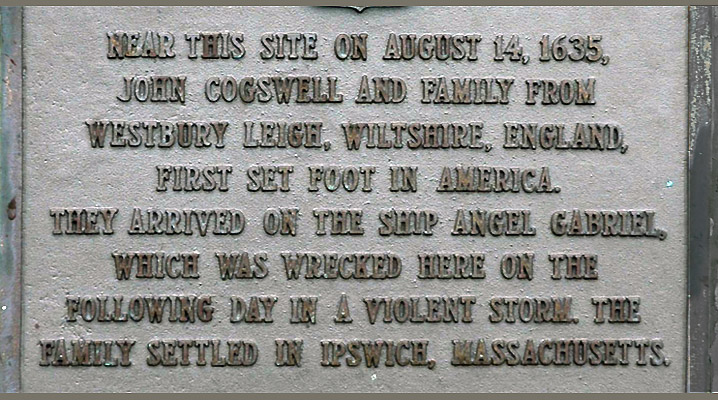
On the last Wednesday of May 1635, the Angel Gabriel, a 240-ton ship, set out from England, bound for New England. The ship had been commissioned as the Starre for Sir Walter Raleigh’s last expedition to America in 1617. It was stout and built for combat, armed with 16 guns, but on this final journey, it would cross paths in August with the most intense hurricane in New England history.
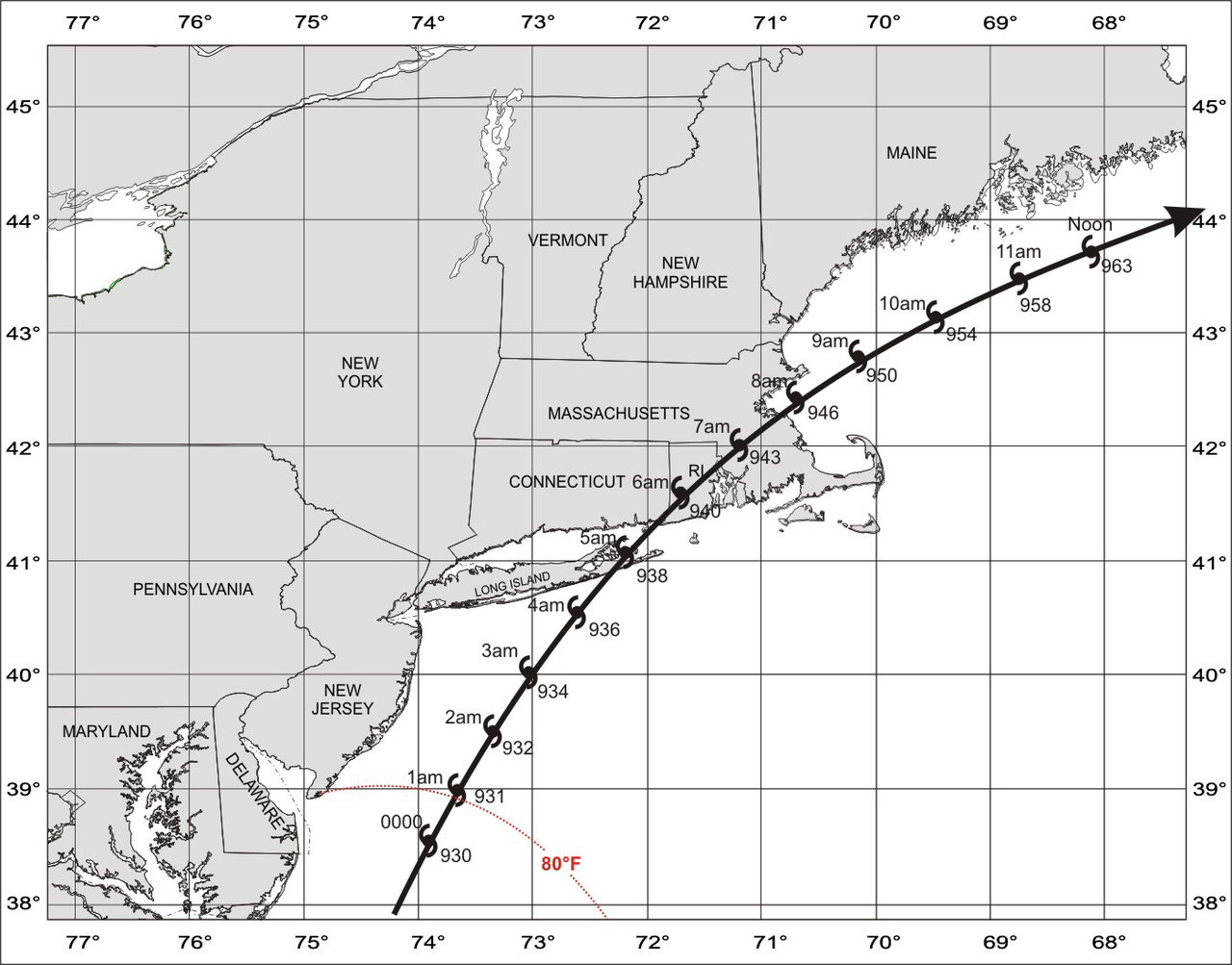
Alan Dunham of the National Weather Service office in Taunton reviewed accounts from mariners and settlers of New England and pieced together an estimated storm track and surge pattern for the Great Colonial Hurricane of Aug. 25-26, 1635, which reportedly “caused ye sea to swell about 20 foote,” and had the highest storm surge in recorded U.S. history. Many ships and lives were lost, including 21 passengers who had set out from Ipswich on August 21, 1635, on a small bark named “Watch and Wait.”
The Angel Gabriel was captained by Robert Andrews of Norwich, Norfolk County, England, and was joined on the journey by the James, the Elizabeth (Bess), the Mary, and the Diligence. As they approached the North American coastline, the unusually powerful early-season hurricane struck. The Category 3 hurricane was moving faster than 30 mph with maximum winds of 130 mph. The three smaller ships were bound for Newfoundland and outran the storm, safely reaching their destination.
The larger and heavier James and the Angel Gabriel were on a course for New England. The James anchored off the Isle of Shoals, but all three anchors were lost. It managed to limp into Boston two days later, its sails ripped apart, with all one hundred-plus passengers surviving. The Angel Gabriel took refuge in Pemaquid Bay, and most of its passengers managed to disembark before the ship broke apart and sank with the loss of several lives. A bark commanded by Captain Gallop made several trips to Boston, transporting the survivors, many of whom made their way to Ipswich and became prominent founding members of the community. A new commemorative plaque was installed at Pemaquid in 2010.
Deposition taken in Massachusetts court on December 1676 by William Furber, servant of William Cogswell
” This Deponent testiiyeth and saith, that in the year of our Lord 1635, I the said Deponent did come over in the ship (called the Angell Gabriel) along with Mr. John Cogswell Sen’, from Old England, and we were cast ashore at Pemnayquid ; and I doe remember that there was saved several Casks both of Dry Goods and Provisions which were marked with Mr. Cogswell Sen. Marks and that there saved a tent of Mr, Cogswell Senior which he had set up at Pemnaquid, and Lived In it (with the goods that he saved in the wracke) and afterwards Mr. Cogswell Removed to Ipswich; And in November after that was cast away I the said Deponent Came to Ipswich and found Mr. Cogswell, Sen. Living there, and hired myself with him for one year; I the said Deponent doe well remember that there were several feather beds and I together with Deacon Haines as servants lay upon one of them, and there were several dozen of pewter platters, and that there were several brass pans besides other pieces of pewter and other household goods as Iron Worke and others necessary as for house Repairing and have in the house then. I the said Deponent doe further testify that there were two maires and two Cows brought over in another ship which were landed safe ashoare and were kept at misticke till Mr. Cogswell had y’, I doe further testify that my maister, John Cogswell Sen., had three sons which came over along with us in the ship (called the Angell Gabriel) the Eldest sonnes’ name were William, and he were about fourteen yeares of age, and the second sonne were called John and he was about twelve years of age then, and the third Sonne name were Edward which was about six years of age at that time, and further saith not.” (Source: Ten Years at Pemaquid)

Cogswell, Burnham, and Andrews
The principal passenger was John Cogswell from Westbury Leigh, Wiltshire, born in 1592. He was a man of wealth and standing, married to Elizabeth Thompson, a daughter of the Vicar of Westbury parish. They embarked with eight of their nine children on the Angel Gabriel, accompanied by his servants and many of their belongings, for the new settlement at Ipswich. Cogswell and his family were swept from the deck and washed ashore, and more than £ 5,000 worth of property, including cattle, furniture, and money, was lost to the sea. Cogswell and his family were eventually transported to Ipswich, where he acquired a sizable estate in an area called Chebacco, which is now Essex. A house on that property, Cogswell’s Grant in Essex, is owned by Historic New England and is open to the public. Cogswell’s reputation and his comparative wealth gave him a leading position in the town.

Also among the survivors of the Angel Gabriel who managed to eventually reach Ipswich were Deacon John Burnham, Robert Burnham, and Lt. Thomas Burnham, who was made Selectman in 1647 and was Deputy to the General Court from 1683 to 1685. In 1667, he was granted the right to erect a sawmill on the Chebacco River near the falls. He owned land both in Chebacco and in Ipswich, which was divided between his sons Thomas and James upon his death. Read more in “The Cogswells in America” and the Cogswell Family Association.
John Burnham was the eldest of the three brothers who came in 1635 and was one of the first two deacons of the first church. He was an uncle of John Burnham, who owned a sawmill at the Falls and father of John Burnham Jr., who, as late as 1693, was granted liberty to set up a Grist mill on the Chebacco River at the launching place.
One of the many historic properties associated with this family is the Burnham-Patch House at 1 Turkey Shore Road in Ipswich. Although it dates to the 1730s, it appears to have been built on the floor plan of an earlier house from the 1670s. Heavy quarter-round chamfered framing timbers in the cellar provide evidence of the earlier structure. The large ell on Poplar Street was added in the early nineteenth century. The Burnham Patch house and the Heard-Lakeman dwelling across the street have two of the original covenants established with the Ipswich Historical Commission, featured in the book “Something to Preserve.”

The David Burnham House on Pond Street in Essex is said to have been built c. 1684 by David Burnham, son of Thomas Burnham, and remained in the Burnham family for almost 150 years. It was the subject of restoration work in the early 20th century by the Essex Institute under the auspices of George Francis Dow. The kitchen fireplace was the largest known to have been uncovered in Essex County at that time.
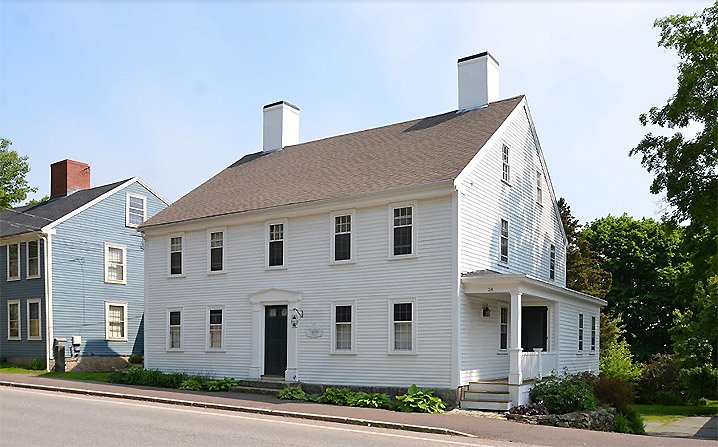
Captain Robert Andrews and his three nephews, who had accompanied him, also settled in Chebacco. Land records from 1635 show that his house lot adjoined the properties of Thomas Firman, John Perkins Jr, John Cross, Richard Hoffield, and Thomas Hardy. Andrews apparently decided he was through with the maritime industry, and was allowed to sell wine by retail, “if he do not wittingly sell to such as abuse it by drunkenness.” His son, Corporal John Andrews, lived for a few years on High Street in Ipswich, where he operated the White Horse Inn.
Also among the survivors was John Tuttle, age 17, who settled in what is now Dover, New Hampshire, where he became known to locals as “Shipwreck John Tuttle.” There is a local tradition that he walked there from Pemaquid after the shipwreck. It is unknown if he was related to John Tuttle, who arrived on the ship Planter in 1638 and settled in Ipswich, and whose son, Simon Tuttle probably built a portion of the Tuttle-Shatswell House, which still stands on High Street.
Sources and Further Reading
- Wreck of the Watch and Wait
- The Great Colonial Hurricane (Miner descent)
- The Journal of Richard Mather
- The Cogswells in America
- New England Historical Society
- History of Essex County
- Samuel Haines
- Passenger List for the Angel Gabriel
- Richard Mather’s Journal
- Angel Gabriel: The Elusive English Galleon, passenger list
- Cartland, John Henry: Ten years at Pemaquid; sketches of its history and its ruins
- Furber Clan: Deposition of William Furber
 Historic Ipswich

How did you (or others) determine the names of the people on this ship? My understanding is that there is no contemporaneous record that actually names them (or that names who captained the ship). Related: Robert Charles Anderson in his Great Migration profile of Robert Andrews of Ipswich indicated it would have been impossible for Robert (who took the oath of loyalty on 6 May 1635 in New England) to have been on a ship that was sitting off the coast of England on 26 May 1635.
I’m an ancestor of Shipwreck John Tuttle. What a guy
i was doing my family tree research and seen i was an ancestor to Robert Andrews and seen a document on ancestry.com that showed he had family who survived the hurricane and the hurricanes date was 8/14-8/15 1635 on it. It’s actually a copy of a will
The British Empire was still using the Julian Calendar. When they adopted the Gregorian Calendar, ten days were dropped, making the modern date of the hurricane 8/24-25.
that makes sense, thank you
They were also my ancestors.. my great grandfather is a cogswell..long line of history.
I Robert Bailey am a descendant of the John Bailey’s and 2 great grandfathers and grand uncle
I am the granddaughter of John Bailey Sr. There was a brother James Bailey too when they moved to Georgia.
Penny Bailey Rehme
I am John Bailey, son of Douglas Bailey, who was the son of Jonathan Jackson Bailey Jr, who was the son of Jonathan Jackson Bailey Sr, who was the son of Elijah Riley Bailey, who was the son of David Hudson Bailey, who was the son of Henry Bailey, who was the son of David Bailey Jr, who was the son of David Wallis Bailey, who was the son of David Bailey, who was the son of Patrick Bailey, who was the son of Robert Bailey, who was the son of John Bailey Sr who arrived in 1635 on the Angel Gabriel. Whew! Nice to meet you!
My Grandfather Samuel Haines was on the ship. He has a history of being apart of many political decisions setting up towns.
I would love his history to also be considered in your history of living family members.
John Cogswell and Elizabeth Thompson are my 9th great-grandparents. 🙂
John and Elizabeth Cogswell were my 9th great grandparents, as well. Their daughter, Hannah, married Cornelius Waldo.
I am also descended from the Cogswells’ daughter Hannah. At the museum at Colonial Pemaquid, there is a trunk that washed ashore after the hurricane which belonged to John Cogswell. I didn’t realize it until I saw a photo of it that my daughter took. Now I want to go back to Pemaquid to see what else is there, I just haven’t had time.
They were my 9th great grandparents, as well. Hannah married Cornelius Waldo my eight great grandparents
cornelius’s daughter Deborah married a Ford which is my 8th great grandmother and then my grandma married a daily.
My maternal grandfather, David Randall Burnham (1894-1964) was born in Essex, Massachusetts. He was a direct descendant of Thomas Burnham, who arrived on the Angel Gabriel. There are still Burnhams in the area, my first cousin, who lives in Magnolia, being one of them. Although I have lived more than half my life in California, I’m still a proud New Englander!
Looks like I’m not the only descendant of Thomas Burnham out here in California my great grandmother on my fathers side was Rosanna Burnham Locke. Good to see another proud New Englander with deep roots!