
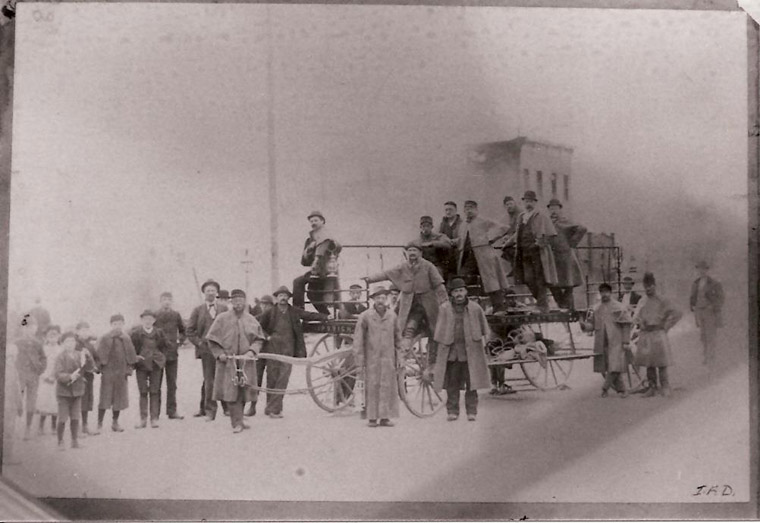
In 1642, it was ordered that every Ipswich householder shall have a ladder in constant readiness for fire. For the next 150 years, the town relied on the men in town to hurry to the alarm with buckets to save people and goods, and to fight the fires.
In 1785, fire wardens were chosen to create an organized system. Ten men of mature years were elected, some of them trained to take command on the battlefields of the Revolution, and represented various sections of the Town, including two in Chebacco and two in the Hamlet. Fire clubs were organized about 1800.
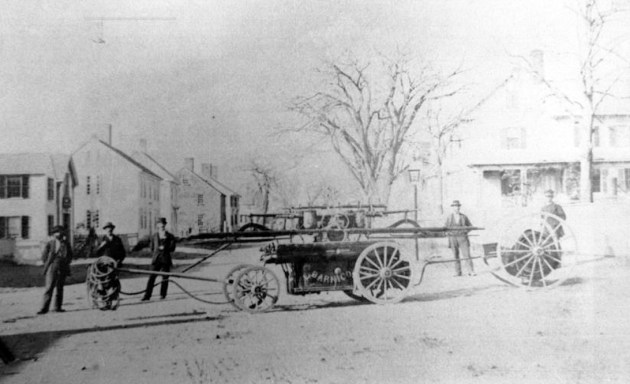
The first fire engine was bought in 1803 by subscription in the First and South Parishes, which provided an engine house. Four fire hooks with chains were provided by the Town in 1808, two for the company in the center of Town, one for Chebacco, and one for Linebrook. A State law was adopted in 1834, allowing all who served as enginemen to have their poll taxes abated.
The engines at that time were diminutive and had no suction hose. Water was poured into the “tub,” as it was always called, by hand buckets, and a small length of hose shot the stream to the fire. Every member had two leather buckets, and on the alarm, he seized his buckets and a large canvas bag and hurried to the fire. The bags were used to save small articles in the homes. The members of the club and other citizens generally formed two lines, one passing the full buckets from the nearest well, the empty ones returning by the other line. Every bucket bore the name and number of the owner, so that they could be identified after the fire was extinguished.

Engine Company No. 2
The Selectmen were instructed on 13 March 1821 to purchase a fire engine, and on 17 January 1822, the Ipswich Fire Engine Company No. 2 was organized, adopting the rules of company No. 1. The engine’s name, Go-Ahead, was changed to Agawam on 8 November 1845. Another engine was provided by 1830.
As Engine No. 1 was out of repair in 1832, the Town instructed its Committee to sell it and buy a new one, with about 60 feet of extra hose, at a price not exceeding $300. The Town of Ipswich purchased the Union fire engine from Manchester. The name was changed on 24 November 1845 to Masconnomet, first of several fire trucks to bear that name. This engine was kept at the Old Town Hall on South Main Street.
The engine houses were only 8 feet wide and 12 feet long, affording very little room for the engine and its equipment, with no room for cleaning and drying the hoses. Companies had to meet outdoors or in a public house. The Town appropriated $300 in 1837 to expand the size of the buildings that housed its fire trucks.
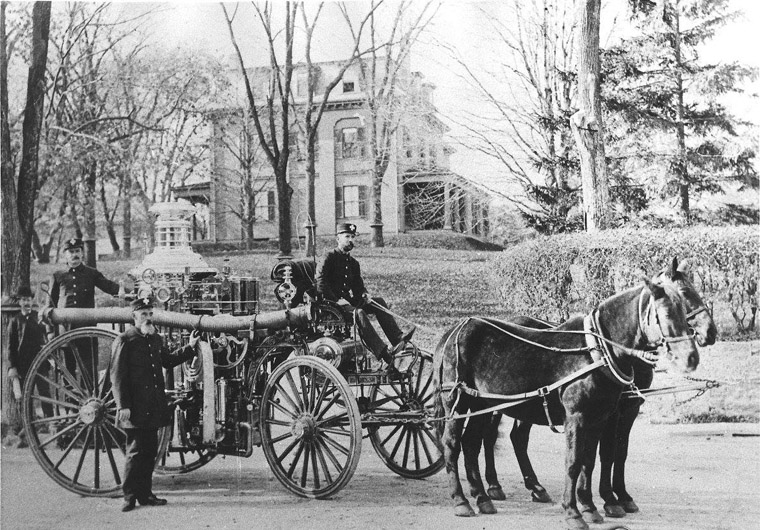
A Committee was appointed on August 18, 1845, to repair the old engines and purchase a new suction engine, and on December 28, 1846, another Committee was chosen to build an engine house near the Town House large enough to allow for hooks and ladders. The report of the Committee, read at the March meeting, 1848, included a new Thayer suction engine, purchased complete for $550.00. Her company was organized on 1 May 1846.
In 1863, the Selectmen were authorized to replace one of the old machines with a new one, and in the following year, they were instructed to consider the expediency of purchasing a steam fire engine. The Warren engine was purchased in October 1864 for $1200, second-hand from Roxbury.
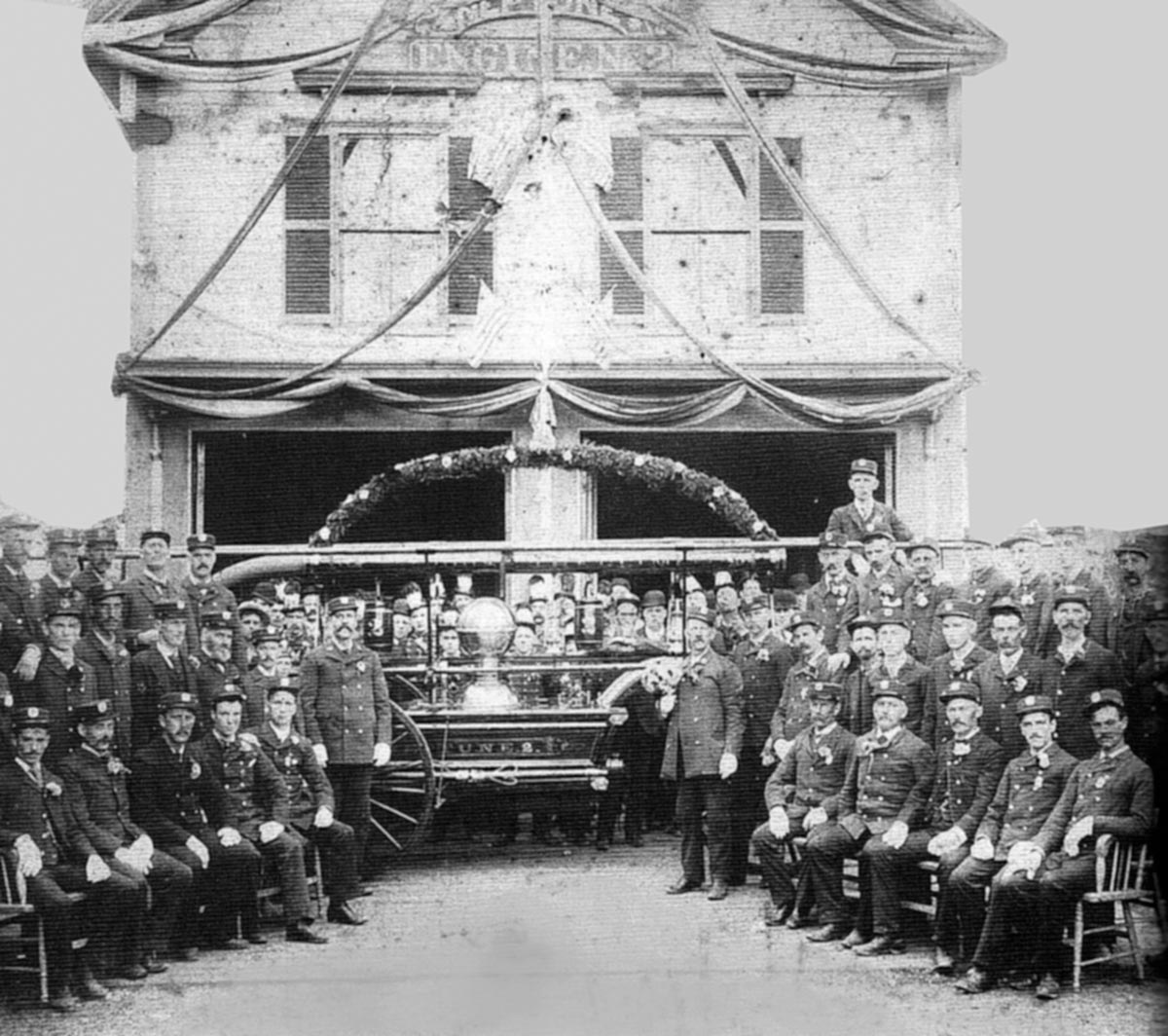
The Lord’s Square Fire Station
The deserted yellow building at Lords Square between Dunkin Donuts and the laundromat was constructed between 1865 and 1872, and once served as one of the town’s three fire stations, housing engine #2, the Neptune, and the town’s first motorized fire truck, Hose 2. The fire station had a bell tower in the front and a tall hose-drying tower in the rear. The “Neptune” was the town’s “hand tub” fire engine housed in this building. Neptune #8 was built in 1878 by Button Fire Engine Works and was first owned by the Newburyport Fire Department. In 1889, the Button engine was sold to Ipswich and was re-numbered Neptune #2. It took 20 men to operate the pump on the Neptune.

The Warren Fire House
In 1884, Edward W. Choate contracted with the town to build a firehouse for $1250.00 on Warren St., on land purchased from Ann Mitchell.
In 1888, the fire department consisted of the Board of Engineers; the Warren engine, housed on Warren Street with a company of fifty men; the Barnicoat engine and a company of fifty men; the Candlewood engine; and the hook and ladder company of twenty men based at the Old Town Hall. Volunteer fire departments were very competitive with each other.
In 1895, the Warren and Neptune Companies were disbanded because the hand engines were no longer needed. The new Masconomet steamer has been purchased at a cost of $3200. The Warren engine was sold for $280.00 the following year, and the top floor of the Warren Street Firehouse was converted to use for school classrooms.
A vote of thanks to Gen. William Sutton was passed by the March meeting in 1873 for his munificent gift of a Hook and Ladder Truck. In April 1886, a thousand dollars was appropriated for the Barnicoat Engine, and the same sum was voted in 1888 for the Torrent engine and its house in Candlewood.

The Candlewood Torrent Fire Engine
The residents of the Candlewood District petitioned for an engine in March 1839, which was approved. In June 1888, the town purchased from Newburyport their Torrent fire engine for $250 and stationed it in the Candlewood district. It was built by Jeffrey of Pawtucket, R. I., and resembled the Warren in its action. Her engine house was built, and the engine was installed.
Water Supply
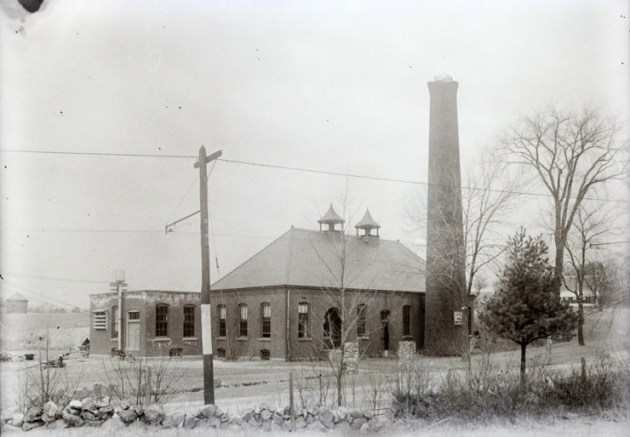
The need for a proper water supply began to be considered in 1872. The fire engines were dependent on the river, whenever it was within reach, or the large fire cisterns, filled with surface water, located at convenient places in the more thickly settled portions of the Town, and on wells, where no larger source of supply was available. The wells were quickly exhausted, and the cisterns afforded only a limited supply. A Committee was appointed on March 18, 1872, to investigate the practicability of taking water from Baker’s Pond, so called, constructing a reservoir on Town Hill, and laying a pipe to the foot of the hill on High Street, of sufficient capacity to supply branch pipes, connecting with small reservoirs at other localities. An appropriation of $200 was made to provide for the expense of surveys. No further action was taken.
The need for a proper supply of water for the Town for fighting fires and other purposes had become so evident that by vote of the Town on March 4, 1889, the Selectmen were instructed to petition the General Court for permission to take water from Hood’s or Pritchett’s Pond, which was amended on April 22 to include any source from which water might be obtained. The Legislature passed an Act giving the Town authority to proceed, which was accepted on Sept. 14, 1889. A Water Act was passed by the Legislature on May 23, 1890, but the Town meeting voted that any action be indefinitely postponed. Another meeting was called on Sept 29, which failed to secure a two-thirds vote. The article was placed on the warrant in January 1891, May 1892, and November 1892, each barely failing to get the necessary two-thirds vote.

1894 Fires
As the time for acceptance under the provisions of the Act of 1890 had now expired, the Town voted on Jan. 31, 1893, to petition the Legislature to continue the Act in force for three additional years, which the Legislature approved on March 29, 1893. Opposition had ceased almost entirely, as 660 votes were cast, 472 being in favor.
On January 13, 1894, the commercial block of Central Street went up in flames. The Torrent was the first hand-pump engine to arrive, but the tub was frozen. The volunteer firemen from the Lords Square station assisted the other two pumpers when they arrived, but every building from Market Street to Wilde’s Court was lost in the fire.
At the Town meeting on March 19, 1894, shortly after the destructive fire in Central Street, it was voted that the Town buy a steam fire engine, and $3500 was appropriated.
On April 17, the Damon block at the other end of Market Street burned down. Water Commissioners were chosen on April 23, and Dow’s Brook was decided upon as the source of supply, with an emergency use of Bull Brook. The construction work was done rapidly, and an exhibition of the power and adequacy of the hydrant service was made on Thanksgiving Day, 1894.
The Central Street Fire Department
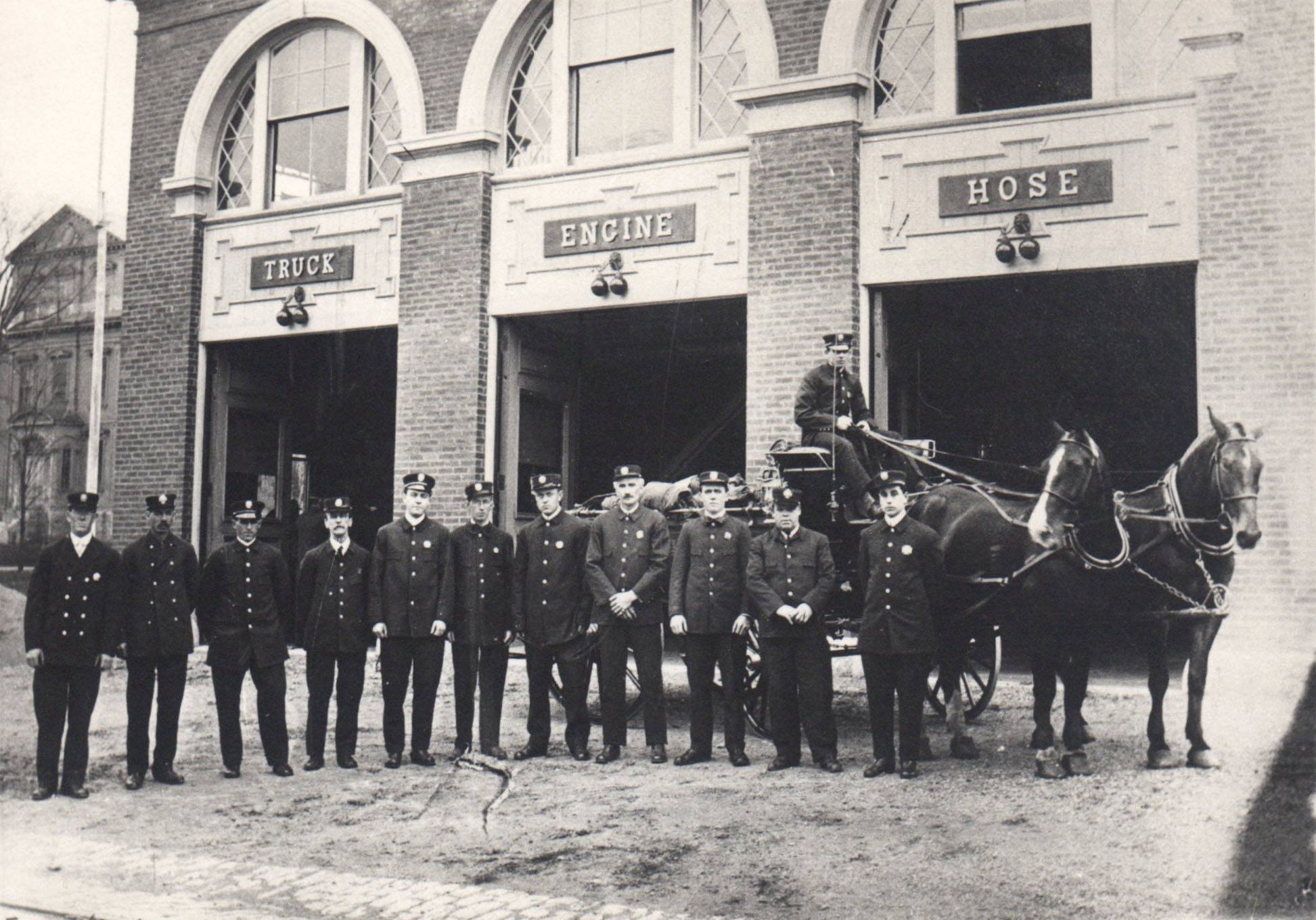
The fire station on Central Street in Ipswich was built in 1907, replacing the firehouse at Lord’s Square. Originally built for horse-drawn equipment, it took over the work of the smaller departments at the Old Town Hall, Warren St., Candlewood Rd., and several other locations in town when it became motorized. For over a century, the building has served as the town’s continuously-staffed fire station. In 1988, Anne Killeen and Anne Keraghan became our first female firefighters.
Sources and Further Information
- Waters, Thomas: Ipswich in the Massachusetts Bay Colony Vol. 2: Fire Department
- The Agawam Manual and Directory: Fire Department
- 4 Lords Square, Old Firehouse (c. 1870)
- 11 Warren Street, the Old Warren Fire House and School (1884)
- The Central Street Fire House
- 1894: The Year that Ipswich Burned
- Felt, Joseph: History of Ipswich, Essex, and Hamilton
 Historic Ipswich
This is great, Gordon! Thank you. Sent from my iPhone