
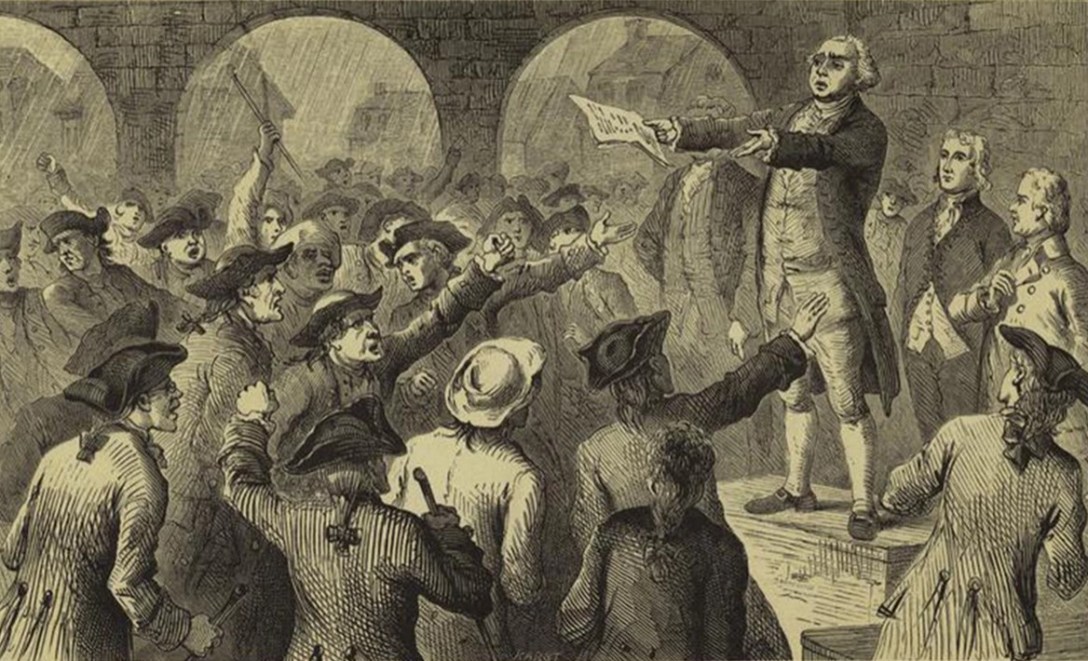
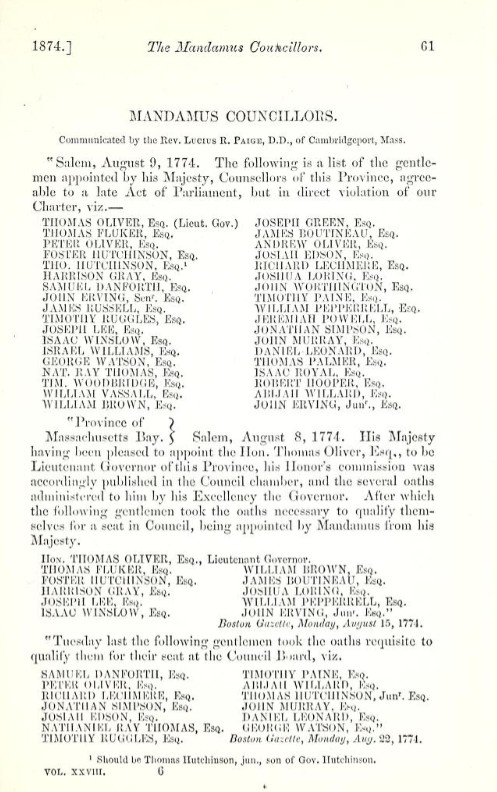
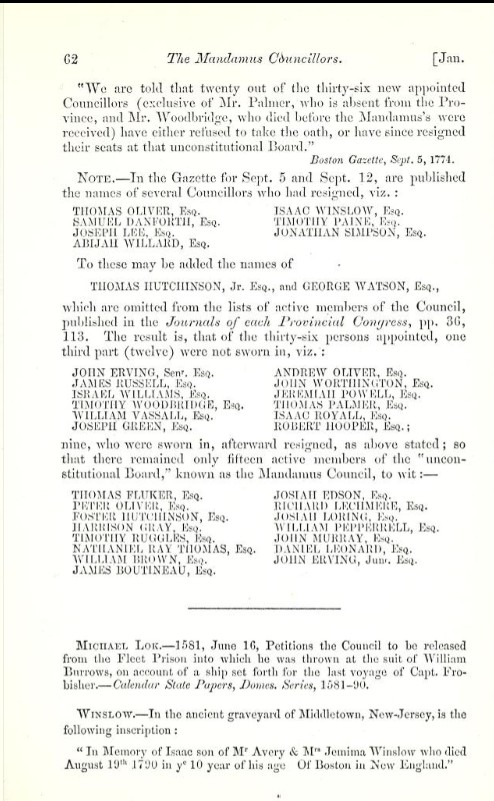
One of the most hated Intolerable Acts, the Massachusetts Government Act of May, 20, 1774, ordered that on August 1 of that year, the upper house of the legislature would be replaced by thirty-six new members appointed by Governor Thomas Gage, on a “royal writ of mandamus.” The new councilors became marked men when their names were published by the resistance. Twenty-five men accepted the appointment, but nine of them soon resigned. The sixteen remaining councilors were forced to take refuge in Boston under the protection of the British army.
Thomas Franklin Waters wrote, “When the list of councilors appointed by the King was received in August, the popular indignation now burst all bonds. At Worcester, two or three thousand citizens went to the house of Hon. Timothy Paine, a member of this body, and obliged him to read his resignation in person with his hat off. They marched then to Rutland and waited on Hon. John Murray. The governor issued a proclamation forbidding a town meeting in Boston and ordered the Committee of Correspondence to disperse the people. He ordered out his troops. They marched to the town line, halted and loaded, and about eighty advanced to within one eighth of a mile of the Town House. But the meeting had transacted its business and dissolved.”
The appointment of the mandamus councilors and the governor’s order forbidding town meetings resulted in the Essex County Convention in Ipswich. Resolutions were adopted by unanimous vote, binding themselves to stand together in opposition to the Crown, demanding the resignation of officials holding office by Royal appointment, and declaring the Provincial Congress, soon to assemble, absolutely necessary for the common safety.
Thomas Oliver
Thomas Oliver, Esqr. of Cambridge was appointed by Governor Gage to the office of lieutenant governor. On September 7, 1774, a mob of four thousand armed men forced him to resign: “I found that I had been ensnared, and endeavored to reason them out of such ungrateful behavior. They gave such answers, that I found it was in vain to reason longer with them; I told them my first considerations were for my honor, the next for my life; that they might put me to death or destroy my property, but I would not submit…I proposed they should call in the people to take me out by force, but they said the people were enraged, and they would not answer for the consequences. I told them I would take the risk, but they refused to do it. Reduced to this extremity, I cast my eyes over the paper, with a hurry of mind and conflict of passion, which rendered me unable to remark the contents, and wrote beneath the following words: ‘My house at Cambridge being surrounded by four thousand people, in compliance with their commands, I sign my name, THOMAS OLIVER.'”
The Confiscation Act
Many loyalists, including multiple members of the Oliver family, were banished and their properties were confiscated. On April 30, 1779, the Massachusetts Legislature passed the Confiscation Act, “An Act to confiscate the estates of certain notorious conspirators against the government and liberties of the inhabitants of the late province, now state, of Massachusetts Bay”, which confiscated the properties of various loyalists, including former Mandamus Councilors:
“Whereas the several persons hereinafter mentioned, have wickedly conspired to overthrow and destroy the constitution and government of the late province of Massachusetts Bay, as established by the charter agreed upon by and between their late majesties William and Mary, late King and Queen of England, etc., and the inhabitants of said province, now state, of Massachusetts Bay; and also to reduce the said inhabitants under the absolute power and domination of the present king, and of the parliament of Great Britain, and, as far as in them lay, have aided and assisted the same king and parliament in their endeavors to establish a despotic government over the said inhabitants…Be it enacted by the Council and House of Representatives, in General Court assembled, and by the authority of the same, that (a list of thirty names) each and every of the persons aforenamed and described, shall be held, taken, deemed and adjudged to have renounced and lost all civil and political relation to this and the other United States of America, and be considered as aliens.”
Sources:
- The Historical and Genealogical Register No. CIX, January-March, 1874, pp. 61-62
- The Adams Papers, Letter to William Tudor
- Waters, Thomas Franklin: Ipswich in the Massachusetts Bay Colony, Vol. II
- Stark, James H.: The Loyalists of Massachusetts
Related articles:
- The Intolerable Acts of 1774
- Persecution of Loyalists in Essex County
- Ipswich and the American Revolution: The Breach with Britain
- The 1774 Ipswich Convention “To Consider the Late Acts of Parliament”
- The 1778 Ipswich Convention and the Essex Result
- Ipswich and the American Revolution, Part 2: The Revolutionary War
- The Revolutionary War Letters of Joseph Hodgkins and Sarah Perkins
- Evacuation Day, March 17, 1776
- Memorial to Crispus Attucks
- John Freeman, an African American Revolutionary War Soldier from Ipswich
- The Siege of Boston
- The Ipswich Minutemen at Bunker Hill, June 17, 1775
- Benedict Arnold and the Fate of the American Revolution
- The Battle of Gloucester, August 8, 1775
- April 29, 1783: How Ipswich Celebrated the End of the Revolutionary War
- Nathan Dane
- The Newburyport Tea Party
- Madame Shatswell’s Cup of Tea
- The “Detested Tea” and the Ipswich Resolves
- The Price Act, Passed at Ipswich, February 1777
- Leslie’s Retreat, or How the Revolutionary War Almost Began in Salem, February 26, 1775
- Paul Revere’s Not So Famous Ride Through Ipswich, December 13, 1774
- Lieutenant Ruhama Andrews and the 1775 Battle of Quebec
- “A State of Nature”, Worcester in 1774
Discover more from Historic Ipswich
Subscribe to get the latest posts sent to your email.

