
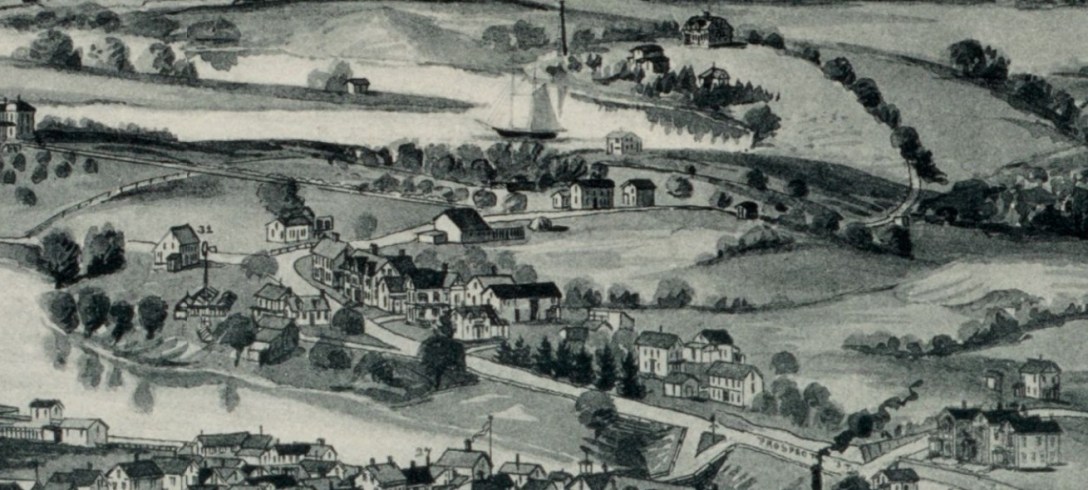
From the earliest times, the land along the south side of the riverbank was known as Turkey Shore, but no one knows why. In the mid-19th Century, it was given the “more proper” name of Prospect Street, but by the 20th Century it had regained its colorful original name.
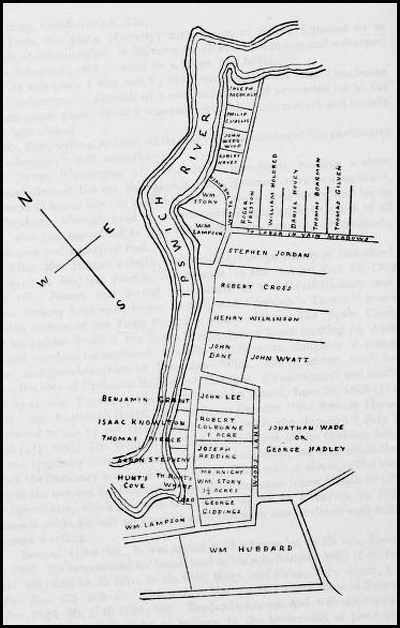
When Roger Preston arrived in Ipswich, he first purchased a lot along the river near what is now the intersection of Turkey Shore and Labor in Vain roads at or near where the Nathaniel Hodgkins house still stands. Thomas Franklin Waters noted that “evidently the neighborhood did not prove popular,” and by 1644 every lot had been transferred.
The corner of Poplar Street, and the section of Turkey Shore Rd. from Green St. to Labor in Vain have houses dating to the 17th and 18th Centuries. In the early years, the land from Poplar to Green Streets along the hillside was farmland, originally known as “Appleton’s Lot,” although it seemed to change hands frequently. In 1770, John Heard’s rum distillery, which later became a tannery, was constructed near the intersection with Poplar Street. Hunt’s Wharf, later known as Dodge Wharf, was nearby.
Very few houses are shown in the stretch between Poplar and Green Streets in the 1884 Ipswich map. Land on the hillside and along the riverbank began to be sold for development about the time that ships quit coming into the cove to the industries on County Street. The Green St. bridge was constructed in 1880 in response to demands from the residents on Turkey Shore, and wholesale development of a late Victorian neighborhood followed. Many of the current houses appear in the 1893 Birdseye map of Ipswich; construction of the new Turkey Shore neighborhood was almost complete in the 1910 village map.


Turkey Shore Road
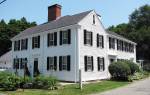
1 Turkey Shore Road, the Burnham-Patch-Day House c. 1670-1730 – This house has a preservation agreement with the Ipswich Historical Commission. The house was built by Thomas Burnham in 1730 on the foundation of the earlier house he bought in 1667. The large ell on Poplar Street was added in the early nineteenth century. Abner Day bought the house of the heirs of John Patch in 1814 and kept a well-known tavern.

2 Turkey Shore, the Heard – Lakeman House (1776) – Nathaniel and John Heard bought this land in 1776 and built the present house. Nathaniel sold the house to Richard Lakeman III in 1795. The house was added to the National Register of Historic Places in 1980, and has a preservation agreement with the Ipswich Historical Commission.

15 Turkey Shore Rd. (c. 1900) – The Queen Anne Free Classic style of the early 20th Century shares some of the characteristics of the more elaborate Queen Anne houses of the late 19th Century, but is a separate class style of architecture.

17 Turkey Shore, the John Edward Norman House (1895) – Capt. John E. Norman was lost at sea, only twenty-eight years old, leaving a widow and a young family. This house is presumed to have been built by his son, John E. Norman, 2nd.
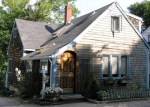
24 Turkey Shore Rd. (by 1884) – The lots at 24 and 26 Turkey Shore were once a single lot. There is an unconfirmed tradition that the house at #24 was moved from “the other side of the River.” The first recorded owner of this lot was either Benjamin Grant in 1734 or his neighbor to the south, Isaac Knowlton. (View map).
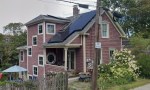
28 Turkey Shore, the Frederick Dawson House, c. 1880. A house is shown in this location in the 1884 Ipswich map, with the owner listed as Frederick Dawson. The heirs of Frederick Dawson sold the property to Hardy Beck and his wife, Julia. In 1894, Hardy & Julia Beck sold to Annie M. Bolles “a certain parcel of land with a dwelling house thereon.”
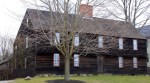
41 Turkey Shore Road, the William Howard House (c. 1680/1709) – Architectural evidence suggests that William Howard removed the 1638 home of Thomas Emerson and built the left side of the present house about 1680. The right side was added in 1709.
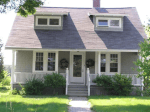
43 & 51 Turkey Shore Rd. Arts & Crafts Bungalows – The identical homes at 43 and 51 Turkey Shore Road were built in the Bungalow Porch Style. This eastern adaptation of California’s Arts and Crafts movement connects the home to the outdoors with an expansive front porch.

48 Turkey Shore Road, the Nathaniel Hodgkins House (1720) – The house at 48 Turkey Shore Road is believed to have been built by Nathaniel Hodgkins in 1720 on land formerly owned by Daniel Hovey. The gambrel roof indicates early Georgian-era construction. A 19th-century rear ell was removed in 2022 and replaced with a modern but compatible addition.

49 Turkey Shore Road, the Austin Measures House (1874) – Austin Measures’ Candy Shop was first located in a small building on North Main Street, and later on Central Street. This house was built in 1874. The low-pitched roof, window hoods, and corbels supporting the flat roof portico are of Italianate influence.

53-55 Turkey Shore Road, the Allan W. and Mary D. Brown House (c. 1890). The house first appears in the 1893 Birdseye map of Ipswich. The 1910 map shows the occupant as A.W. Brown. The 1896 Ipswich directory lists Allan W. Brown, teamster & ice dealer on this street. The 1910 Ipswich census lists Allan Brown as a farmer and his wife as Mary D. Brown, with two children. The 1902 town report identifies Alan W. Brown as a surveyor and lists payments to him for highway work in District No. 3; in 1913, he was still receiving substantial payments for street repairs.

59 Turkey Shore Road, the Elizabeth and Otis Glover House (c1870). Elizabeth Glover, wife of Otis Glover, inherited the property at 59 Turkey Shore Road from her father, Abraham Soward. She moved the old house off the lot and built this large Queen Anne house on the location. Her husband, Otis Glover, was in the Civil War from 1861 to 1864, and lived until 1903.
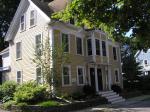
63 Turkey Shore Road, the Isaac Foss House (1870) – The Foss House is the finest example of the Gothic Revival era in Ipswich. The steep front gables on this home show the influence of a romantic movement in architecture inspired by medieval design, a departure from the classical Federal and Greek Revival styles popular earlier in the century.

67 Turkey Shore Road, the Stephen Boardman House (1725) – This house is named for Stephen Boardman, the son of Thomas Boardman and Sarah Langley. The wide pine board floors in the house are original, and 4 restored fireplaces share a central chimney.
Further reading:
Thomas Franklin Waters, Ipswich in the Massachusetts Bay Colony, Vol. II
Discover more from Historic Ipswich
Subscribe to get the latest posts sent to your email.


