


Just past the Choate Bridge on South Main Street, the Ipswich Visitor Center is located in the Hall-Haskell House, sometimes called the “Little Red House.”
The Ipswich Visitor Center, located in the 1820 Hall-Haskell House, sits at the heart of our town on the Center Green, in one of several Ipswich historic districts. The Hall-Haskell House operates spring through fall as an art gallery and welcome center, providing an abundance of maps & brochures. The Ipswich Visitor Center is staffed entirely by friendly and well-informed volunteers.
The Hall-Haskell House Gallery showcases local & regional artists, changing weekly from June – October.
Ipswich Visitor Center Hours: Open 7 days a week, Memorial Day through Columbus Day. Call (978) 356-8540
- 10am – 2pm Mondays
- 10am – 4pm Tuesdays through Sunday
Read the History of the Hall-Haskell House
History of the Hall-Haskell House
In 1765 Henry Wise mortgaged his house and land to the widow Mary Storer of Boston, “a house in Ipswich in which I now dwell.” (116:77). On Sept. 13, 1800, Ebenezer Storer of Boston and others sold to Charles Hall Jr., a mariner, “all the estate in Ipswich which belonged to Mary Storer, deceased, and was formerly the estate of Henry Wise…a lot of land on which formerly stood the house of said Henry Wise” (170: 207). Charles Hall conveyed this lot, from which the dwelling had disappeared, to the widow Mary Hall and Sarah Rust on Oct. 29, 1819 (222: 28). Mary Hall ran a small store beneath her living quarters to provide for herself. The store is said to have been known as the “Rust Shop.” In the late 18th century, Dr. Wallis Rust, whose house sat next door, operated an apothecary shop at or near this location.
The Widow Eunice Haskell
Mary Hall, Sarah B. Hall and her husband John Rust, a cordwainer, sold the land “with the store thereon” to Eunice Haskell on March 1, 1825 (236: 259). The deed refers to her as the wife of Mark Haskell. Her husband died two weeks later on March 15 at age 81.
Eunice Haskell was born in 1748, the daughter of Isaac and Eunice Smith. She married, first, John Caldwell 4th in 1799. She married, second, Mark Haskell in 1823. He died two years later at age 79, a year after Eunice purchased this building. (Ipswich Vital Records).
The 1832 Ipswich map shows the building owned by the “Widow Haskell”. It is unknown how long Eunice Haskell lived in the building or operated a store. She passed away in 1843 at age 91. Her gravestone (E-209 ) at the Old North Burying Ground reads, “In memory of Mrs. Eunice Haskell, who died Feb. 16, 1843, Aged 91. She survived two husbands; the first was Mr. John Caldwell, and the second was Dea. Mark Haskell.” The Ipswich Vital Records record the same date of death.
Mark Haskell
At the Old North Burying Ground is the gravestone of Deacon Mark Haskell, C-28. It reads, “Sacred to the memory of Dea. Mark Haskell, a man of piety and integrity, an exemplary member and judicious officer of the First Church in Ipswich, who deceased March 15, 1825, Aged 81. And his daughter, Sarah Haskell, who deceased May 25, 1841; Aged 65. “Precious in the sight of the Lord is the death of his saints”. Eunice Haskell is not mentioned on the stone. The Findagrave site and Ipswich Vital Records list his two previous wives as Elizabeth, who died in 1796, and Jane, who died in 1819. Felt’s History of Ipswich erroneously lists his wife as “Mary, died 1832 at age 86.” Adding to the confusion, the circa 1750 house at 21 High Street was constructed for a different Mark Haskell (1687-1775), whose second wife was named Elizabeth, and he had a daughter named Eunice.
Abraham Caldwell
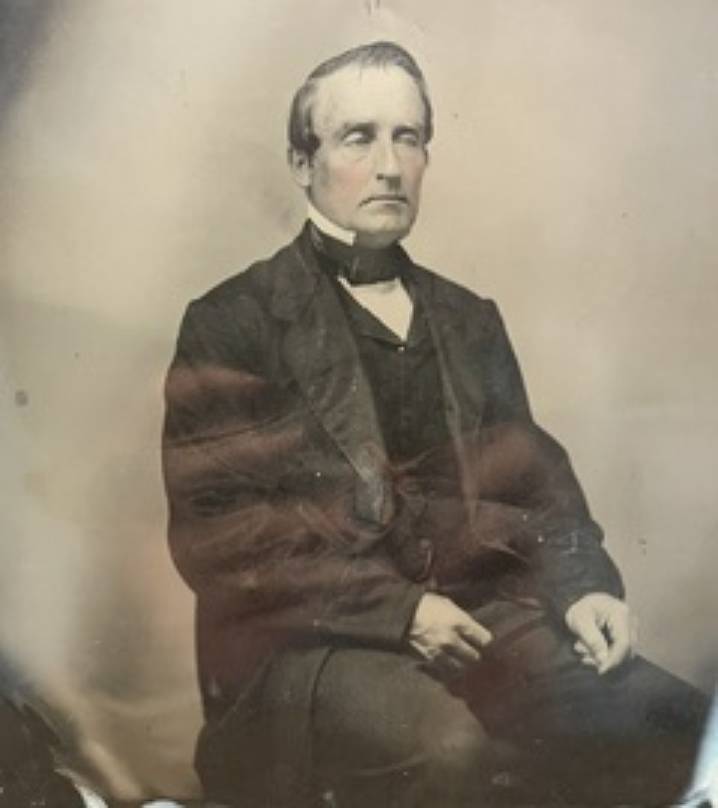
Eunice Haskell’s nephew by her first marriage, Abraham Caldwell, moved back to Ipswich from Beverly in 1824, and at some point became the owner. He enlarged the building and changed the hip roof to a pitched roof. Structural features suggest that he added the right side of the building at that time. The basement floor under the larger left side has a brick floor, while the right side is bare soil. The floor framing and the foundation walls are different on the two sides of the building.
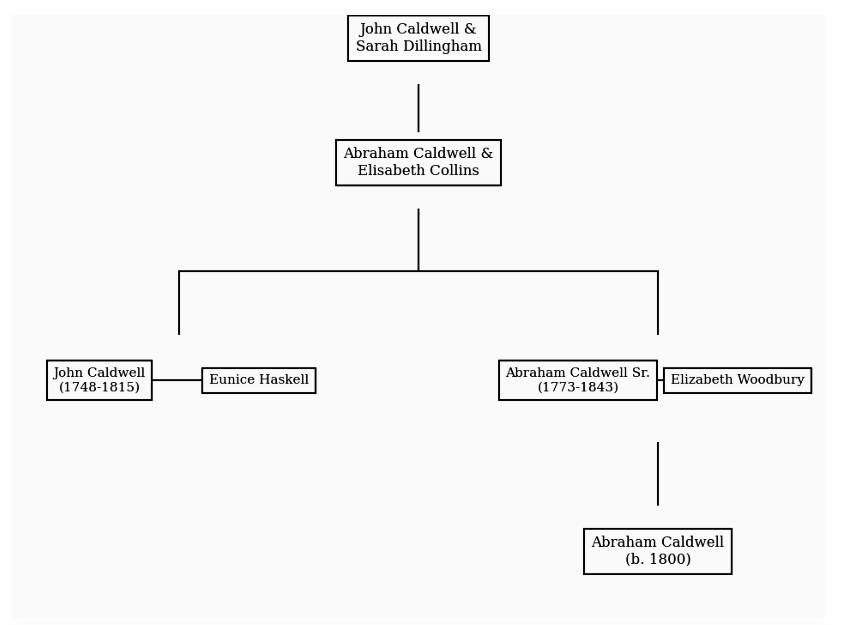
Abraham Caldwell was born in Beverly on March 22, 1800, the son of Abraham Caldwell Sr. (1773-1843), who was born in Ipswich and married Elizabeth Woodbury of Beverly (1773-1842). The senior Abraham was the brother of John Caldwell (1748-1815), Eunice Haskell’s first husband. Their parents were Abraham Caldwell and Elisabeth Collins of Ipswich, descendants of John Caldwell and Sarah Dillingham Caldwell of Ipswich, said to be the first generation of that surname in New England.
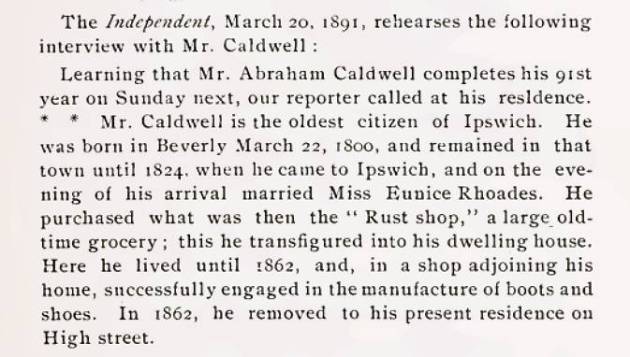
In 1824, Abraham Caldwell moved back to Ipswich and married Miss Eunice Rhoades of Beverly. She died January 3, 1862, and he next married Mrs. Eliza Lawrence of Saugus, who died bout 1874. Caldwell was originally a weaver by trade, but after the powered looms put hand weaving out of business, he manufactured shoes in Ipswich for about eighteen years. In a shop adjoining his home, he successfully engaged in the manufacture of boots and shoes.
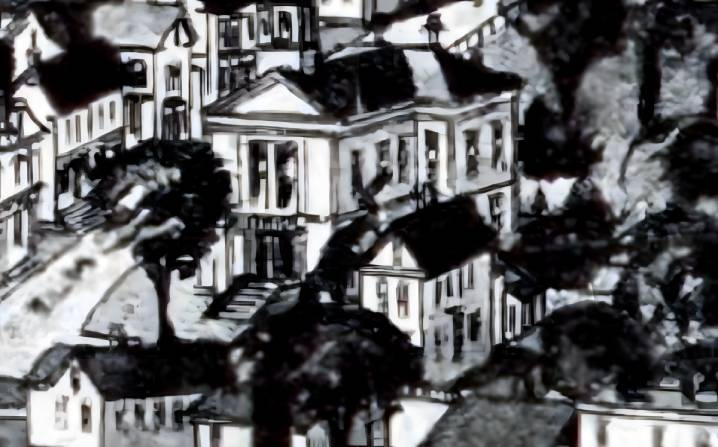
In 1862, Abraham Caldwell and his wife Eliza R. Caldwell purchased the “Joseph Bolles House” at 30 High Street from the heirs of Daniel Lord. In August 1864, the couple sold the house at 36 S. Main to Mr. John Heard for $3000.00 (675:275), as shown in the 1872 map. Abraham Caldwell died in Ipswich on Feb. 4, 1894, at age 93, of pneumonia. At the time, he was the oldest person alive in Ipswich.
John Heard owned almost all of the properties between Elm Street and South Main except for the former Town Hall and the Second Congregational Church, which stood facing the South Green. The large park-like lot stayed in the Heard family, and the last resident of the house was the widow of John Heard, who died in 1930.

By the 1980s, the house, now in bad condition, was owned by the Town of Ipswich, which planned to demolish the building. In 1987, the town received a matching grant from the Massachusetts Historical Commission to help restore the structure. It was saved due to the efforts of Terri Stephens, Vivian Endicott, Paul McGinley, Paula Bishop, Stephanie Gaskins, Don Curiale, and the Essex National Heritage Commission.
In 1991, members of the advanced woodworking class at Ipswich High School raised the beam that supports the ceiling of the Ipswich Arts side of the Hall Haskell House. The little red house on South Main Street now serves as the Ipswich Visitor Center, open in the summer months as an art gallery.
Personal Narratives of How the Hall-Haskell-Caldwell House Was Saved
Terri Stephens:
The Hall-Haskell House was in desperate need of help and had been slated for demolition back in the early 1980s. A few local people interested in historic preservation did some research on the building and formed a committee called “Friends of the Little Red House” to save the Little Red House as it was known by that name. Those first involved with this whole process were Vivian Endicott, Terri Stephens, Bill Thoen, Peg Burr, Peg Broekel, and Isadore Smith. Terri and Vivian spent many hours talking with local business owners, selectmen, and the town manager, George Howe, to get their support to save the house.
Initially, we were met with lots of negativity, but with polite persistence, the selectmen and town manager gave their blessing to proceed with our idea. There were 2 requirements: (1)We were not to seek funding from the town for restoration, and (2) being a town-owned building, we, as private citizens, needed to become a standing committee of the town. This took place at the 1981 Ipswich Town Meeting under Article 44. Mrs. Vivian Endicott moved that the town vote (1) to establish a standing committee known as the Hall Haskell House Committee and (2) to assign to them the management of the Hall Haskell House on its original site at the entrance to the business district of Ipswich, said committee (3) to designate its use as a civic center, for promoting the town’s interest in horticulture and agriculture, architectural and historic preservation and for providing information to welcome visitors to Ipswich.
This committee then proceeded to start raising funds to stabilize the building. With advice from town historian Mary Conley, town planner Betsy Ware, and Paul McGinley, preservationist Terri Stephens took on the role of grant writing, and various grants were submitted to various foundations. In 1987, we were awarded a grant from the Massachusetts Historical Commission for $20,000.
On September 28, 1978, a town meeting approved the $ 20,000 appropriation, which acted as a loan to cover the project. Once the work was completed, the town would be reimbursed. Terri Stephens functioned as the project manager. The unfortunate side of the grant requirement was that a contractor needed to be on Mass Historical’s approval list, and no local contractors qualified, so we ended up having to subcontract to a qualified individual.
Over the years, committee members were involved with all facets of the project, and some of us continue to this day. Bill Thoen, as a structural engineer, offered advice and physical labor for some of the projects. James Lahar took on the role of treasurer. Don Curiali, along with the Essex National Heritage Area, brought about the visitor center signage and location. Stephanie Gaskins joined our committee in the 1990s, and the art gallery has been her responsibility. This has been a long journey, and many changes have occurred over time, but our main goal that the building be available for community activities has stood the test of time.
It has been very gratifying to be involved with this building over time, and I am grateful to the town manager, board of selectmen, all the volunteers who staff the visitor center, town employees, and others who have helped and continue to help along the way. —Terri Stephens
Stephanie Gaskins:
I joined the Hall Haskell House Committee in the early 1990s, when, after saving the building from demolition and stabilizing the structure, there was plenty of work to be done on the interior. There were holes in the floors, no heat, no bathroom, and the ceiling of the first floor was falling down. Bill Thoen enlisted the help of the high school manual arts department, and soon the project was underway. Bill’s expertise and the boys’ enthusiasm installed a new beam, and the building was declared safe for use. Bob Linehan found the proper wide boards to patch the floor, and Dave Humphrey created the first indoor bathroom of the house. The first floor was painted and ready for occupancy.
Massachusetts was looking for a home for the Ipswich Information Center, and there was a need for an outlet for the burgeoning art community. Thousands of visitors have been greeted by local volunteers who staff the information center, and hundreds of Ipswich artists have shown their art during the past three decades. Scheduling and supervising the May to December season of the Hall Haskell House Gallery has been my pleasure, and although I joined the Hall Haskell House Committee a bit later than the original group, I have been involved now for three decades and am proud of our town for continuing to give its artists a venue, and thankful to the artists who support the building. —Stephanie Gaskins
Don Curiale wrote, “I remain proud of our Ipswich Center, our enduring spirit of volunteerism, and other local citizens who raised funds and restored the house. After many fundraisers and work on the house, it was opened as an art space and later became home to the Ipswich Visitor Center. A bench dedicated to Vivian Endicott is in the garden behind the house.”
Download: “History of the Hall-Haskell House” by Gordon Harris
Sources and Further Reading:
- Waters, Franklin Thomas: Ipswich in the Massachusetts Bay Colony, Vol. 1, page 452).
- Bush, Dona Lee, “The Hall-Haskell House”
- Record of the Rust Family, page 93
- Abraham Caldwell: Essex County Historical & Genealogical Register by M. V. B. Perley, published in 1894.
- Abraham Caldwell: “The Independent,” March 20, 1892
- Caldwell Records
- Old North Burying Ground E-234: Abraham Caldwell, Mar. 22, 1800-Feb. 4, 1894.
- John Caldwell and Sarah Dillingham Caldwell, his wife, Ipswich, Mass., 1654: genealogical records of their descendants, eight generations, 1654-1900
- Family Search: John Caldwell and Eunice Smith
Hall – Haskell House, 36 S. Main St. Preservation Agreement
- Hall-Haskell-house-36-south-main-preservation-agreement-page-1
- Hall-Haskell-house-36-south-main-preservation-agreement-page-2
- Hall-Haskell-house-36-south-main-preservation-agreement-page-3


A most interesting area where I completed High School at the old school in 1955. I departed for the USAF in1957 and never came home to live as my Air Force carrier kept me moving until I retired in Sherwood Arkansas in 1979. Carl