On Aug 6th 1795, Pomp an African-American slave was hung for chopping off the head of his master. He was confined in Ipswich jail, and a sentence of death was passed. He was held there until the day of his execution, which was attended by a "cheering crowd of thousands" after a sermon by Rev. Dana.
Tag: Court
Mark Quilter, Upon Complaint Against Him for Striking Rebeckah Shatswell
“Dalliance and Too much Familiarity”
The Defiant Samuel Appleton
Samuel Symonds, Gentleman: Complaint to Salem Court Against His Two Servants, 1661
Death in a Snowstorm, December 1, 1722
On December 1, 1722, Daniel Rogers was returning to Ipswich from a court case in Hampton and took a wrong turn that led deep into Salisbury marshes. His body was found a few days later near Salisbury beach. Suspicion fell on one Moses Gatchel but no charges were filed, there being a lack of solid evidence.
The Muster Murder of 1787
Luke and Elizabeth Perkins, Notorious Disturbers of the Peace and a “Wicked-Tongued Woman”
Luke Perkins and his wife, Elizabeth were notorious disturbers of the peace in 17th Century Ipswich, and she had a "venomous tongue." It was a happy day for the town when Luke and Elizabeth loaded their belongings into a boat and set sail for the solitary island farm owned by his father on Grape Island.
Illegal Currency: Ipswich and the Land Bank Scheme of 1740-41
The Hanging of Ezra Ross and Bathsheba Spooner, July 2, 1778
The Ipswich Jails
Troubles with Sheep
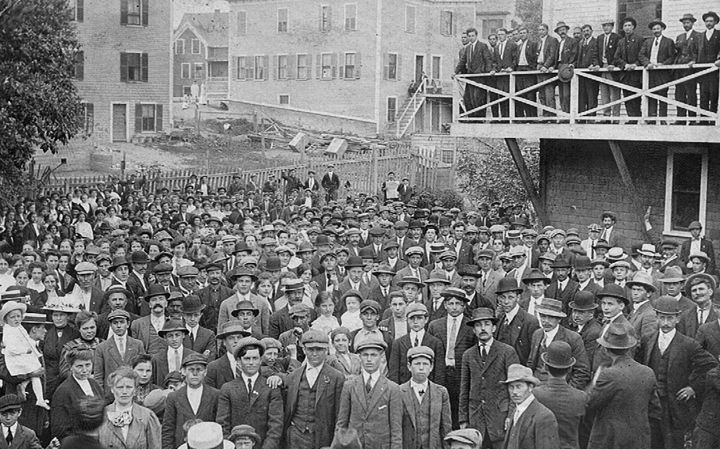
Police Open Fire at the Ipswich Mills Strike, June 10, 1913
One Third for the Widow
Under Puritan law an adult unmarried woman was a feme sole, and could own property and sign contracts. A married woman was a feme covert and could not own property individually. Widows regained the status of feme sole but the Right of Dower entitled them to keep only one third of their property. When a woman was left a widow some men like vultures were ready to take the other two thirds.
The Wearing of Long Hair and Wigs
The wearing of long hair was a burning theme of address in the early Puritan pulpit. The clergy prescribed that the hair should by no means lie over the band or doublet collar. In 1649, the Governor and seven of the Assistants declared their “dislike and detestation against the wearing of such long hair, whereby men doe deforme themselves, and offend sober and modest men.”