
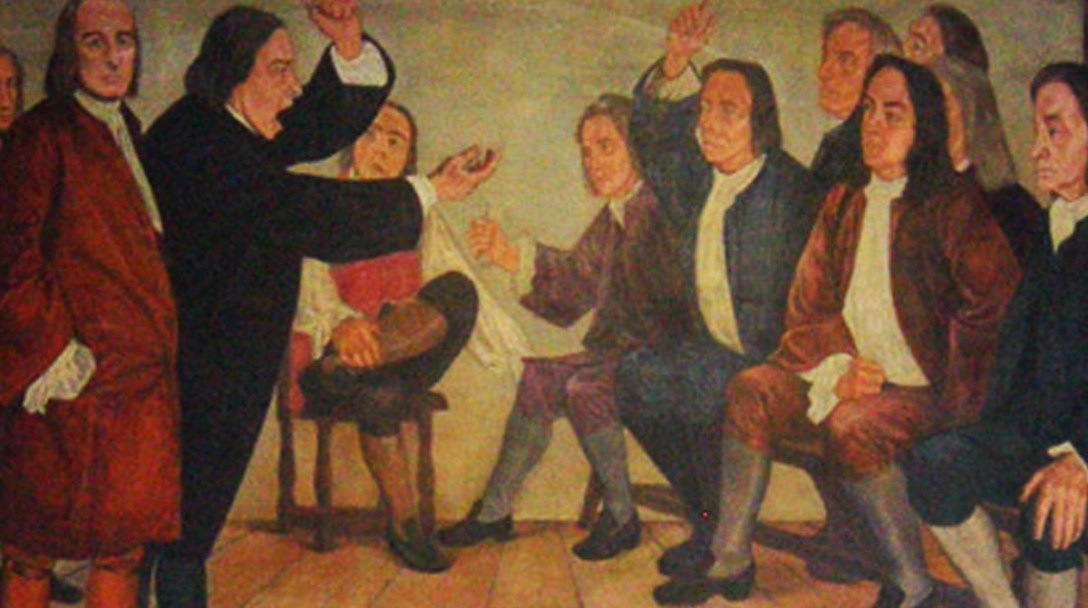
Featured image: Ipswich MA post office mural depicting John Wise and other Ipswich men 1687, and act for which Ipswich is known as the “Birthplace of American Independence.”
The concepts of freedom about which Thomas Jefferson wrote in the Declaration of Independence came from the pulpit and pen of the Rev. John Wise of Ipswich, Massachusetts.
“The first human subject and original of civil power is the people…and when they are free, they may set up what species of government they please. The end of all good government is to cultivate humanity and promote the happiness of all, and the good of every man in all his rights, his life, liberty, estate, honor, etc., without injury or abuse done to any.”
– Rev. John Wise, Chebacco Parish of Ipswich (Essex), circa 1700
“We hold these truths to be self-evident, that all men are created equal, that they are endowed by their Creator with certain unalienable Rights, that among these are Life, Liberty and the pursuit of Happiness.–That to secure these rights, Governments are instituted among Men, deriving their just powers from the consent of the governed.”— Declaration of Independence, July 4, 1776
In 1683 at the age of 31, John Wise became the minister of the church at Chebacco Parish (now Essex). He built his home on the road between Chebacco and the town of Ipswich.
His congregation quickly became convinced that the Rev. Wise was spiritually powerful and that his prayers begat results. When the crew of a ship from his parish were captured by pirates, he beseeched the Lord on a Sabbath morning to give them speedy deliverance, and if no other way be possible, for the Lord to help them “rise up and butcher their enemies.” The next day, the men arrived back at home, having attacked and killed the pirates.
Before Rev. Wise arrived in Ipswich, he served briefly as chaplain in King Philip’s War. He was one of three ministers assigned to serve as chaplain with General Phipps’ ill-fated 1690 expedition in the Battle of Quebec. His services were highly esteemed “not only for the Pious Discharge of his Sacred Office, but his Heroic Spirit, and Martial Skill and Wisdom did greatly distinguish him.” Wise was not a passive observer, but rather a fierce opponent of the enemy, and described the failures of the English forces to be an “unpardonable folly.” When they stalled in the countryside, he became “very troubled in mind” and chided the commander, “You are out of your wits– we did not come hither to drive a parcel of Cowardly Frenchmen from swamp to swamp, but to attack Quebec thither!” After much urging from Wise, word was given to march, but he wrote in his journal, “I will assure you things went on with insufferable dullness enough to any men.”
John Wise was of great muscular strength and had a reputation as a superior wrestler. John Chandler of Andover, being undefeated, prevailed upon Mr. Wise to a match. The story is told that after reluctantly accepting the match, Wise quickly had the boastful antagonist on his back, then picked him up and pitched him over the fence. Humiliated in defeat, Mr. Chandler asked Mr. Wise if he would mind throwing his horse over in like fashion.
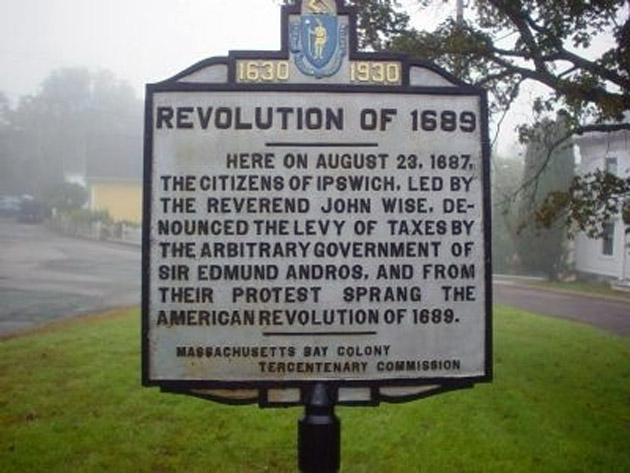
Even more legendary was his intellect and witty, if somewhat wordy, prose. He took stands against the witchcraft hysteria and stood in support of Dr. Manning, an Ipswich physician who proposed inoculation for smallpox. In the widely read “A Vindication of the Government of the New England Churches,” Wise defended the rights of congregations to be self-ruled.
In 1689, the British Crown revoked the Massachusetts Bay Colony charter and appointed Sir Edmond Andros as governor, who thereupon imposed a Province Tax to be collected in each town. Rev. Wise, John and Samuel Appleton, and the selectmen of Ipswich initiated a campaign of resistance.
Wise advised the town not to appoint a tax collector, arguing that the tax violated rights guaranteed in the Charter. For leading the rebellion, Wise and the others were arrested, tried in Boston, imprisoned, and fined heavily. He was deposed from his ministry until he and all but Samuel Appleton conceded. The people of Boston, now greatly encouraged, rose up in resistance, and Andros was arrested. The town of Ipswich paid the Reverend’s fine and sent him as its representative to take part in reorganizing the government. Wise personally prosecuted Chief Justice Dudley for refusing him the privileges of habeas corpus while he was imprisoned.
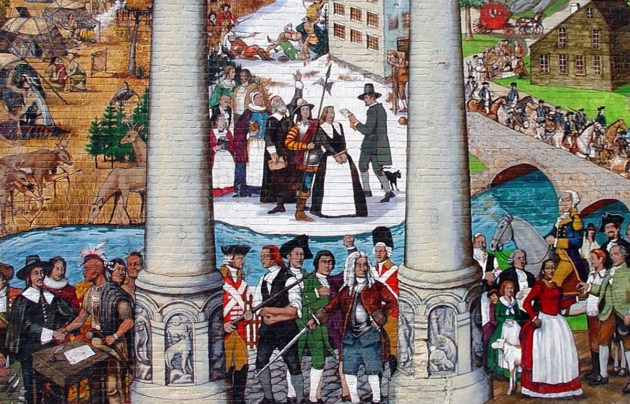
These actions were a precursor to revolts in Boston that led to the American Revolution, and for this, Ipswich is known as the Birthplace of American Independence. The Declaration of Independence incorporated principles from John Wise’s memoirs, in which he wrote :
“The first human subject and original of civil power is the people…and when they are free, they may set up what species of government they please. The end of all good government is to cultivate humanity and promote the happiness of all, and the good of every man in all his rights, his life, liberty, estate, honor, etc., without injury or abuse done to any.”
As he approached his death in 1725, John Wise observed that he had been a man of contention but upon reflecting on his conduct, he had fought a good fight. He is buried at the Old Burying Ground in Essex. A tablet honoring him, supported by four legs, stands over his final resting place.

The Chebacco Congregation
In September, 1719, during the Colonial Land Bank crisis, John Wise appealed to the Justices of the Quarterly Court meeting in Newbury:
“The Subscriber being under the Benign Umbrage of your Authority, Petitions your Favour in his present Grievances relating to his Temporal Support. The Salary allowed by this Precinct is in the Original Grant but a poor business to maintain a Family Sick & Well, it being but Seventy Pounds in Money; That to diminish or any ways weaken it must needs stand under the head of Oppression if not a heavier denomination My Good Neighbors who are obliged by God and the Law to make this annually good to me as appears by Covenant; They demur upon my demands for Money and offer to pay in Bills of Publick Credit as pretending they are Money. I acknowledge I am very loth to extend with my Neighbors but out of a due respect to Just Interest and Temporal Support, I cannot submit to any other Terms, but to have my Salary paid in proper Specie, or in a full Equivalent.”
“The utmost of my desires at this time is that Your Honours will do me the favour as to signify in a few words to my Neighbors that they must needs persuade themselves, That Bills are not Money nor must they be so understood; and also that they must pay me in the proper Specie the Place Indented for near Twenty Years ago: or otherwise, if they pay in Bills, then to do it to my Satisfaction…I have ordered my Son to lay this Address before this Honorable Sessions, Seven Months are Expired and the half Years Salary not paid; To live till the next Quarter Sessions without any Recruit will be very mortifying.” (Waters, Vol.II pp 146-147).
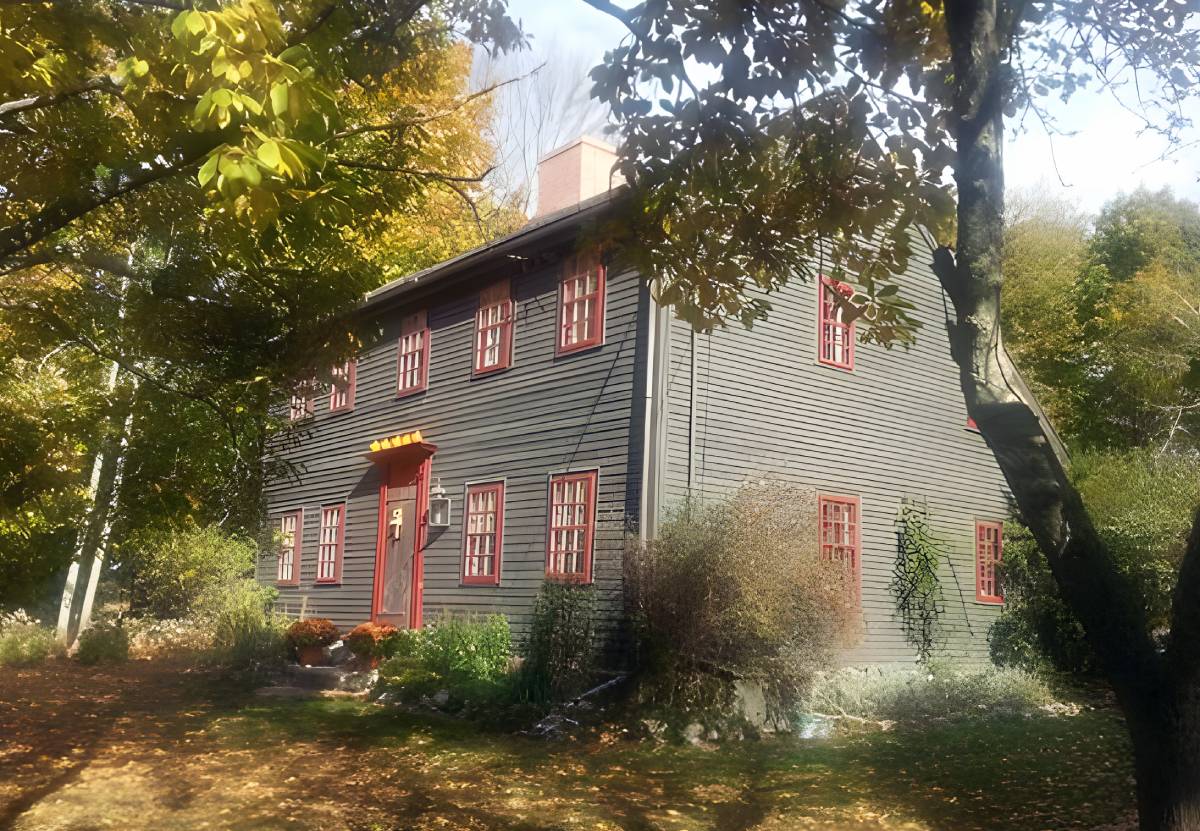
The John Wise House, 85 John Wise Avenue, Essex MA
Multiple sources from as early as the 1800s state the the home of the Rev. John Wise was constructed in 1702, which would place in the last couple of decades of the First Period era. In 2026, the owners invited Ipswich architectural historian Gordon Harris inside for a visit. Although historical narratives and deeds verify that the home of Rev. John Wise was at or near this location, it is improbable that the house as it appears today was constructed during the First Period of English construction (1630-1725).
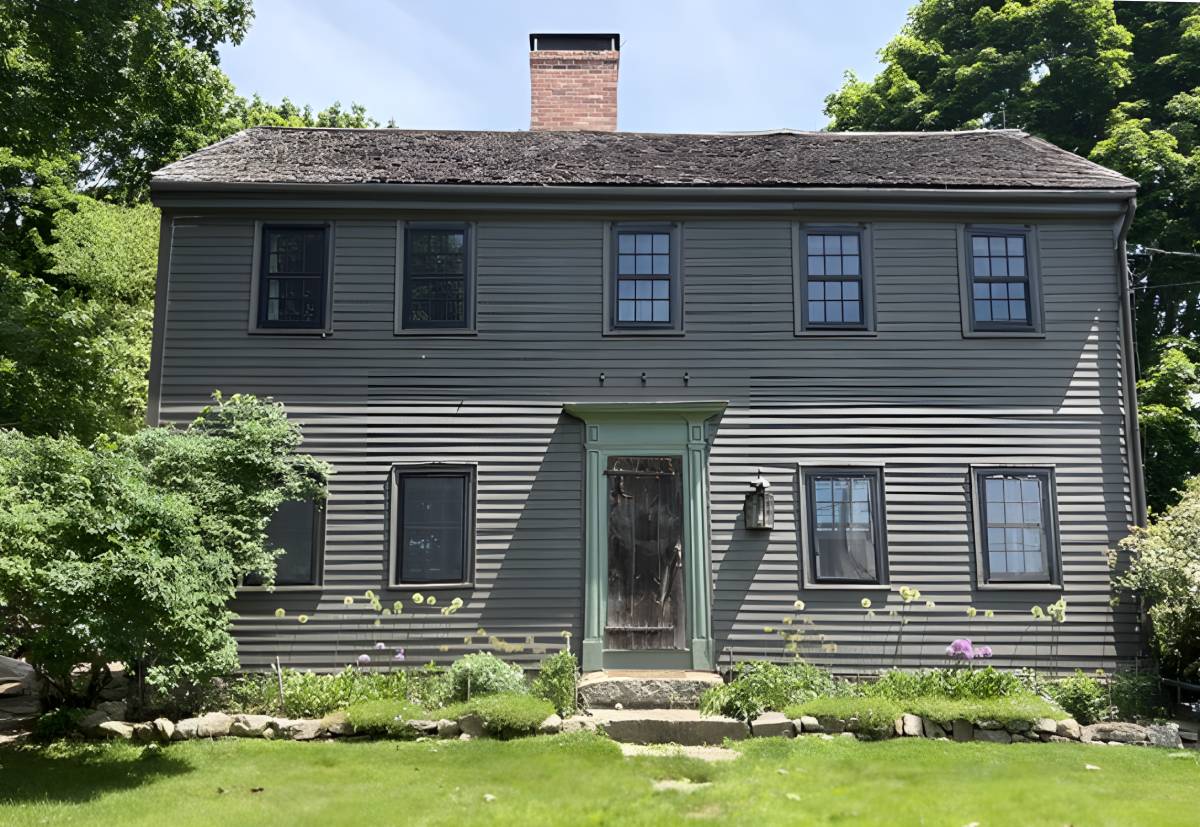
External Features of the John Wise House
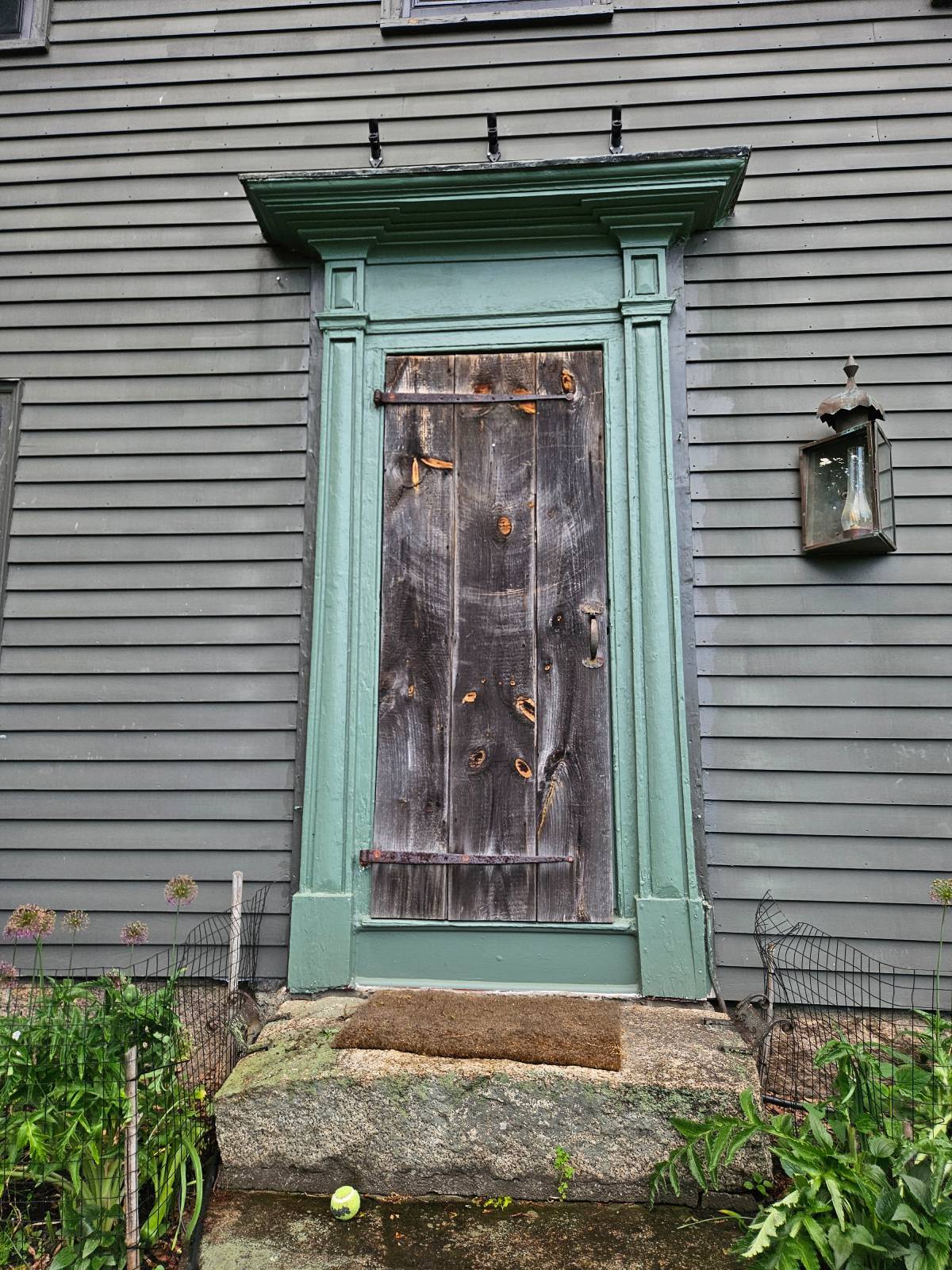
The existing house has Georgian and early Federal features, suggesting that it may have been built by John Wise II, who inherited the homestead. The house appears to have been greatly restored and remodeled during the Federal era, likely during its ownership by George Pierce from 1766 to 1812. The front of the house is uniform and symmetrical, and in the rear is a shallow saltbox extension for the kitchen. The front doorway has unique elaborate Georgian casings, which if original, would approximately date it to before 1780.
Interior Features of the John Wise House
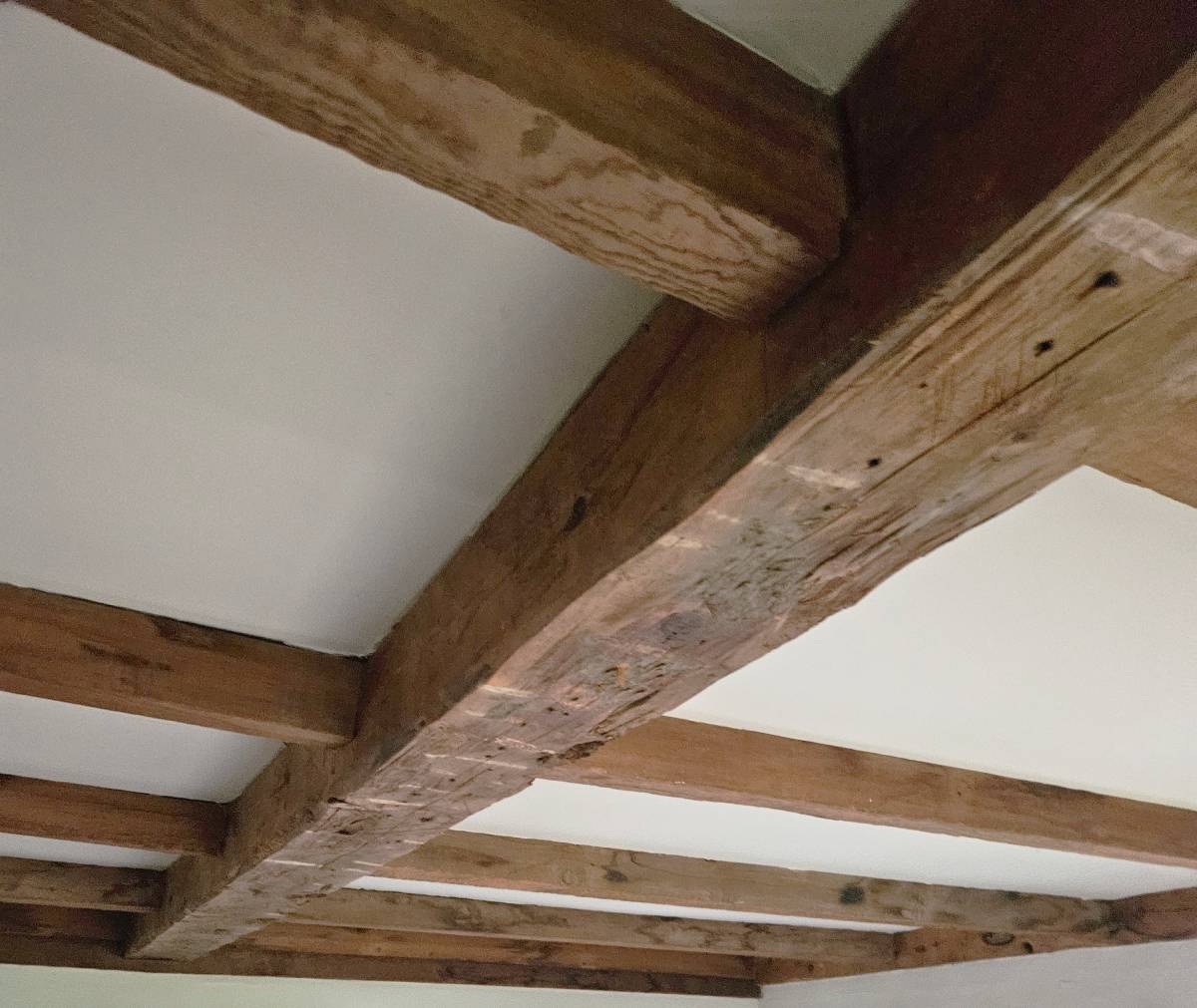
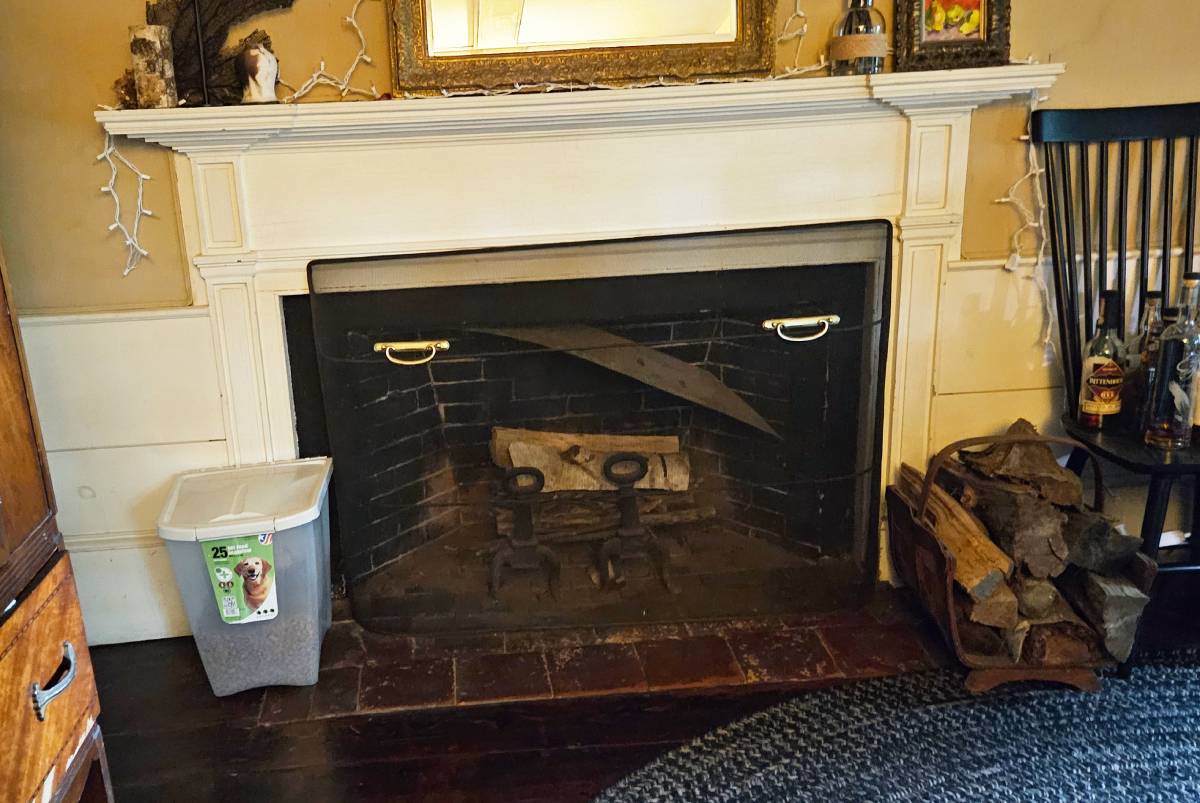
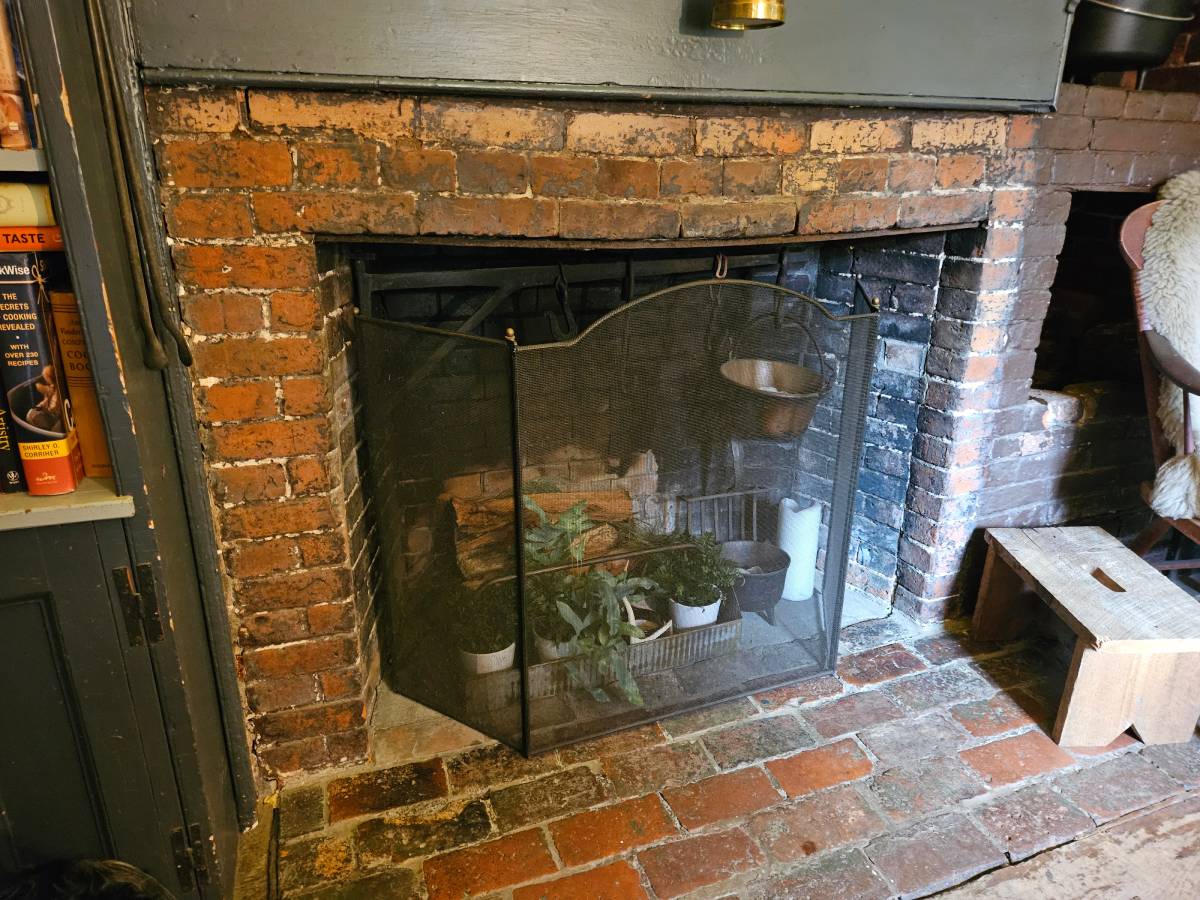
Inside, where the ceiling framing has been exposed in the large “hall” room, the timbers are sawn, rather than hewn, indicating that they were never intended to be exposed. Ceilings in the other rooms are still plastered, and the vertical framing is boxed. There are circa 1800 Rumford-type fireplaces in each room of the house, supported by a brick masonry arch in the basement. The two cooking fireplaces have beehive ovens on the front walls, rather than inside the fireplace, a feature found in Federal Period houses, circa 1800-1830. It is unknown if the house originally had stone masonry and earlier-style fireplaces. Because of the more compact masonry, the front entryway is fairly generous and deep, with a winder stairway leading to the second floor. Below, in the basement, is an original stone foundation wall indicating that part of the house, maybe the left side, was added to the original structure.
The Lean-to
The most conspicuous well-preserved early element in the John Wise House is the unusually shallow leanto, the rear section of a saltbox house. The owner stated that the rafters extend from the apex of the roof over the lean-to, indicating that the rear room was part of the original construction, rather than added. Leantos originated as additions to First Period houses in the late 17th century as kitchens. They became an integral part of the colonial house form in the early 1700s and persisted until around 1800. The leanto walls in the John Wise House are plastered to the window frames, without casings. Early colonial builders applied a mixture of clay, lime, sand, and animal hair right up to the edges of the window and door frames without any applied moldings. Around the middle of the 18th century, plaster grounds were being applied, along with casings. The ceiling and floor in this room, which served as a kitchen, are quite slanted with age, not an unusual situation for a New England saltbox.
Historical Record of the John Wise House
In his old age, his daughter Mary remained at home to provide and care for them. His sons John and Henry had obtained land nearby and constructed homes. John Wise died in 1725.
A record of the construction of the John Wise House appears in a 1943 publication of the Essex Institute: “It was not until 1702 that a school house was built…At about this time, too, Mr. Wise, built for himself on the ten acre lot that the parish had “given to him and his heirs and assigns forever” at the time of his ordination. It appears, though, that before Mr. Wise built his house, the parish had already engaged for him a new parsonage, and had also voted to give Mrs. Wise 100 pounds in case she should be left a widow in the parsonage-house in the event that she became a widow. Curiously, at a subsequent meeting the Church offered Mr. Wise the sum of fifty pounds if he would release them from these obligations. Mr. and Mrs. Wise graciously accepted the offer of the parish and in a few years their new house was ready for occupancy. Mr. Wise was to receive during his lifetime the rents of the old parsonage house. Perhaps the size of the minister’s family as well as the affluence of the parish had something to do with the building of a new house, for by this time Mr. and Mrs. Wise had 6 children: Jeremiah had graduated from Harvard and had been settled for four years as pastor in Berwick, Maine. Lucy was married to the Rev. John White of Gloucester. Joseph was living in Boston. Mary, Henry, Ammi Ruhami, and John are at home. The study is in the south-east corner of the house where its occupant might have the most light and heat.”
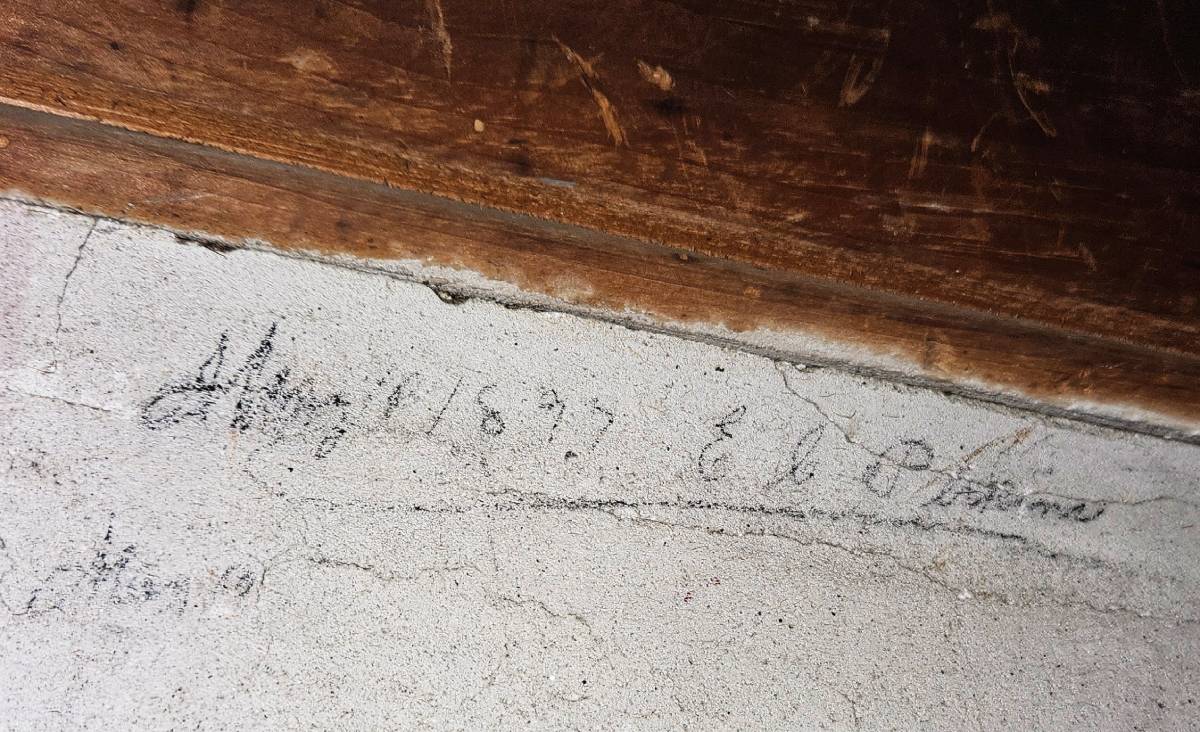
Owners of the John Wise house from 1703 to 1935, by Parker C. Choate (unconfirmed)
- John Wise — 1703 to 1725 — 22 years
- John Wise, Jr. — 1725 to 1762 — 37 years
- George Pierce — 1766 to 1812 — 56 years. (Revolutionary soldier—Antiquarian Papers)
- John Mears, Sr., — 1826 to 1865 — 39 years
- William Williams — 1869 to 1885 — 16 years. The 1872 and 1885 maps show W. Williams.
- Mary Ellen (Hobbs) Williams widow — 1885
- Jane E. (Hobbs) Burnham, sister, by will — 1897
- Ellis Jeremiah Burnham, by inheritance — 1906
- The Hobbs-Bumham family 1885 to 1922 — 37 years
- Richard T. Crane, Jr., through Atty. Lockhard, 1922-35, 15 yrs.
- Mrs. Jacob S. Perkins, 1935
Excerpt from “The Founder of American Democracy” by J. Mackaye, The New England magazine, 1887
“LIKE many great men in the annals of American history, John Wise was of lowly origin. His father, Joseph, came to New England as the serving man of a Dr. Alcock about 1635. These serving men, of whom many emigrated to the New World early in the seventeenth century, were too poor to pay the expense of the voyage across the Atlantic and who there- fore pledged or mortgaged their ser vices to some person better provided, in consideration of being transported to America and supported there until able to buy their liberty.
“John Wise graduated in 1673 and took his master’s degree in 1675. In the interim, he had preached at Branford. Connecticut, and in December 1675, served as chaplain to a company that marched from thence against the Narragansetts during King Philip’s War. After taking his master’s degree, he preached for two years in Hatfield, Connecticut, returning to Roxbury in 1678, where he married Abigail Gardner the same year.
“Ipswich was at this time the second town in the colony, and its inhabitants were scattered over a wide area, including the present towns of Hamilton and Essex. To serve the spiritual needs of the population, but one Parish church was provided, and to attend divine service and the Thursday lecture, the inhabitants of the more remote districts were compelled to traverse miles of forest infested by wolves and Indians.
“Dissatisfied with such conditions, the residents of that part of the town known as Chebacco, comprising the present town of Essex, took preliminary steps in 1676 toward the establishment of a church and parish of their own, and in 1677 petitioned the General Court for the necessary permission. The petition was tabled, and the petitioners referred to the town, which had already refused to grant the desired separation, and on a second application refused a second time. After a good deal of fruitless negotiation, the inhabitants of Chebacco in 1679 decided to erect a meeting house of their own, to be used, if circumstances permitted, as a place of public worship; and for that purpose assembled the timbers for the same and prepared to raise them.
“The authorities of the Ipswich church, however, obtained an order from the General Court restraining the men of Chebacco from raising the meeting house — what we should today call an injunction — and thus again brought the enterprise to a standstill. At this critical juncture, when the Chebacco people seemed so successfully thwarted, the women of the neighborhood, by a little ingenuity, circumvented the Ipswich church and the Great and General Court. Unknown to their husbands, Mrs. Varney, Mrs. Goodhue and Mrs. Martin, after a conference with other women of the neighborhood, set out on horseback through the woods for the adjacent towns of Gloucester and Manchester, and presenting the case to their friends in those towns, soon returned with a small army of men, not of Chebacco, and therefore not restrained by the injunction, who quickly raised the meeting house.
“The only punishment resulting from this bold act was that suffered doubtless by the baked punkin’, Injun pudding, beans and hard cider of the well pleased and hospitable Chebacco folk, and this we may be sure was sufficiently severe.
“It was to the independent and enterprising parish thus established that John Wise was recommended as pastor by the General Court, and in 1680 he began preaching at Chebacco. In 1683, he was formally ordained, his settlement consisting of an annual salary of £60, “one-third in money and two-thirds in grain at the current price, forty cords of oak wood by the year yearly and eight loads of salt hay.” In addition, they assigned to him ten acres of land and agreed to build him a house and barn, “the house to be equal in every respect to Samuel Giddings’ house.”
“The last provision was later altered, and Wise in 1703 built his own house, still standing on the road from Ipswich to Essex. From 1680 to 1703, he lived in a house, long since gone, which stood a little further to the south. Four years after his ordination at Chebacco, an event occurred which made Wise famous throughout the colony, and which alone entitles him to a place among those whose “eternal vigilance” during the colonial era was the price of liberty to their posterity.
“Sir Edmund Andros had been for two years and more the Governor of New England. The charters of the several colonies, under which they had for two generations practised self-government, had been abrogated by a characteristic act of the House of Stuart. Andros had already made himself obnoxious by his tyrannical conduct, and in the summer of 1687, added to his malodorous reputation by arbitrarily levying a tax of a penny a pound on property holders indiscriminately. The people had no voice in the matter.
“A town meeting had been called in the town of Ipswich for August 23, 1687, to consider the appointment of assessors to apportion the tax thus imposed. The night before the meet- ing, Wise, with several others prominent in the town, attended a caucus at the house of John Appleton near the center, and it was then decided that “it was not the Town’s duty any way to assist that ll method of raising money without a General Assembly, which was apparently intended by Sir Edmund and his Council.”
“The next day in town meeting Wise made a speech opposing the appointment of as- sessors for the purpose specified, in the course of which he gave emphatic expression to the sentiment that “taxation without representation is tyranny,” and local tradition has it that on that occasion he not only expressed the sentiment but originated the phrase. As a result, the meeting voted unanimously to appoint no assessors, thus setting an example of rebellion which was shortly followed by several other towns in the colony. For this act, Wise, William Goodhue, Robert Kinsman, John Andrews, John Appleton, and Thomas French were lodged in jail at Boston, where they remained for three weeks awaiting trial. While there, he demanded and was denied the right of habeas corpus in violation of the English constitution, was accused of “contempt and high misdemeanor,” and was found guilty by a packed jury, composed principally of aliens.
“As of interest to the student of comparative jurisprudence the following extract from the charge of Chief Justice Dudley to the jury may be worth quoting: ‘I am glad there be so many worthy gentlemen of the jury so capable of doing the King’s service and we expect a good verdict from you, seeing the matter hath been so sufficiently proved against the criminals.’
“At his trial, Wise pleaded his privileges under Magna Charta, but the provisions of that instrument were construed as inoperative in America. According to an account of the trial later drawn up by Wise and sent with other charges against Andros to the home government, one of the judges asserted that “we must not think that the laws of England follow us to the ends of the earth,” adding, “Mr. Wise, you have no more privileges left you than not to be sold as slaves,” and no man in Council contradicted.
“Wise was fined £50 and costs, was suspended from the ministry, and compelled to furnish bonds in the sum of £1,000 for good behavior. The town, however, paid the fine, together with those imposed on his townsmen, and recompensed them for the expense they had incurred during their trial.
“It has been asserted that John Wise was the first man in America to thus maintain the just prerogatives of the people in defiance of government. The outcome of the affair had much poetic justice in it. In 1688, when James II fled from London, his agent Andros attempted to escape from Boston but was deposed by the people and was sent as a prisoner to England. Meanwhile, Wise was chosen as one of two delegates to represent the town of Ipswich at the convention called to reorganize the colony, and later he sued Justice Dudley for denying him the privilege of habeas corpus and recovered damages.
“The Andros incident was not the only one that proves Wise to have been an advocate and exemplar of the ‘strenuous life.’ He was as powerful physically as he was mentally. Tradition represents him as very tall and strongly built, of fine presence, combining affability with dignity. In his day, he was famous as a wrestler. It is related that a Captain Chandler of Andover, himself a wrestler of local repute, hearing of the athletic parson, rode over on horseback to Chebacco to test his prowess. Wise, at first reluctant to engage in such a contest with a stranger, eventually consented to try a bout and soon laid the confident Chandler on his back. That worthy not being satisfied, he repeated the performance, finally depositing him on the other side of the wall, whereat the discomfited Captain, scrambling to his feet, remarked that if Mr. Wise would hand his horse over after him, he would take himself home. The stone wall standing within the memory of those now living, in front of the present house, marked, according to tradition, the place of this incident, and its memory is still cherished by the old inhabitants.
“On another occasion, several of his parishioners were captured by pirates, many of whom at that date infested the coast. The following Sunday, he referred to his missing townsmen in his prayer, expressing the hope that if no other alternative was open, they would rise and slay their captors. Faith in the efficacy of prayer among his parishioners was much augmented the following day when the missing men returned and related that on the day preceding, they had surprised the pirates, killed them, and escaped, thus fulfilling the prophecy of their pastor’s prayer almost at the moment of its utterance.
“When Cotton Mather, with whom Wise was not on good terms was making efforts to introduce inoculation to check smallpox, the Chebacco parson was one of his few supporters, even though the public mind was so incensed against the innovators that a mob attempted to blow up Mather’s house and made an ineffectual effort to hang Dr. Zabdiel Boylston, the only physician in Boston who dared advocate the unpopular practice.
“In 1690, Wise joined the expedition of Sir William Phipps in the disastrous attempt to capture Quebec. Few reaped any honors in that adventure, but Wise, though present only in the capacity of chaplain, distinguished himself by “his Heroic Spirit and Martial Skill and Wisdom.”
“It was during the witchcraft delusion of 1692 that Wise most conspicuously displayed his courage. The danger to those who advocated moderation and justice in the treatment of witches is well illustrated by a pamphlet issued in 1693 by Increase Mather, then President of Harvard College and a man with as little to fear from the superstition of the time as anyone in the colony. He endeavored to show in this pamphlet, among other thing,s that the so-called “Spectral Evidence” for the detection of witches, was not to be depended upon and he rested his demonstration upon proofs, “all considered according to the Scriptures, History, Experience and the Judgment of many Learned Men.” Mild as was the protest, Mather deemed it safer to have it prefaced by a commendatory statement signed by fourteen “influential gentlemen” of whom Wise was one, to disarm his critics and possible accusers.
“The opening sentence of this statement gives evidence of the inflamed state of the public mind: “So Insidious and Abominable is the Name of a witch to the Civilized, much more the Religious part of mankind, that it is apt to grow up into a Scandal for any so much as to enter some sober cautions against the over-hasty suspecting or too precipitant Judging of Persons on this account.”
“Despite the danger implied in such conditions when anyone speaking a word in favor of a witch made himself an object of suspicion, Wise, with several of his parishioners signed an address to the Essex General Court in behalf of John Proctor, a former neighbor and at that time in Salem jail, convicted of witchcraft and awaiting execution. The address was unavailing and Proctor was hanged, but in 1703 another address signed by him urged that the attainders attaching to the families of those convicted during the delusion be removed, and declared that “there is a great reason to fear that innocent persons suffered and that God may have a controversy with the land upon that account” was more successful.
“An act was passed to the effect that “the several convictions, judgments and attainders be and hereby are reversed and declared to be null and void.” Upham, in his “History of the Salem Witchcraft,” says of Wise, “He had a free spirit and was perhaps the only minister in the neighborhood or country who was discerning enough to see the erroneousness of the proceedings from the beginning.”
“The service for which Wise should be held in veneration by posterity was, however, not rendered till the latter part of his life. It consisted of the contribution made by him to the theory of church and civil government. Led by the Mathers, a council met at Boston in 1705 and drew up sixteen proposals which were submitted to the various churches for their consideration. The proposals in substance contemplated a change in the form of church government and placed the control of many matters formerly determined by the separate parishes in the hands of certain councils, which were to decide all doubtful points and settle all disputes.
“Wise read these proposals and highly disapproved of them as ‘something which smells very strong of the Infallible chair’ and as containing doctrine subversive of democratic principles. In 1710 appeared a pamphlet from his pen entitled “The Churches’ Quarrel Espoused” in which he took vigorous issue with the authors of the proposals using both exhortation and satire to emphasize his views. Satire was an unusual weapon for a minister to wield in that austere age, but in Wise’s hands it proved so effective as to bring to a halt the campaign of the Mathers, and when in 1717 he published a second pamphlet, “A Vindication of the Government of New England Churches” he established the foundations of Congregationalism so firmly that they have since remained in all essential respects unshaken.
“It is upon the theorems contained in his second essay that his claim as the founder of American democracy must principally rest. The essay marks him as the earliest political philosopher in America, and in it, the sentiments of the Declaration of Independence are expressed in language as clear and as strong as in that of Jefferson’s famous document. What vital principle is to be found in the Declaration of Independence that is not involved in the following extracts from Wise’s argument for free government drawn from the Light of Nature? ‘All men are born free, and nature having set all men upon a level and made them equals, no servitude or subjection can be conceived without inequality.” “The first human subject and original of civil power is the people…When the subject of sovereign power is quite extinct, that power returns to the people again, and when they are free, they may set up what species of government they please.” “The formal reason of government is the will of the community.” “A civil state is a compound moral person… whose will is the will of all.” “The end of all good government is to cultivate humanity and promote the happiness of all and the good of every man in his rights, his life, liberty, estate, honor, etc., without injury or abuse done to any.”
“Though Wise was the first man in America to express such views so potent in the history of the continent, and probably the first in the world to so clearly express them, his name and his services have been consigned to oblivion by the historians of Democracy. Wise as the originator of the dictum is entitled to the credit which the world unites in bestowing upon Jefferson. In fact, the work was a sort of textbook of Liberty to the patriots of the Revolution, as indeed it was the obvious intention of those who caused its republication that it should be.
“John Wise died in his seventy-third year on the 8th of April, 1725, at his home in Chebacco. On his death bed, he said to his son-in-law, John White of Gloucester, “I have been a man of contention, but the state of the churches made it necessary. Upon the most serious review, I can say I have fought a good fight, and I have comfort in reflecting upon the same: I am conscious to myself that I have acted sincerely.” Had he not been a man of contention, the history of the American nation would doubtless have been different. There can be little doubt that through the confidence inspired in the Revolutionary leaders by his work and the sanction it accorded their deeds, he was a critical factor in determining the time and place of the commencement of the struggle for the liberation of the colonies, and in that determination the history of the Revolution and perhaps its immediate issue was involved.
“Though John Wise’s deeds have been all but forgotten by his posterity, and his services but obscurely recorded, his character and achievements may nonetheless be cherished by Americans as a product of the same land and stock of which they are products, and his grave in the old burial ground at Essex may be invested with the veneration accorded to those which hold the dust of America’s more conspicuous, but not more worthy son.”
Sources and Further Reading:
- Waters, Thomas Franklin, Ipswich in the Massachusetts Bay Colony, Vol.II pp 146-147)
- John Wise of Chebacco, a presentation by Thomas Franklin Waters to the Ipswich Historical Society, 1927
- Trial and Punishment of Mr. Wise and His Fellow-Citizens, In His Own Words
- John Wise, A Classical Controversialist, by Richard M. Gummere
- John Wise, the Father of American Independence by Paul Simpson McElroy
- Vindication of the Government of New England Churches, And the Churches’ Quarrel Espoused, or a Reply to Certain Proposals
- John Wise of Ipswich Was No Democrat, by Raymond B. Stearns
- John Wise: The Father of American Independence” by Paul Simpsoit McElbot, Essex Institute (July 1945)
- Will of John Wise Made August 8, 1717
- Description of the John Wise House (by Paul Simpsoit McElbot, Essex Institute (July 1945)
- Owners of the John Wise house from 1703 to 1935
- John Wise early American democrat by George Allan Cook (1966)
- John Wise, a Star of the First Magnitude“: Six characters in search of a republic: studies in the political thought of the American colonies by Rossiter, Clinton Lawrence, 1917-1970
- Wikipedia: John Wise
- Wikitree: Family tree for John Wise
- Saltboxes and Catslides, by Gordon Bock, Old House Journal, 2001
- History of the town of Essex : from 1634 to 1868 by Crowell, Robert, 1787-1855
- John Wise Would Be Proud, by Stephen Miles
Discover more from Historic Ipswich
Subscribe to get the latest posts sent to your email.


He’s my 9th great grandpa!!!
Rev. John Wise was my 8th great grandfather. I’m very proud to be one of his descendants.
My 8th great grandfather as well. What a life he lived!
My name is David Brown and he was 10x generational grandfather. My mother is a Wise.
he’s my 7th! I am writing about him in a book coming out called Who Needs College Anymore? !
Thank you so much this is a fantastic article. I realized that my first Known grandfather and his father-in-law were both in Ipswich and Chebacco at this time. His father-in-law had been a Scottish prisoner of war ( John Waddell) and a Soldier so when he was freed he moved down to Stonington and foot in the king Phillips war. I will have to check further to see if they knew each other. The interesting thing For my family might be that my relative was an ardent Covenanter and a Presbyterian and the son of a well-known minister. Reverend Wise Was a Puritan. I will have to see if I can find copies of Wise’s journals and letters To see if they knew each other. Who knows? You have given me a wonderful lead to research. I’m hoping this will bring stories of my family’s history to life for me. If you know where such journals or letters or documents exist I hope you will share the information.
I am looking for the meaning of an expression voiced in 1900-15
Two people jailed in Oregon were heard to converse “Are you sure you’re Johnny-wise?”
“Yes I am” “I am Johnny-wise too.”
Have his sermons been collected and published? Are the sermons available?