
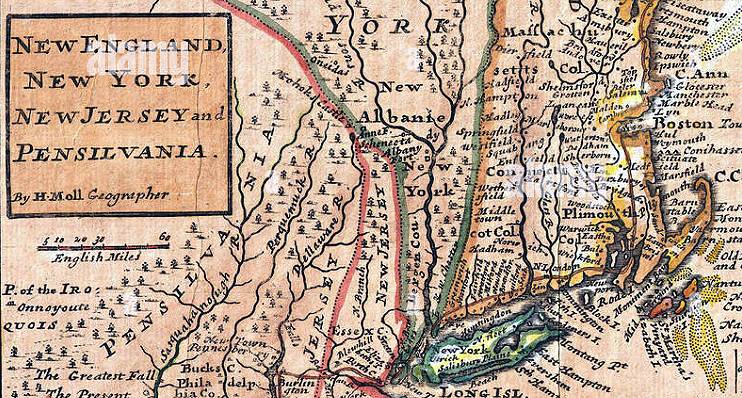
By: Stephen Miles, Member, Ipswich Historic Commission, Former Board Member Ipswich Historical Society (now Ipswich Museum). June 15, 2026. Contact: smiles@sloan.mit.edu
In 1629 John Winthrop was appointed head of a corporate venture under the jurisdiction of King Charles I (reigned 1625–1649). In John Winthrop’s 1630 sermon “A Model of Christian Charity,” the best part of the “city on a hill” plan was its radical vision of community interdependence and charity. The worst part was the crushing weight of divine scrutiny—a total lack of privacy and zero tolerance for failure. Because the settlement was completely open to the judgment of others, any failure, conflict, and because the community was bound by a strict “covenant” with God, disagreement with church or state leaders was viewed as treason against both the community and God. This intolerance directly led to the banishment of figures like Anne Hutchinson and Roger Williams.
In 1684, the Massachusetts Bay Colony charter was revoked due to repeated violations of the charter’s terms. These violations included the colonists continued to trade with other countries despite the Navigation Acts of 1651 and 1660 prohibiting them from doing so. The colony also ran an illegal mint that made coins without the king’s image on them and melted down English coins to remake them into their own coins. Finally the Massachusetts General Court created a number of laws that did not align with England’s laws, particularly by passing religious based laws that discriminated against Quakers and Anglicans
In March 1681 King Charles II of England granted William Penn a royal charter for approximately 45,000 square miles of land in North America to settle a massive debt he owed to Penn’s late father, Admiral William Penn, making his son a sole proprietor. William Penn’s “Holy Experiment” was a bold 17th-century initiative to establish Pennsylvania as a diverse, democratic sanctuary free from religious persecution. Its best aspects were unprecedented religious tolerance, fair dealings with Indigenous peoples, and forward-thinking justice. The worst aspects included hypocritical stances on slavery and its ultimate unravelling due to political factionalism.
While both Winthrop and Penn successfully leveraged religious networks to fund and populate their colonies, they operated under entirely different legal, financial, and organizational frameworks. The differences lie in the distinction between a corporate joint-stock venture (Winthrop) and a proprietary, network-marketed land development (Penn).
Legal and Financial Structures
Winthrop and the Massachusetts Bay Company
The capitalization of Massachusetts Bay relied on the joint-stock company model, a corporate entity formalized by a royal charter from King Charles I in 1629.
- Corporate Investment: Wealthy Puritan merchants and gentry bought shares in the company. Capital was raised to fund the fleet, provisions, and establish infrastructure.
- The Cambridge Agreement Loophole: In August 1629, Winthrop and his allies signed the Cambridge Agreement. They agreed to emigrate only if the management and the physical company’s royal charter were legally transferred with them to New England. By buying out the non-emigrating “adventurers” (investors), Winthrop transformed a commercial trade monopoly into a self-governing religious commonwealth.1
- Land Allocation: Investors did not buy individual plots of land from England. Instead, the company held the land collectively, and the General Court later distributed it to groups of settlers to establish organized, nucleated towns.
By buying out the non-emigrating “adventurers” (investors), Winthrop transformed a commercial trade monopoly into a self-governing religious commonwealth. The initial distribution of land in Ipswich, Massachusetts—incorporated in 1634 after its settlement as Agawam in 1633—stands as a classic example of the corporate Puritans’ system under the Massachusetts Bay Company. Unlike the individualistic, commercial real estate model William Penn deployed in Pennsylvania, land in Ipswich was managed collectively by the community through the town meeting and a select group of “seven men” (the early Selectmen) who served as trustees.
A Modern “Cambridge Agreement” Transaction example:
● The Ultimatum (The MBO): The CEO and eleven top executives form a privateprivate-equity consortium. They issue an ultimatum to the board: “We hold theoperational expertise. Either you sell us controlling voting interest in the company, or we walk away entirely, rendering your asset worthless.”
● The Valuation & Asset Split: To satisfy the passive investors who refuse to leave Delaware, the corporation splits its stock into Voting Class B shares (held entirely by the management team moving to the field) and Non-Voting Class A tracking stock (given to the London investors to pay them out of future fur/timber cash flows without giving them a say in operations).
● The Jurisdictional Inversion: The moment the management team gains voting control, they hold a shareholder meeting and vote to re-domicile the corporation out of Delaware and into an un-regulated, sovereign offshore jurisdiction. They physically move the corporate servers, the intellectual property, and the legal headquarters to the new territory.
The initial distribution of land in Ipswich, Massachusetts—incorporated in 1634 after its settlement as Agawam in 1633—stands as a classic example of the corporate Puritans’ system under the Massachusetts Bay Company. Unlike the individualistic, commercial real estate model William Penn deployed in Pennsylvania, land in Ipswich was managed collectively by the community through the town meeting and a select group of “seven men” (the early Selectmen) who served as trustees.
Asset Allocation
The Grantees: Who Received Land?
To receive land, an individual had to be formally admitted as a proprietor or “freeman” of the town. This status was not granted automatically to anyone who showed up; it required being a church member in good standing and being accepted by the community. Land was distributed based on a distinct Puritan socio-economic hierarchy known as the “Rule of Proportion.” Land was not divided equally. Instead, it was allocated according to three factors:
- Financial investment into the common fund of the Massachusetts Bay Company.
- Socio-professional status (ministers, magistrates, and skilled artisans like blacksmiths or millers received larger or more premium plots).
- Family size and their immediate capacity to clear and cultivate the wilderness.
The Three-Part Allotment System
When a settler was granted land in early Ipswich, they did not receive one contiguous farm. To ensure equity and maintain a tightly knit, defensive community, a settler’s grant was split into three distinct geographic pieces:
A. The House Lot (The Village Center)
To preserve social order and religious cohesion, the town mandated that everyone live clustered near the meetinghouse (originally built on what is now Meetinghouse Green). House lots were small, typically ranging from a half-acre to two acres. This allowed families to live side-by-side, cultivate a small kitchen garden, keep a few domestic animals, and easily walk to the mandatory Sabbath services.
B. The Planting and Tillage Lots (Outlying Arable Land)
These were larger plots located outside the residential village center—often 6, 10, or 20 acres—meant for growing essential crops like maize, rye, and barley. Areas like “Little Neck,” the “Great Neck,” or the plains along the Ipswich River were systematically divided into narrow, rectangular strips so that multiple families had access to prime, fertile soil.
C. The Salt Marshes and Thatch Lots (The Coastal Resource)
In early Ipswich, the expansive salt marshes were incredibly valuable. Because clearing dense upland timber to create fresh pasture took years of grueling labor, the settlers relied on the salt marshes for “salt hay” to feed their cattle through the harsh New England winters. Families were granted specific plots of marshland to harvest this native grass, as well as “thatch lots” along the mudflats to gather reeds for roofing their first homes.
Commonage and the Undivided Lands
Any land not explicitly granted to an individual remained the collective property of the town, known as The Common Lands or the “Commonage.” All recognized proprietors held common rights to these vast tracts (such as the extensive woodlands and undivided pastures). These rights were highly protected assets:
- Grazing: Settlers could turn their livestock out into the common pastures, managed by town-appointed herdsmen (such as the cowherd or swineherd).
- Timber: Proprietors were permitted to cut down trees on common land for firewood or building materials, but they were strictly prohibited from exporting timber out of Ipswich without the explicit permission of the town meeting—a measure designed to prevent the depletion of local natural resources.
This meticulous, highly regulated framework ensured that the geographic landscape of Ipswich directly mirrored its social and spiritual goals: a deeply cooperative, strictly ordered community centered entirely around the church and the common good as determined by town leadership.
The Average Lot Size Breakdown
While estates varied wildly, historical probate and town archives indicate that the average total landholding for an early Ipswich inhabitant was roughly 50 acres, though more than half of the early settlers held total estates under 20 acres.
- House Lots: Usually standardized between 0.5 to 2 acres in the compact village center within a half-mile of the meetinghouse. This was intentionally tight to ensure communal defense and enforce religious accountability.
- Planting/Tillage Lots: Ranged from 6 to 20 acres out in the open plains or river necks.
- Large Gentry Grants: Reserved for elite leaders, these frequently ranged from 100 to over 500 acres.
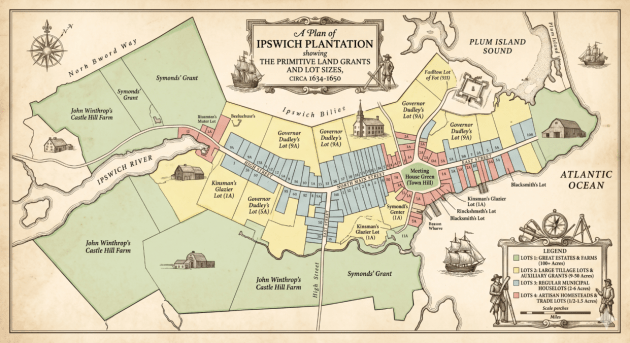
Using Gemini, I generated the above detailed historic map of the early Ipswich settlement (circa 1634–1650), designed to visualize the spatial distribution of the primary lot sizes. This reconstruction highlights how the early Puritan leaders prioritized a defensive and community-focused core, creating distinct concentric zones of land ownership:
- Zone 4: Artisan & Trade Lots (Smallest; Red): Clustered immediately around Meeting House Green (Town Hill) and the Town Wharf along the river. These lots (0.5 to 1.5 acres) were for tradesmen like Robert Kinsman (Glazier) and the blacksmiths, who didn’t need farming space but required proximity to water and the municipal center.
- Zone 3: Regular Municipal House Lots (2-6 Acres; Blue): This area comprises the dense, linear “ribbon lots” that defined early Ipswich. Lining both High Street and North Main Street, these standard allocations were the baseline for average families, providing a modest tillage field and kitchen garden within walking distance of the meeting house.
- Zone 2: Large Tillage & Auxiliary Grants (9-50 Acres; Yellow): As seen in the various Governor Dudley Lots (e.g., the prominent 9A parcel near High St.), these provided substantial farmland for wealthier or more established citizens, located just on the perimeter of the village core.
- Zone 1: Great Estates & Farms (Largest; Green): These massive, peripheral grants, such as John Winthrop’s Castle Hill Farm and the various Symonds’ Grants, occupied hundreds of acres each. They formed the agricultural and capital powerhouse of the young plantation, situated away from the dense residential center.
Major Landholders in Ipswich and Their Status
The major landholders in early Ipswich achieved their elite status because they were either high-ranking officers of the Massachusetts Bay Company, crucial religious leaders, or wealthy gentry who financed the initial migration fleets. They used this social capital to secure the finest agricultural, timber, and coastal assets in the region.
| Major Landholder | Notable Land Holdings | How Status Achieved |
| John Winthrop, Jr. | Castle Hill & Argilla Farm | Governor’s son; led 1633 vanguard to block French advancement. |
| Samuel Appleton | South Ipswich (Appleton Farms) | Wealthy Suffolk immigrant; invested heavily in the Puritan enterprise. |
| Richard Saltonstall, Jr. | Ipswich River lands 14 acres & mill rights | Son of MB Company patentee; used immense family leverage for choice land- first mill on the Ipswich river |
| Maj. Gen. Daniel Denison | Town estate sited at 17 County Street (Waters-subsequently a mill) & outlying pasture | Militia Commander-in-Chief; married Gov. Dudley’s daughter. |
| Simon & Anne Bradstreet | Vast ancestral acreage; original home site of 33 High Street | Magistrate and future Governor; married to America’s first published poet. |
| Jonathan Wade | South Green parcels | Wealthy merchant; brought liquid capital to invest in local commerce. |
How They Maintained “Commoner” Status
In colonial Massachusetts, under the leadership of Governor John Winthrop, land within new
towns was frequently granted to an elite, restricted class of initial shareholders known as
Proprietors.While Winthrop and his assistants in the General Court held the top-tier stock in the
Massachusetts Bay Company, local towns mirrored this shareholder system when distributing
new land.
The Founders’ Shares: Original grantees (often church members and established community
leaders) were granted large parcels of town land, undivided common fields, and timber rights.
Exclusion of Newcomers: As towns grew, “latecomers” did not automatically receive an equal
share of the town commons. They often had to purchase rights directly from the Proprietors or
petition the town to be admitted to this select class of landowners.
The Freemen: At the colony level, this concept of town shareholders evolved into the status of
Freemen.Only men who held shares in the company and were members in good standing of a
Puritan congregation were granted the title of Freeman. Freemen formed a special voting class
that had the sole right to elect the governor (like John Winthrop), magistrates, and deputies
To keep this land system within the family lines, the original landholders established a legal
distinction known as being a Commoner. By town decree, only those who owned the original
house lots granted during the first years of settlement (or those explicitly voted in by the early
proprietors) held “Rights of Commonage.” This meant that while anyone could theoretically buy
a house in Ipswich later on, only the descendants or legal assignees of the original major
landholders held the perpetual rights to graze cattle on the town’s 3,000+ acres of undivided
“Cow Commons,” cut timber for firewood, or harvest the highly valuable salt-hay from the
coastal marshes.
The formation of early Ipswich (originally the Native American land of Agawam, purchased from
the sachem Masconomet by John Winthrop Jr. in 1634 for £20) followed a carefully structured
hybrid land-grant system. The Massachusetts Bay Company combined a corporate joint-stock
layout with a traditional English closed-field model. Under the town’s first “lot layers” (Henry
Short, John Perkins, Robert Muzzey, and John Gage), land was distributed based on a
hierarchy of social status, wealth invested in the corporate venture, and a family’s capacity to
“subdue and improve” the wilderness.
Classes of Shareholders
In colonial Massachusetts, under the leadership of Governor John Winthrop, land within new
towns was frequently granted to an elite, restricted class of initial shareholders known as
Proprietors.
The Proprietors: While Winthrop and his assistants in the General Court held the top-tier stock
in the Massachusetts Bay Company, local towns mirrored this shareholder system when
distributing new land.
The Founders’ Shares: Original grantees (often church members and established community
leaders) were granted large parcels of town land, undivided common fields, and timber rights.
Exclusion of Newcomers: As towns grew, “latecomers” did not automatically receive an equal
share of the town commons. They often had to purchase rights directly from the Proprietors or
petition the town to be admitted to this select class of landowners.
The Freemen: At the colony level, this concept of town shareholders evolved into the status of
Freemen. Only men who held shares in the company and were members in good standing of a
Puritan congregation were granted the title of Freeman. Freemen formed a special voting class
that had the sole right to elect the governor (like John Winthrop), magistrates, and deputies.
The Tiers of Lot Sizes and Land Distribution
The distribution of land was split into distinct tiers that separated immediate town living from large agricultural production. Every freeholder generally received an integrated package consisting of a small village home lot, a tillage lot for crops, and shared rights to the common pastures.
Tier 1: The Massive Proprietary Farms (100 to 500+ Acres)
These were “King’s Grants” awarded by the General Court or the town to the colony’s socio-economic elite—magistrates, wealthy merchants, and high-ranking ministers who funded the Puritan migration.
- Purpose: Large-scale agricultural operations, often leased out to tenant farmers while the owners lived closer to the town center or Boston.
- Average Size: Commonly ranged from 100 to 500+ acres.
Tier 2: The Outlying Tillage and Meadow Lots (6 to 50 Acres)
The “middling sort” of early Puritan society—established farmers, skilled artisans, and shipbuilders—received substantial outlying plots for crop cultivation and livestock grazing.
- Purpose: Field cultivation, orchard growing, and haying.
- Average Size: Tillage lots were frequently standardized around 6 acres per householder within the larger common fields (such as the South Eighth or the fields near the Egypt/Rowley River), while wealthier families averaged estates closer to 50 acres total across multiple plots.
Tier 3: The Urban House Lots (1 to 2 Acres)
To maintain structural cohesion, religious orthodoxy, and safety, the town required settlers to build their primary residences clustered within a central, nucleated village.
- Purpose: A home, a small garden, and space for a barn or workshop.
- Average Size: Tightly regulated at 1 to 2 acres (and occasionally down to a single acre for newer arrivals or specific tradesmen, such as Robert Kinsman’s 1-acre grant on Green Street).
Number of Lots in Each Tier
While the exact number of subdivided parcels shifted constantly during the high-migration years of the 1630s and 1640s, the macro-allocation of early Ipswich acreage illustrates how tightly the town controlled its resources:
- Total Granted Acreage (by 1642): The town of Ipswich and the General Court handed out approximately 9,000 acres of land to individual freeholders.
- The Proportions: Large proprietary farms (Tier 1) accounted for more than half of the geographically distant acreage (for instance, over 4,300 acres were sliced off in large blocks in the area that later became Topsfield alone).
- The Commons Inventory: To prevent runaway speculation, the town intentionally held back a massive amount of territory. By 1642, 3,000 acres were locked up as strictly managed common pastures (like the “Great Cow Common”), leaving 7,000 acres completely ungranted for future generations.
Major Landowners and Their Holdings
The initial land register of Ipswich reads like a directory of early Massachusetts leadership. The largest, most influential tracts were clustered in distinct geographic pockets:
| Landholder | Notable Holdings & Locations | Historical Context |
| John Winthrop Jr. | Argilla Farm, Maplecroft Farm, & 300 acres in Linebrook | Settlement founder and Governor’s son; his lands are iconic open spaces today. |
| Samuel Appleton | Massive tract on Waldingfield Road (Appleton Farms) | Oldest continuously operating farm in America; held by 7 family generations. |
| Samuel Symonds | 500-acre “Olivers” estate at Pye Brook | Prominent magistrate whose land bridged early Ipswich and Topsfield. |
| The Heard Family | Central holdings & deep-water trading properties | Prominent merchants with an ancestral footprint in the town center. |
| Rev. Nathaniel Rogers | Clerical grants near Pye Brook & central meetinghouse | Puritan minister from England; ordained as Ipswich pastor in 1638. |
| John Endecott | 550 acres along Ipswich River (north of Salem) | Early Governor held deep real estate in 17th century Ipswich. |
The April 1665 audit and land division in Ipswich, Massachusetts is one of the clearest historical examples of early American corporate town-shareholding. Following the 1664 town vote to halt all future land grants, a special municipal committee spent months auditing local property ownership to determine exactly who held “right of commonage” (shares in the town’s remaining public corporate lands). The resulting 1665 report officially codified an explicit, three-tiered system of shareholders based on social rank,tax contributions, and original corporate status:2
1684: Ipswich resists Royally appointed Council, Governor Andros
When the original charter that had established the Massachusetts Bay Colony was revoked by England in 1684, creating a legal limbo that had a significant impact on the witch trials to come eight years later, Ipswich was one of the most vocal towns opposed to English attempts to establish tighter control 1. When Boston’s General Court was dissolved and a royally-appointed council took its place, Ipswich was outraged. Royal Governor Edmund Andros arrived in late 1686, immediately imposing a tax of one penny on a pound for revenue.
Ipswich historian Waters recounts, “Topsfield, Rowley, and Ipswich were recognized as hostile to the new government, at its very beginning.” At this time, when Boston, Salem, and Ipswich were the most important towns in the colony, and both Boston and Salem agreed to the new tax, it was the Town of Ipswich who voted unanimously not to elect a taxation commissioner. Waters notes, “The high-handed course of this influential community made it a target for official wrath.” Several of Ipswich’s leaders were arrested and jailed in Boston, among them Reverend John Wise of Chebacco Parish, as well as the town’s Clerk, Moderator, and Constable. All eventually capitulated, except Major Samuel Appleton who, says Waters, ““…scorned even the appearance of submission. He had made no petition for bail, and he refused to make any apology. He continued in the same defiant mood.” The town seal of Ipswich notes this early stand against English interference with the words “The Birthplace of American Independence, 1687.”
Puritan government treatment of “Dissidents”
In the 17th century, the Massachusetts Bay Colony operated as a strict corporate theocracy where religious conformity was directly tied to civic survival. Because the legal framework required church membership to hold political “freeman” status or secure a baseline voice in the town meeting, theological deviance was viewed as an existential threat to civil order.
While Ipswich earned lasting historical renown for its resistance to royal tyranny—most notably the 1687 tax revolt against Governor Sir Edmund Andros that coined the phrase “No Taxation Without Representation”—the town’s internal social structure was deeply intolerant of religious or philosophical dissidents.
1. The Persecution of Quakers
The Society of Friends (Quakers) faced the most severe, coordinated state persecution in 17th-century New England. To the Puritan magistracy, the Quaker belief in the “Inward Light”—which bypassed the need for ordained ministers, state-sanctioned scripture interpretation, and mandatory church taxes—was a direct assault on the corporate order.
Cutting off the ears, and boring the tongue with hot irons were not uncommon as means to torture the Quakers. As the witchcraft heresy spread, new tortures were devised, and in December, 1662, Captain Richard Waldron, the Crown magistrate in Dover, issued the following order:
“To the Constables of Dover, Hampton, Salisbury, Newbury, Rowley, Ipswich, Windham, Linn, Boston, Roxbury, Dedham, and until these vagabond Quakers are out of this jurisdiction:
You and every one of you are required in the King’s Majesty’s name to take these vagabond Quakers, Anna Colman, Mary Tompkins, and Alice Ambrose, and make them fast to the cart’s tail, and drawing the cart through your several towns, to whip them on their naked backs not exceeding ten stripes apiece on each of them in each town, and so convey them from Constable to Constable till they are out of this jurisdiction, as you will answer it at your peril, and this shall be your warrant.”2
Waldron, as the local crown magistrate, ordered them to be punished as vagabonds by being bound behind a cart and being made to walk over 80 miles (130 km) in a bitter winter through ten neighboring townships. Beginning in Dover, and on arrival in each township, they were to be publicly stripped to the waist and whipped ten times. Major Robert Pike stopped the torture and released them in Salisbury, the third township in which they were mistreated. There, after urgently required medical assistance from Walter Barefoote, the women left for Maine.3 These three Quaker women are the subject of the poem How the Women Went from Dover by the 19th-century American Quaker poet, John Greenleaf Whittier.4
The Essex County Quarterly Court records, which frequently sat at Ipswich, document extensive, aggressive measures taken against local Quakers and those who showed them hospitality:
- Fines for Non-Attendance: Local families who skipped the mandatory services at the First Church meetinghouse to hold silent Quaker meetings were heavily fined. In 1859, dynamic local figures like Samuel Shattuck (1616-1674) [185 Essex St, Salem] and Nicholas Phelps [Salem Woods, West Peabody, Massachusetts – originally part of Salem)] who founded the first Quaker Meeting in the colony, were systematically prosecuted for absenting themselves from public worship. The Shattucks were prominent Quakers in Salem, with Samuel Shattuck Sr. famous for carrying King Charles II’s mandate to Boston that halted the execution of Quakers.
- The Case of Quartermaster Robert Shatswell [88-90 High Street] : In the early 1660s, local residents who showed basic human charity to traveling Quaker preachers were severely penalized. Robert Shatswell was heavily fined and reprimanded simply for allowing Quakers to lodge under his roof, as the town aggressively sought to prevent the “contagion” of their theology from taking root in Essex County.
- Physical Punishment and Banishment: Under colonial law, persistent Quaker dissidents were sentenced to the stocks, public whipping at the cart’s tail through the town streets, or outright banishment upon pain of death.
2. The Persecution of Baptists and Anabaptists
Baptists, who rejected infant baptism in favor of believer’s baptism, were treated with similar legal severity. Because infant baptism was the mechanism by which new individuals were integrated into both the church roll and the civic tax base from birth, denying its validity threatened the foundation of the Puritan commonwealth.
- The Outlawing of Thomas Cobbett’s Opponents: The Reverend Thomas Cobbett, who served as the influential minister of the First Church of Ipswich from 1656 until his death in 1685, was one of the colony’s most fierce intellectual combatants against the Baptist movement. He even published a famous treatise explicitly defending infant baptism.
- The Case of Lady Deborah Moody: While her primary estate was in Lynn, prominent elites who held Baptist sentiments were systematically hauled before the Ipswich court. Those who refused to recant were disenfranchised, stripped of their social standing, and effectively forced out of the jurisdiction into more tolerant colonies like Rhode Island or the Dutch New Netherlands.
3. The Witchcraft Delusion of 1692
The ultimate expression of persecuting perceived ideological and social outsiders occurred during the Salem Witchcraft Crisis of 1692. While the tragedy bears the name of neighboring Salem, the town of Ipswich was deeply entangled in the legal, logistical, and human machinery of the 1692 Witchcraft Crisis. Because the Salem jail was far too small to hold the 150 to 200 people swept up in the escalating panic, the Massachusetts Bay authorities distributed prisoners among four regional county jails: Boston, Cambridge, Salem, and Ipswich. Ipswich served as a primary holding center for the accused, a venue for early examinations, the home of prominent victims, and—ultimately—a center of early institutional resistance to the hysteria.
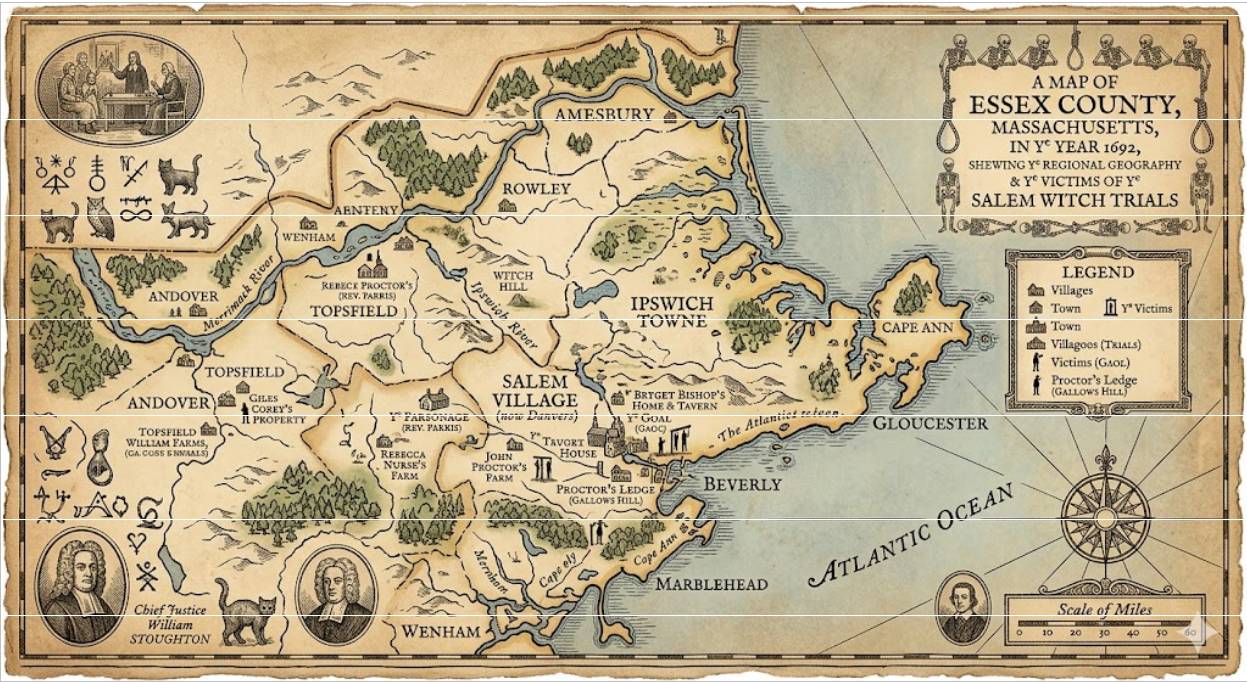
This geographic breakdown of the 20 individuals executed during the Salem Witchcraft Trials—and where their homesteads were originally located—reveals the broad footprint of the crisis across the region.
Ipswich as a Center of Resistance
While local magistrates like Major John Appleton initially participated in the legal machinery, Ipswich ultimately became a primary source of institutional opposition that helped break the power of the trials.
- The Courageous Ministers: The Reverend John Wise (pastor of the Chebacco Parish, now Essex) and the Reverend William Hubbard of the First Church of Ipswich openly challenged the validity of the trials. John Wise drafted a bold petition defending his parishioner John Proctor (who was ultimately hanged), explicitly attacking the use of unreliable “spectral evidence” (the claim that a witch’s spirit could leave their body to attack victims).
- Blocking the Accusers: As the hysteria began to wane in the late summer of 1692, the “afflicted girls” of Salem attempted to travel to Ipswich to spark an entirely new wave of accusations. However, alert and skeptical Ipswich residents took a physical stand, blocking the bridge into town and refusing to allow the girls entry, effectively declaring that the witch-hunt would go no further in their community.
William Penn and the Proprietary Venture
William Penn operated as a Sole Proprietor. In 1681, Charles II granted Penn a massive tract of land to settle a £16,000 debt owed to Penn’s late father, Admiral Sir William Penn.
- The Land Office Model: Penn did not have a corporate board of directors or public shareholders. He was the sole landlord of Pennsylvania and Delaware. To liquidate this vast asset and pay off his own mounting debts, Penn set up a sophisticated real estate operation, acting essentially as a land developer.
- Quitrents: Unlike New England, where land was granted freely by towns, Penn sold land directly to individuals or consortia. He also instituted quitrents—an annual fee paid to the proprietor for the ongoing right to hold the land. This provided him with a continuous revenue stream independent of initial purchase prices.
Penn’s Quaker Meeting Strategy
Penn took full advantage of the structured, international network of the Society of Friends. Because Quakers were highly organized through Monthly, Quarterly, and Yearly Meetings—and were facing intense economic and legal persecution in Britain—they represented a captive market of motivated buyers.
- Targeted Marketing: Penn published promotional tracts (translated into German and Dutch, as well as English) and distributed them directly through Quaker meeting networks.
- Group Purchasing: By encouraging entire Quaker meetings from places like Wales, Cheshire, and Ireland to purchase large blocks of land collectively (such as the 40,000-acre “Welsh Tract”), Penn secured massive cash injections up front. This strategy allowed tight-knit communities to emigrate together and maintain their social and spiritual cohesion on distinct, pre-purchased plots.
Terms of Penn’s Contracts with the “First Purchasers”
When Penn received his charter in 1681, he immediately issued a prospectus titled Some Account of the Province of Pennsylvania, followed by a legal framework called the “Conditions or Concessions” in July 1681. To attract cash-paying buyers rapidly, he offered standardized, structured real estate packages:
- The 5,000-Acre Master Block: This was the premier tier. A 5,000-acre block cost £100 sterling up front (roughly 10 cents or a few pence per acre in modern purchasing equivalence).
- The Urban Bonus (The “Liberty Lands”): To encourage immediate development, Penn tied rural purchases to prime urban real estate. For every 500 acres of country land purchased, the buyer received 1 acre of surveyed land within the city limits of Philadelphia (initially drawn from a 2% pool called the Liberty Lands).
- The Anti-Speculation Clause: Fearing that wealthy investors would simply hold land vacant until values rose, Penn required that any purchaser of 1,000 acres or more must settle at least one family on the land within three years.
- The Quitrent System: Even after buying the land outright, purchasers owed Penn an annual, perpetual quitrent of 1 shilling per 100 acres (or 1 penny per acre for smaller plots). This acted as an ongoing proprietary tax to fund the provincial government.
Socio-Economic Outcomes in Massachusetts & Pennsylvania
These structural choices fundamentally shaped the layout and society of the two regions.
- Massachusetts Bay developed into a tightly centralized network of towns. Because the corporation was transformed into a localized government, the state closely regulated the economy, land distribution, and religious orthodoxy. Wealth was relatively well-distributed among the middling-sort emigrants, but it was structurally difficult for outsiders to break into the system.
- Pennsylvania, by contrast, was built on a highly commercialized real estate foundation. Penn’s aggressive marketing attracted not just British Quakers, but a highly diverse, pluralistic mix of German Pietists, Scotch-Irish Presbyterians, and secular investors. This diversity quickly turned Philadelphia into a booming commercial hub, though it also led to chronic political friction between the colonists and Penn’s family over the collection of quitrents.
American Colonist currencies
American colonists have the distinction of issuing the first paper money of any government in the Western world.
Pennsylvania “bills of credit”
Pennsylvania was the first British colony to issue a permanent, circulating paper currency, starting in 1723. These early notes, known as bills of credit, were issued by the General Loan Office and famously printed by Benjamin Franklin.The state’s paper money history occurred in three distinct eras:The Colonial Era (1723–1775): To combat severe coin shortages, the province began issuing paper money backed by land mortgages. These notes were heavily utilized and functioned as an effective economic stimulus, despite opposition from British authorities
Massachusetts “certificates of indebtedness”
The Massachusetts Bay Colony issued its first paper money in 1690. (Seven more colonies followed by 1712.) A military expedition led by its governor, Sir William Phipps, set out in the fall of 1690 to conquer Quebec. It failed. The colonial government expected the soldiers to be paid from seizing the enemy’s treasury. Upon their return, the surviving soldiers demanded immediate pay from the government. The colonial treasury was empty, as revenues were collected only to meet anticipated annual expenditures. The solution was to issue bills in the form of “certificates of indebtedness” to the possessor on the part of the legislature. Bills would be receivable by the colonial treasury in payment of taxes. The law provided that a portion of the notes would be called in and retired (destroyed) each year as revenues materialized.
The bills issued in 1690 were called Colony or Old Charter bills. They became known as “bills of public credit,” or “bills of credit” for short, and were printed in denominations of 5s., 10s.. 20s., and £5. Their issue was justified on the basis of borrowing for a specific public expenditure. The bills were not called money since none of the colonies had received the right to coin money. Bills of credit were inscribed as legal tender and valid payments for all obligations, including taxes and bills of exchange. The original issue in the amount of £7,000 was raised to £40,000 a year later.
Massachusetts Bills of credit were initially met with distrust. Soldiers who received the first bills were able to exchange them for no more than 12-14 shillings to the pound in other forms of money. To establish public confidence in them, by an act in 1692 the General Court of the colony, its governing body, attached a 5 percent premium in their use to pay taxes (which remained in place until 1720). This measure made bills of credit more valuable than other lawful money. By early 1693, most of the bills had been redeemed. Popular demand for bills of credit to facilitate commerce and payment of taxes led to their regular reissue. Bills of credit remained at par with specie for about 20 years.
Population growth 1700-1800 across Philadelphia, New York and Boston
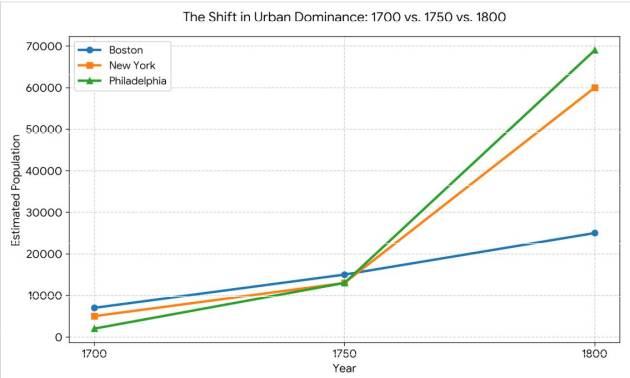
Summary of land development and capitalization models by region in the eighteenth century
1. Massachusetts Bay Trading company Model: Municipal Gatekeeping
The Puritan concept that land distribution must serve the spiritual and social cohesion of the collective community—rather than individual profit—lives on in the highly restrictive municipal governance of modern New England.
- Modern Reflection: Home Rule and Strict Zoning. In Massachusetts, real estate investment is notoriously difficult due to decentralized town-by-town zoning laws, historic preservation restrictions, and environmental bylaws (such as wetlands protection acts).
- The Strategy: Developers cannot simply buy a tract and build. They must navigate intense public town meetings, design review boards, and local conservation commissions. Because the barrier to entry is so high, the investment strategy here is “Value-Add” or opportunistic development via entitlement risk—investors make their money by successfully converting an old mill or unpermitted parcel through years of local political negotiation, creating high-value, supply-constrained assets.
2. The New York Model: Institutional Scale; Tenant-Landlord Friction
The legacy of the Dutch Patroon system and English manorial grants—which consolidated vast acreage into the hands of a tiny, elite class of river-front landlords—shaped New York into an economy dominated by massive, permanent landlords and a perpetual tenant class.
- Modern Reflection: Institutional “Prestige” Real Estate and Rent Regulation. New York real estate is defined by massive scale, high density, and a deep-seated legal friction between powerful landlords (like old-line real estate dynasties or institutional REITs) and organized tenant advocates.
- The Strategy: Real estate investment here requires massive capital entry. It favors Core and Core-Plus institutional investing (buying multi-family skyscrapers or commercial office towers). However, because the historical tension between tenant and landlord is so acute, investors must perfectly underwrite highly complex local regulatory frameworks, such as rent stabilization, eviction protections, and tenant opportunity to purchase acts.
3. The Pennsylvania Model: Master-Planned Communities and “Build-to-Rent”
William Penn’s brilliant marketing of standardized acreage packages, tied to urban bonus lots and sold through pre-organized network syndicates, was the direct precursor to the modern master-planned community (MPC) and commercial land syndication.
- Modern Reflection: Suburban Master-Planning and Parcel Subdivisions. Penn was essentially America’s first master developer, mapping out a central hub (Philadelphia) and selling structured regional blocks (like the Welsh Tract) to group consortia who would then handle local infrastructure.
- The Strategy: This model tracks directly with modern land banking and master-planned residential development. Large-scale investment funds purchase thousands of raw acres on the path of suburban growth, build out the primary infrastructure (roads, utilities, master association guidelines), and then sell individual parcels off to production homebuilders (or hold them for single-family rental/Build-to-Rent portfolios), exactly mirroring how Quaker trustees subdivided tracts for arriving families.
4. The South Carolina Model: Extreme Wealth Concentration and Hospitality/Luxury Plays
The early coastal lowcountry was defined by a small, aristocratic planter elite that accumulated massive fortunes by dominating premium geographic assets (riverfronts and shipping access), using a brutal labor model to fund an opulent, urban lifestyle in Charleston.
- Modern Reflection: High-End Luxury, Hospitality, and Coastal Aggregation. The modern real estate market in the lowcountry remains deeply stratified, focusing heavily on premium geographic scarcity—waterfront access, historical asset preservation, and exclusive private enclaves (like Kiawah or Hilton Head).
- The Strategy: Modern investment in this footprint leans heavily into luxury hospitality, boutique resort development, and high-net-worth residential vacation markets. Success relies on aggregating irreplaceable coastal or historic assets where demand is driven by global wealth insulation, rather than everyday local workforce housing metrics.
5. The Ohio Model: Commodity Real Estate and Data-Driven Logistics
The Land Ordinance of 1785, which imposed a rigid, mathematically precise grid across Ohio before anyone arrived, stripped land of its “mystique” and turned it into a standardized, highly liquid financial commodity.
- Modern Reflection: The Industrial/Logistics Boom and Commodity Housing. Because Ohio is built on a standardized geometric grid with flat, accessible geography and a highly decentralized network of medium-sized industrial cities (Columbus, Cleveland, Cincinnati, Dayton), it became the logistical backbone of the country.
- The Strategy: Real estate investment in the Midwest is highly secular, mathematical, and data-driven. Because there are fewer geographic barriers to entry (unlike coastal mountains or ocean fronts), land cannot easily be monopolized. Therefore, investors focus heavily on industrial real estate (distribution centers, data centers, and manufacturing plants) where value is determined by transportation efficiencies, proximity to interstate crossroads, and cost-per-square-foot yield, rather than scarcity.
Footnotes:
- The Massachusetts Bay Company Royal Charter (1629): Outlines the corporate joint-stock structure under which John Winthrop operated, and records the Cambridge Agreement (August 1629)
- Ipswich in the Massachusetts Bay Colony by Waters, Thomas Franklin, 1851-1919; Ipswich Historical Society; p68
Bibliography
- Town Records of Ipswich, Massachusetts (Vol. I & II): Transcribed and analyzed in Thomas Franklin Waters’ definitive history, Ipswich in the Massachusetts Bay Colony (Ipswich Historical Society). These files detail the “Rule of Proportion” guidelines used by the town’s lot-layers, original commonage rights, and early gentry grants awarded to John Winthrop Jr., Samuel Appleton, and Daniel Denison.
- Essex County Quarterly Court Records (1650–1692): Legal dockets detailing the systematic fining, corporate disenfranchisement, and physical punishments levied against religious dissidents, Baptists, and early local Quakers (such as Samuel Shattuck, Nicholas Phelps, and Robert Shatswell) within the Ipswich jurisdiction.
- The Salem Witchcraft Papers (SWP No. 072 – Elizabeth Howe): The official legal repository containing the original May 28, 1692, arrest warrant, the pre-trial examination recorded by the Reverend Samuel Parris, and the hostile neighborhood depositions submitted by the Perley and Cummings families of Ipswich against Elizabeth Howe.
- The Deposition Against Rachel Clinton: Preserved in historical analyses like John Putnam Demos’s Entertaining Satan: Witchcraft and the Culture of Early New England, which details the local economic, marital, and property disputes that culminated in the 1692 witchcraft charges against Ipswich resident Rachel Clinton.
- “The Letter of the Ten” (1692 Petition): The official written protest and petition for bail drafted collectively by the freezing prisoners held within the unheated walls of the Ipswich Gaol on Meetinghouse Green, submitted directly to the Governor and the General Court.
- Ipswich in the Massachusetts Bay Colony …Waters, T. Franklin. (190517). Ipswich, Mass.: The Ipswich historical society.
- The Massachusetts Bay Company Royal Charter (1629): Outlines the corporate joint-stock structure under which John Winthrop operated, and records the Cambridge Agreement (August 1629) which legally authorized the transfer of the company’s governance and charter directly to New England.
- During the Provincial Period. By Mrs. Nate M. Kellogg [A paper read before Molly Stark Chapter, Daughters of the American Revolution, February twenty-second, eighteen hundred and ninety-seven.]Published by the Press of The Nate Kellogg Company, Manchester, N.H., 1897.
- Jim Schneider, Holly Rubin (2012). The Ancestry of J.G. Williams & Ursula Miller. Lulu.com. pp. 171–172. ISBN 978-1300785774.
- The Whipping of the Quaker Women. Dover Public Library. Retrieved 22 November 2014.
 Historic Ipswich